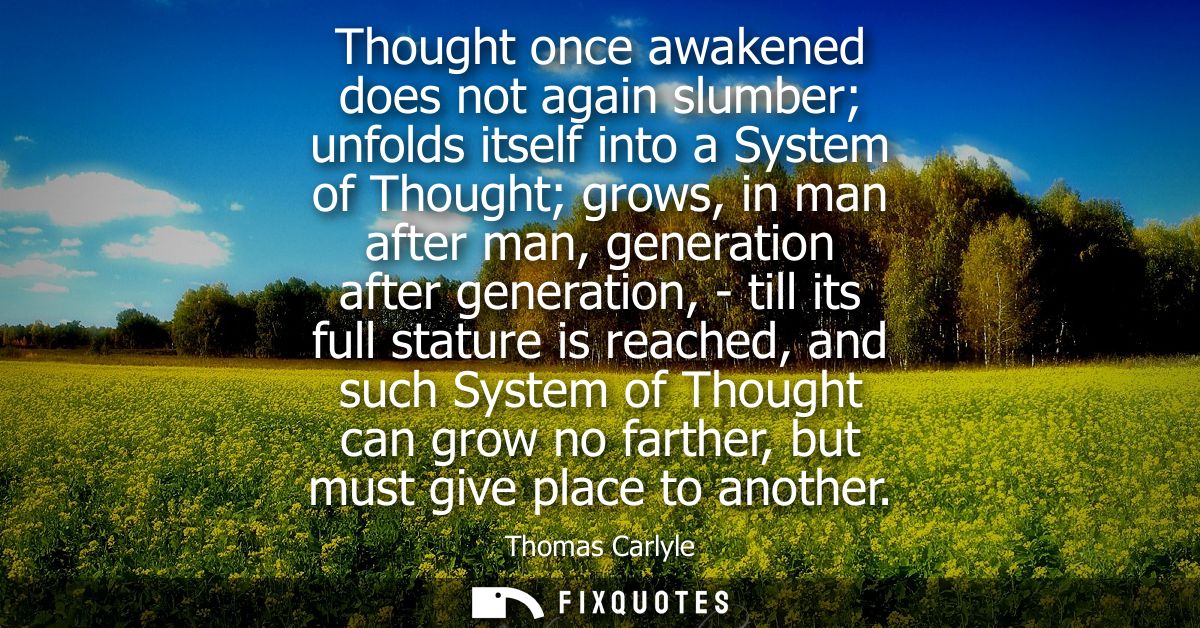
"Thought once awakened does not again slumber; unfolds itself into a System of Thought; grows, in man after man, generation after generation, - till its full stature is reached, and such System of Thought can grow no farther, but must give place to another"
About this Quote
The phrase "System of Thought" does heavy lifting. Carlyle isn’t talking about private reflection; he’s talking about the scaffolding that whole cultures climb: religions, political creeds, philosophical climates. The line "in man after man, generation after generation" turns individuals into relay runners, passing on an idea that outlives them. There's a faint menace here, too: systems don't merely enlighten; they discipline. Once a thought becomes a system, it can harden into orthodoxy, train institutions, and crowd out competing ways of seeing.
Then comes the twist that keeps it from being simple progress-talk: systems hit a ceiling. "Must give place to another" signals Carlyle's cyclical view of intellectual regimes - growth, dominance, exhaustion, replacement. Written in a 19th-century Britain rattled by industrialization, democratic agitation, and shaken faith, it reads like a diagnosis of modernity: our governing ideas don't fade gently; they get succeeded, often violently, when they can no longer make the world legible.
Quote Details
| Topic | Wisdom |
|---|---|
| Source | Help us find the source |
| Cite |
Citation Formats
APA Style (7th ed.)
Carlyle, Thomas. (2026, January 17). Thought once awakened does not again slumber; unfolds itself into a System of Thought; grows, in man after man, generation after generation, - till its full stature is reached, and such System of Thought can grow no farther, but must give place to another. FixQuotes. https://fixquotes.com/quotes/thought-once-awakened-does-not-again-slumber-34396/
Chicago Style
Carlyle, Thomas. "Thought once awakened does not again slumber; unfolds itself into a System of Thought; grows, in man after man, generation after generation, - till its full stature is reached, and such System of Thought can grow no farther, but must give place to another." FixQuotes. January 17, 2026. https://fixquotes.com/quotes/thought-once-awakened-does-not-again-slumber-34396/.
MLA Style (9th ed.)
"Thought once awakened does not again slumber; unfolds itself into a System of Thought; grows, in man after man, generation after generation, - till its full stature is reached, and such System of Thought can grow no farther, but must give place to another." FixQuotes, 17 Jan. 2026, https://fixquotes.com/quotes/thought-once-awakened-does-not-again-slumber-34396/. Accessed 25 Mar. 2026.