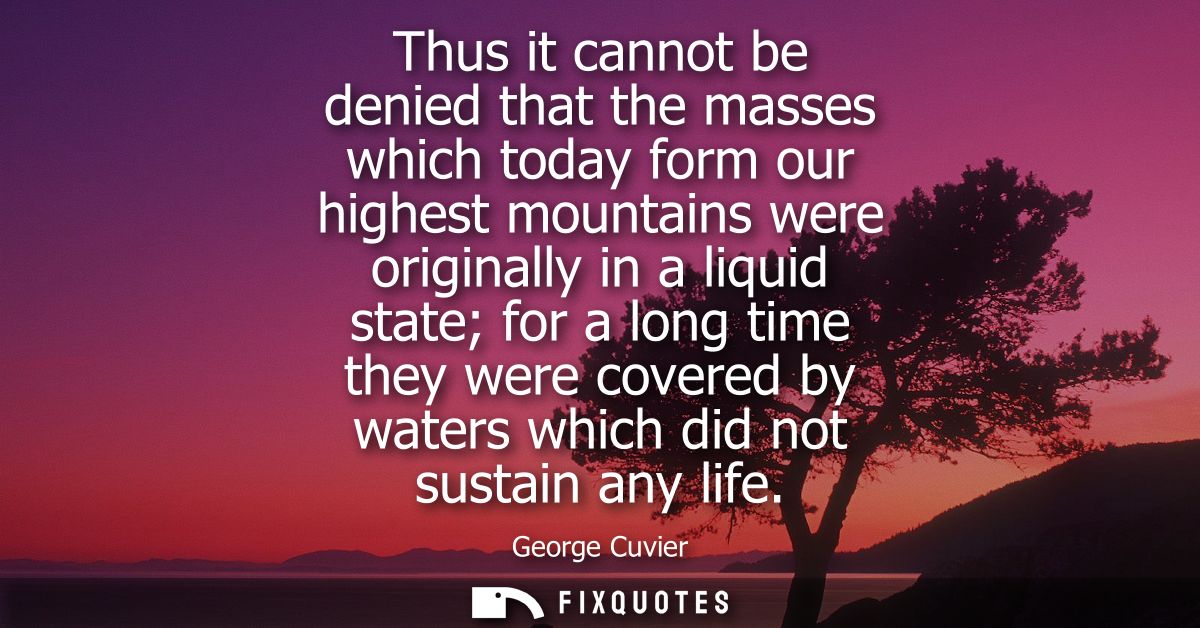
"Thus it cannot be denied that the masses which today form our highest mountains were originally in a liquid state; for a long time they were covered by waters which did not sustain any life"
About this Quote
The line also telegraphs Cuvier’s larger project: catastrophism. He built his scientific reputation on fossils and comparative anatomy, arguing that Earth’s past was punctuated by upheavals and extinctions. “Waters which did not sustain any life” reads like a fossil collector’s cold comfort: the planet is old enough to have had whole chapters where life either hadn’t arrived or had been wiped clean. Either way, the subtext is extinction as a normal condition, not an aberration.
It’s striking how he avoids drama while describing something dramatic. No flaming cataclysm, no sublime terror; just “for a long time.” That restraint is the persuasion. He’s offering a modern sensibility before modernity is ready for it: the idea that the world has a biography, that solid ground is an aftereffect, and that nature’s archive (rocks, strata, fossils) can overrule inherited stories. The quote works because it treats the unimaginable as matter-of-fact, turning awe into evidence.
Quote Details
| Topic | Mountain |
|---|---|
| Source | Help us find the source |
| Cite |
Citation Formats
APA Style (7th ed.)
Cuvier, George. (2026, January 14). Thus it cannot be denied that the masses which today form our highest mountains were originally in a liquid state; for a long time they were covered by waters which did not sustain any life. FixQuotes. https://fixquotes.com/quotes/thus-it-cannot-be-denied-that-the-masses-which-55166/
Chicago Style
Cuvier, George. "Thus it cannot be denied that the masses which today form our highest mountains were originally in a liquid state; for a long time they were covered by waters which did not sustain any life." FixQuotes. January 14, 2026. https://fixquotes.com/quotes/thus-it-cannot-be-denied-that-the-masses-which-55166/.
MLA Style (9th ed.)
"Thus it cannot be denied that the masses which today form our highest mountains were originally in a liquid state; for a long time they were covered by waters which did not sustain any life." FixQuotes, 14 Jan. 2026, https://fixquotes.com/quotes/thus-it-cannot-be-denied-that-the-masses-which-55166/. Accessed 12 Feb. 2026.