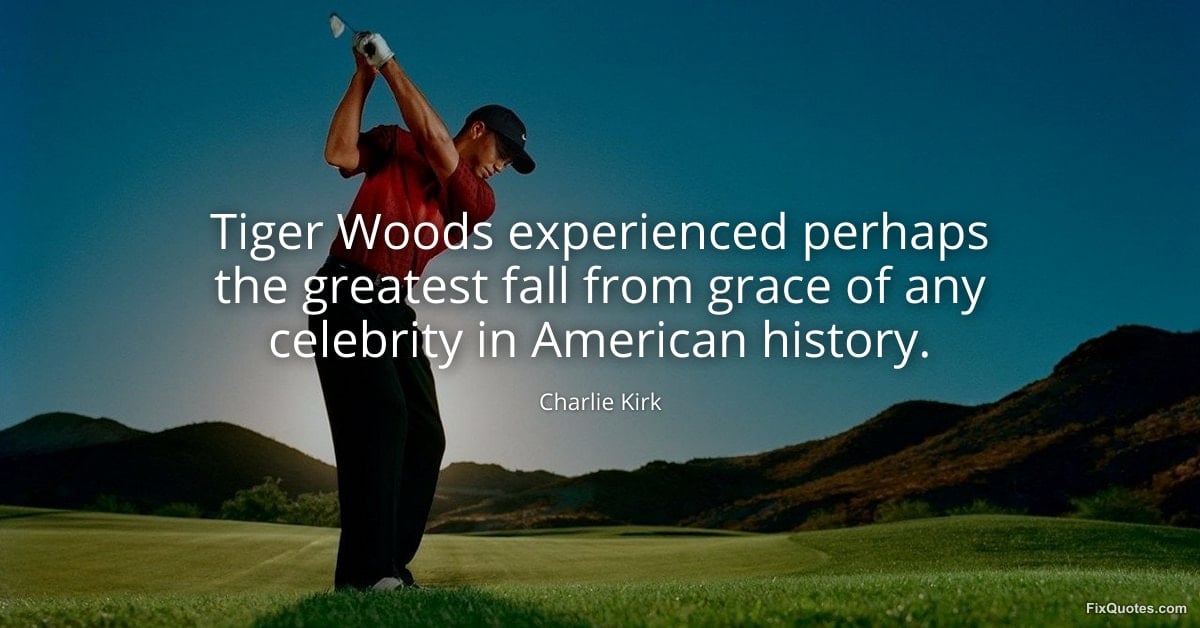
"Tiger Woods experienced perhaps the greatest fall from grace of any celebrity in American history"
About this Quote
Kirk’s line isn’t really about Tiger Woods; it’s about making “fall from grace” a weaponized category in America’s moral imagination. The phrasing (“perhaps the greatest,” “of any celebrity,” “in American history”) is deliberately maximalist, designed to flatten nuance into a single, shareable verdict. It turns a messy, tabloid-saturated scandal into a civic parable: talent and adoration, followed by exposure, punishment, and exile. In other words, the sentence is built to travel.
The subtext leans heavily on what Woods once symbolized. He wasn’t just a dominant athlete; he was marketed as controlled, aspirational, almost frictionless. Sponsors, media, and fans invested in a kind of polished invulnerability. When his private life imploded publicly, the rupture felt larger than the facts because the brand had been constructed as morally clean, not merely professionally elite. Calling it the “greatest” fall recycles that old bargain: we’ll crown you, but only if you perform wholesomeness too.
Kirk’s intent, as a political figure, is also to stage a values argument without arguing. By invoking Woods, he cues a familiar narrative about celebrity decadence, public accountability, and the cost of hypocrisy. It’s an efficient way to signal cultural conservatism: the spectacle becomes proof that fame corrodes character, and that America’s admiration is conditional. The irony is that Woods’ later redemption arc, and his continued popularity, complicates the absolutism; the quote works best if you ignore that Americans rarely stop loving a star, they just renegotiate the terms.
The subtext leans heavily on what Woods once symbolized. He wasn’t just a dominant athlete; he was marketed as controlled, aspirational, almost frictionless. Sponsors, media, and fans invested in a kind of polished invulnerability. When his private life imploded publicly, the rupture felt larger than the facts because the brand had been constructed as morally clean, not merely professionally elite. Calling it the “greatest” fall recycles that old bargain: we’ll crown you, but only if you perform wholesomeness too.
Kirk’s intent, as a political figure, is also to stage a values argument without arguing. By invoking Woods, he cues a familiar narrative about celebrity decadence, public accountability, and the cost of hypocrisy. It’s an efficient way to signal cultural conservatism: the spectacle becomes proof that fame corrodes character, and that America’s admiration is conditional. The irony is that Woods’ later redemption arc, and his continued popularity, complicates the absolutism; the quote works best if you ignore that Americans rarely stop loving a star, they just renegotiate the terms.
Quote Details
| Topic | Legacy & Remembrance |
|---|---|
| Source | Unverified source: Kirk: Tiger Woods Defines American Exceptionalism (Charlie Kirk, 2019)
Evidence: The quote appears verbatim in Charlie Kirk’s bylined Breitbart article dated April 17, 2019. In the article text, it is presented as Kirk’s own narration (not in a quoted block attributed to someone else). I did not find an earlier primary-source occurrence in the searches performed; many later q... Other candidates (1) Charlie Kirk (Charlie Kirk) compilation33.1% tics to censor silence and suppress the opposition by any means kirk was key to that he presented himself and his org... |
More Quotes by Charlie
Add to List