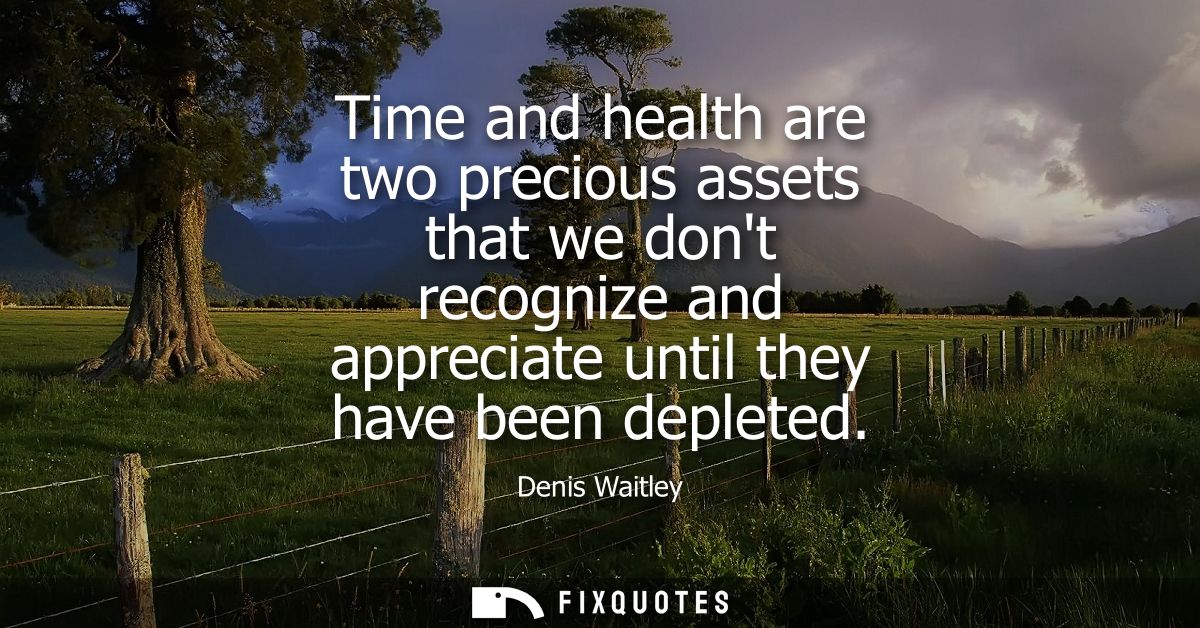
"Time and health are two precious assets that we don't recognize and appreciate until they have been depleted"
About this Quote
The specific intent is motivational, but not in the poster-on-a-wall way. It’s a preemptive eulogy for your future self: imagine the version of you who’s burned through free afternoons or taken a body for granted, then ask what you’d pay to get any of it back. That future regret is the lever. The line implies that appreciation isn’t a feeling; it’s a behavior you fail to practice until scarcity forces it.
The subtext is quietly American and late-20th-century self-help: agency is assumed, and crisis is treated as a teachable moment rather than a structural condition. “We” universalizes the mistake, making the warning feel less like blame and more like a common human glitch: abundance breeds amnesia. It also couples time and health to show how they conspire. Health is what makes time usable; time is what health tends to steal when it goes.
In context, Waitley’s career as a performance-and-success writer shows here: the sentence is designed to be memorable, repeatable, and slightly uncomfortable, the kind of pocket maxim that turns vague anxiety into a prompt for action today rather than nostalgia tomorrow.
Quote Details
| Topic | Time |
|---|---|
| Source | Help us find the source |
| Cite |
Citation Formats
APA Style (7th ed.)
Waitley, Denis. (2026, January 18). Time and health are two precious assets that we don't recognize and appreciate until they have been depleted. FixQuotes. https://fixquotes.com/quotes/time-and-health-are-two-precious-assets-that-we-6382/
Chicago Style
Waitley, Denis. "Time and health are two precious assets that we don't recognize and appreciate until they have been depleted." FixQuotes. January 18, 2026. https://fixquotes.com/quotes/time-and-health-are-two-precious-assets-that-we-6382/.
MLA Style (9th ed.)
"Time and health are two precious assets that we don't recognize and appreciate until they have been depleted." FixQuotes, 18 Jan. 2026, https://fixquotes.com/quotes/time-and-health-are-two-precious-assets-that-we-6382/. Accessed 31 Mar. 2026.