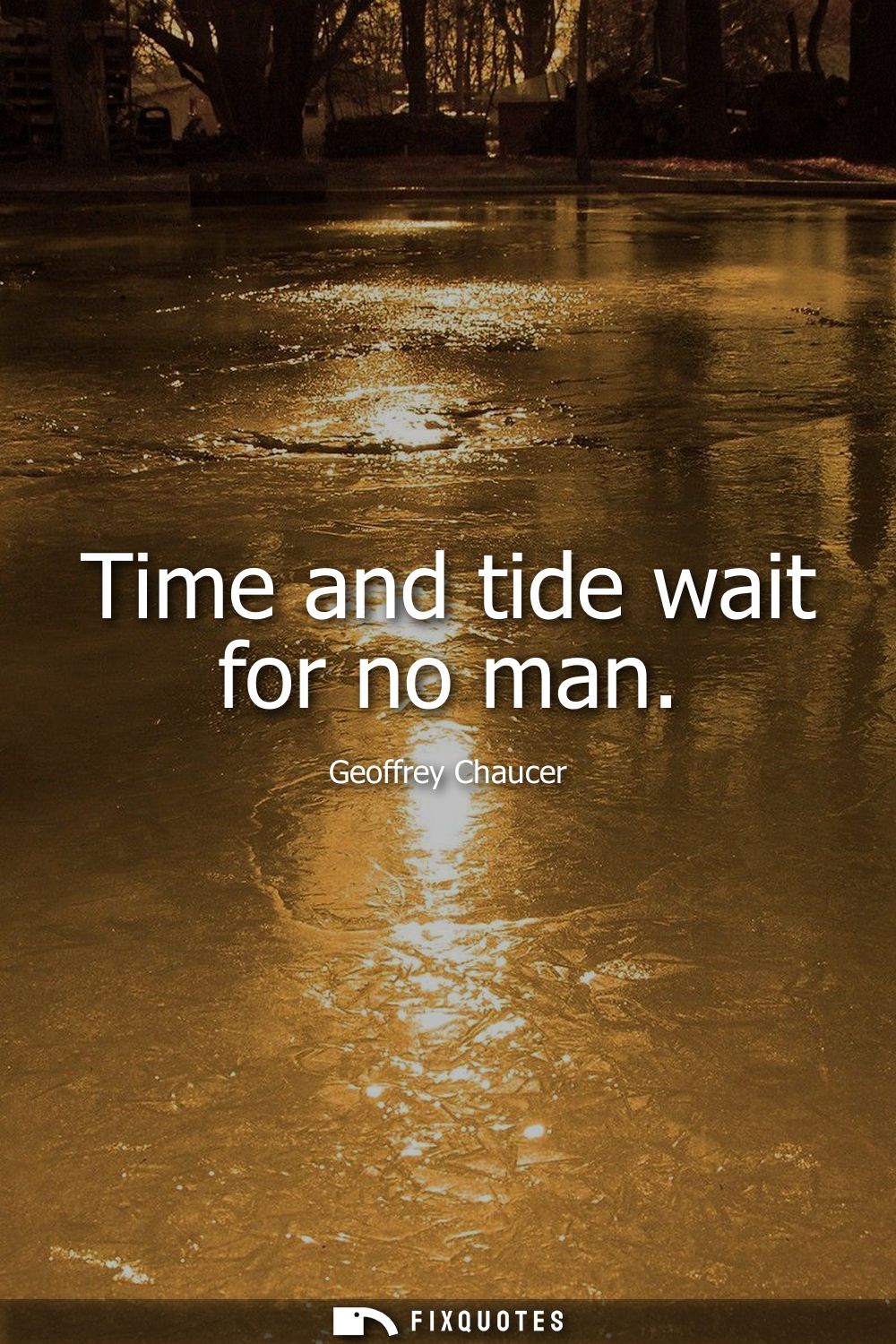
"Time and tide wait for no man"
About this Quote
Chaucer’s line lands with the bluntness of a town crier and the elegance of a proverb: the world keeps moving, and your status, virtue, or excuses don’t earn you a pause. Pairing “time” with “tide” is the trick. Time is abstract, slippery; tide is visible, physical, rhythmic. You can watch the water rise and realize, in your bones, that delay isn’t a moral failure so much as a misread of reality. Nature doesn’t negotiate.
The subtext is less motivational-poster than social critique. In Chaucer’s England, life was bracketed by forces that made “waiting” a fantasy: plague cycles, seasonal labor, war levies, hard travel, precarious medicine. The line folds that contingency into a compact warning. Don’t assume permanence; don’t assume tomorrow; don’t assume the world’s timetable aligns with your comfort. It’s also a quiet rebuke to medieval hierarchies. “No man” levels the field: kings and peasants share the same clock and the same coastline. Authority can command people; it can’t command the hour.
Its intent isn’t to romanticize urgency but to discipline it. Chaucer’s wider work is obsessed with human self-deception - the stories we tell to avoid choice, to postpone reckoning, to dress procrastination up as prudence. “Time and tide” punctures that. The phrase survives because it still names a modern anxiety: deadlines, aging, climate, market shifts - systems that roll forward indifferent to personal narrative. It’s not comforting. It’s clarifying.
The subtext is less motivational-poster than social critique. In Chaucer’s England, life was bracketed by forces that made “waiting” a fantasy: plague cycles, seasonal labor, war levies, hard travel, precarious medicine. The line folds that contingency into a compact warning. Don’t assume permanence; don’t assume tomorrow; don’t assume the world’s timetable aligns with your comfort. It’s also a quiet rebuke to medieval hierarchies. “No man” levels the field: kings and peasants share the same clock and the same coastline. Authority can command people; it can’t command the hour.
Its intent isn’t to romanticize urgency but to discipline it. Chaucer’s wider work is obsessed with human self-deception - the stories we tell to avoid choice, to postpone reckoning, to dress procrastination up as prudence. “Time and tide” punctures that. The phrase survives because it still names a modern anxiety: deadlines, aging, climate, market shifts - systems that roll forward indifferent to personal narrative. It’s not comforting. It’s clarifying.
Quote Details
| Topic | Time |
|---|---|
| Source | Help us find the source |
| Cite |
Citation Formats
APA Style (7th ed.)
Chaucer, Geoffrey. (2026, January 16). Time and tide wait for no man. FixQuotes. https://fixquotes.com/quotes/time-and-tide-wait-for-no-man-104799/
Chicago Style
Chaucer, Geoffrey. "Time and tide wait for no man." FixQuotes. January 16, 2026. https://fixquotes.com/quotes/time-and-tide-wait-for-no-man-104799/.
MLA Style (9th ed.)
"Time and tide wait for no man." FixQuotes, 16 Jan. 2026, https://fixquotes.com/quotes/time-and-tide-wait-for-no-man-104799/. Accessed 4 Mar. 2026.
More Quotes by Geoffrey
Add to List