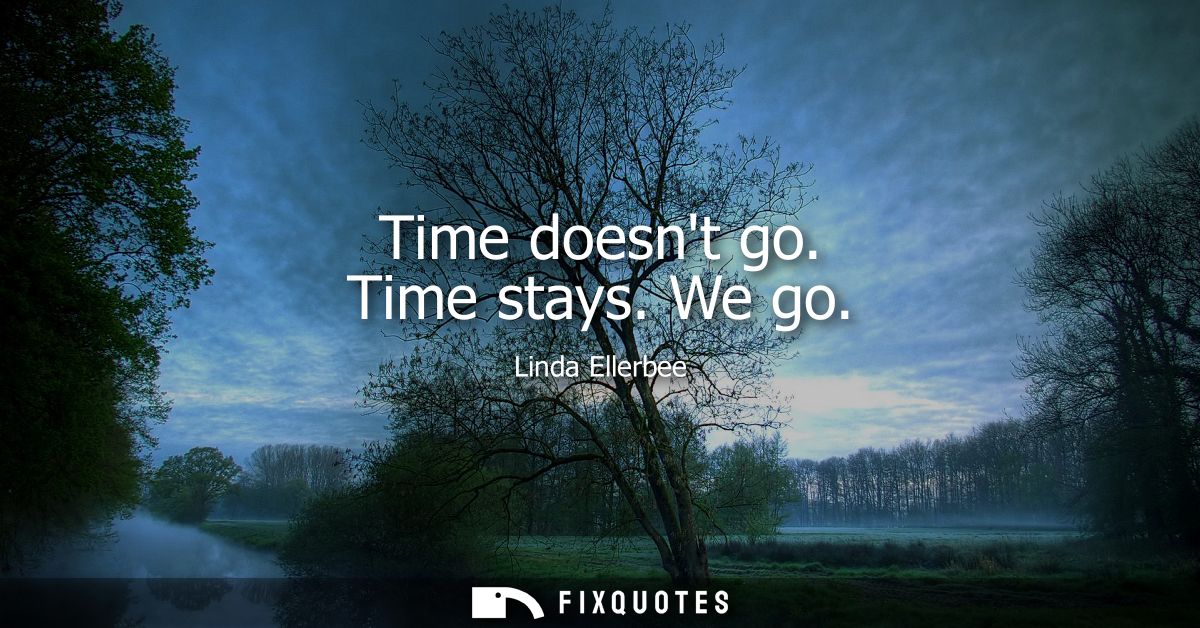
"Time doesn't go. Time stays. We go"
About this Quote
Ellerbee’s line lands like a cool corrective to the way we talk about time as if it were a runaway train. “Time doesn’t go” flips the cliché and makes the reader feel, briefly, that the world has stopped moving. Then the second sentence snaps the focus back onto the only thing that actually changes: us. It’s a journalist’s move, not a poet’s mist. In ten words, she strips away a comforting metaphor and replaces it with accountability.
The intent is to puncture nostalgia and the passive fatalism baked into phrases like “time flew” or “where did the years go?” Those are linguistic alibis. Ellerbee refuses them. Time “stays” because the calendar isn’t a predator; it’s a constant measure. What disappears is our access: our youth, our people, our versions of ourselves. “We go” is blunt, even a little unsentimental, which is exactly why it works. The subtext is mortality without melodrama.
As a longtime broadcast journalist, Ellerbee also understands the politics of attention. News culture treats time as the villain: deadlines, cycles, urgency, a perpetual now. Her phrasing pushes against that manufactured acceleration. Time isn’t speeding up; our lives are being spent, often by forces we didn’t choose. Read that way, the quote is less about clocks than about agency: if time isn’t the thing escaping, then the question becomes what we’re doing with the limited motion we have.
The intent is to puncture nostalgia and the passive fatalism baked into phrases like “time flew” or “where did the years go?” Those are linguistic alibis. Ellerbee refuses them. Time “stays” because the calendar isn’t a predator; it’s a constant measure. What disappears is our access: our youth, our people, our versions of ourselves. “We go” is blunt, even a little unsentimental, which is exactly why it works. The subtext is mortality without melodrama.
As a longtime broadcast journalist, Ellerbee also understands the politics of attention. News culture treats time as the villain: deadlines, cycles, urgency, a perpetual now. Her phrasing pushes against that manufactured acceleration. Time isn’t speeding up; our lives are being spent, often by forces we didn’t choose. Read that way, the quote is less about clocks than about agency: if time isn’t the thing escaping, then the question becomes what we’re doing with the limited motion we have.
Quote Details
| Topic | Time |
|---|---|
| Source | Help us find the source |
| Cite |
Citation Formats
APA Style (7th ed.)
Ellerbee, Linda. (2026, January 16). Time doesn't go. Time stays. We go. FixQuotes. https://fixquotes.com/quotes/time-doesnt-go-time-stays-we-go-93057/
Chicago Style
Ellerbee, Linda. "Time doesn't go. Time stays. We go." FixQuotes. January 16, 2026. https://fixquotes.com/quotes/time-doesnt-go-time-stays-we-go-93057/.
MLA Style (9th ed.)
"Time doesn't go. Time stays. We go." FixQuotes, 16 Jan. 2026, https://fixquotes.com/quotes/time-doesnt-go-time-stays-we-go-93057/. Accessed 27 Mar. 2026.
More Quotes by Linda
Add to List