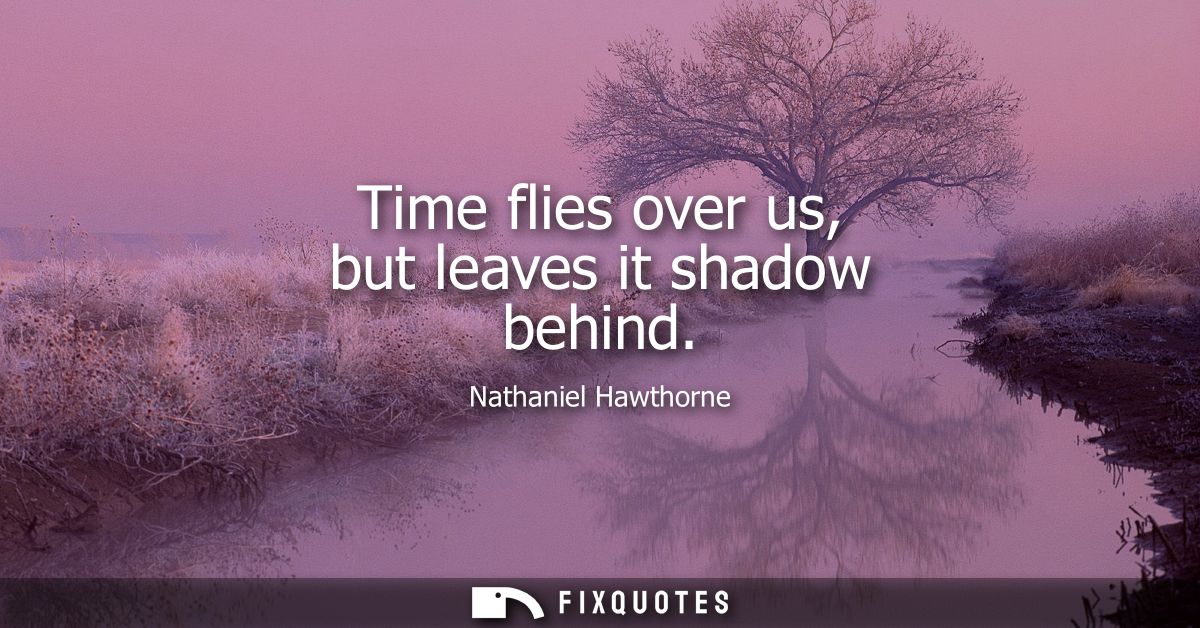
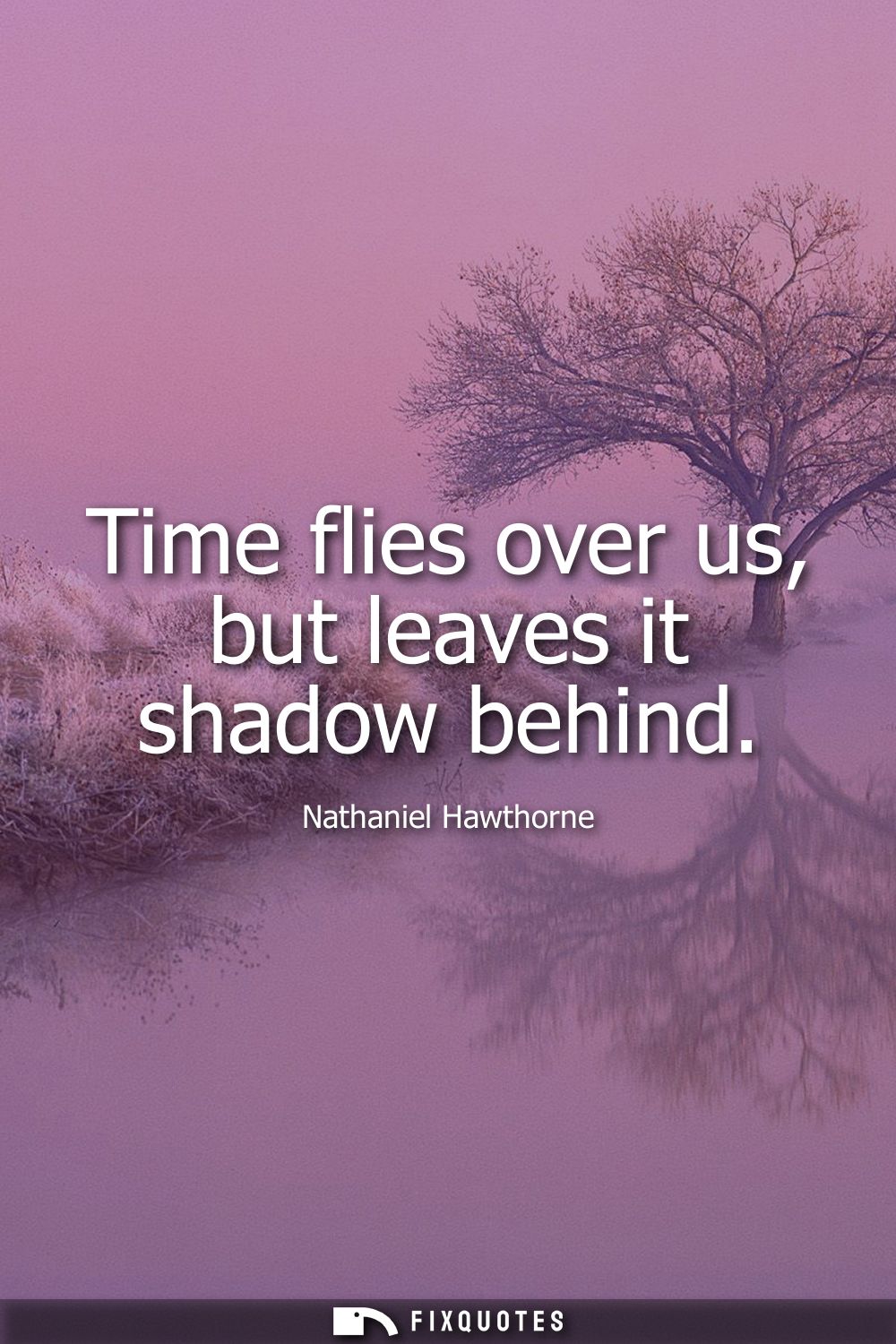
"Time flies over us, but leaves it shadow behind"
About this Quote
Time doesn’t just pass in Hawthorne’s world; it haunts. “Time flies over us” borrows the familiar comfort of speed and inevitability, then undercuts it with a gothic afterimage: “but leaves its shadow behind.” The line works because it refuses the modern fantasy that moving forward equals escaping. Time is not a clean river carrying you away from trouble; it’s a bird of prey that crosses overhead and, even as it disappears, darkens what’s beneath it.
Hawthorne, writing out of a Puritan-inherited moral atmosphere, is obsessed with the way the past stains the present. The “shadow” isn’t only memory in a sentimental sense; it’s consequence. It’s the residue of choices, secrets, inherited guilt, and social judgment that lingers after the moment that produced it is gone. That word also signals his recurring interest in doubleness: the public self in sunlight, the private self in shade. You can outlive an act, but you can’t outpace what it casts.
The phrasing is slyly physical. “Over us” places time above, sovereign and indifferent, while “behind” suggests that what time leaves is both trailing and inescapable, like a silhouette that follows you even when you refuse to turn around. Read in the mid-19th-century American context Hawthorne knew well, it also nods to a nation rushing toward progress while dragging older shadows: ancestral violence, rigid moral codes, and the stubborn persistence of shame. The line’s quiet menace is the point: speed doesn’t liberate; it merely rearranges what still darkens the room.
Hawthorne, writing out of a Puritan-inherited moral atmosphere, is obsessed with the way the past stains the present. The “shadow” isn’t only memory in a sentimental sense; it’s consequence. It’s the residue of choices, secrets, inherited guilt, and social judgment that lingers after the moment that produced it is gone. That word also signals his recurring interest in doubleness: the public self in sunlight, the private self in shade. You can outlive an act, but you can’t outpace what it casts.
The phrasing is slyly physical. “Over us” places time above, sovereign and indifferent, while “behind” suggests that what time leaves is both trailing and inescapable, like a silhouette that follows you even when you refuse to turn around. Read in the mid-19th-century American context Hawthorne knew well, it also nods to a nation rushing toward progress while dragging older shadows: ancestral violence, rigid moral codes, and the stubborn persistence of shame. The line’s quiet menace is the point: speed doesn’t liberate; it merely rearranges what still darkens the room.
Quote Details
| Topic | Time |
|---|---|
| Source | Help us find the source |
| Cite |
Citation Formats
APA Style (7th ed.)
Hawthorne, Nathaniel. (2026, January 16). Time flies over us, but leaves it shadow behind. FixQuotes. https://fixquotes.com/quotes/time-flies-over-us-but-leaves-it-shadow-behind-83174/
Chicago Style
Hawthorne, Nathaniel. "Time flies over us, but leaves it shadow behind." FixQuotes. January 16, 2026. https://fixquotes.com/quotes/time-flies-over-us-but-leaves-it-shadow-behind-83174/.
MLA Style (9th ed.)
"Time flies over us, but leaves it shadow behind." FixQuotes, 16 Jan. 2026, https://fixquotes.com/quotes/time-flies-over-us-but-leaves-it-shadow-behind-83174/. Accessed 12 Feb. 2026.
More Quotes by Nathaniel
Add to List