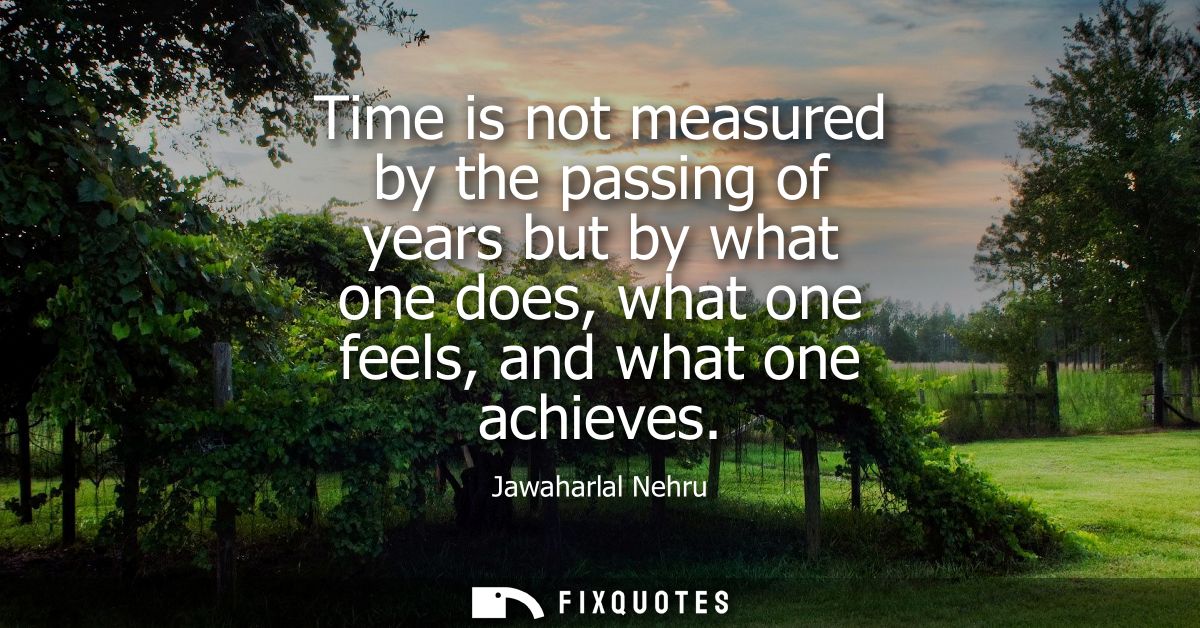
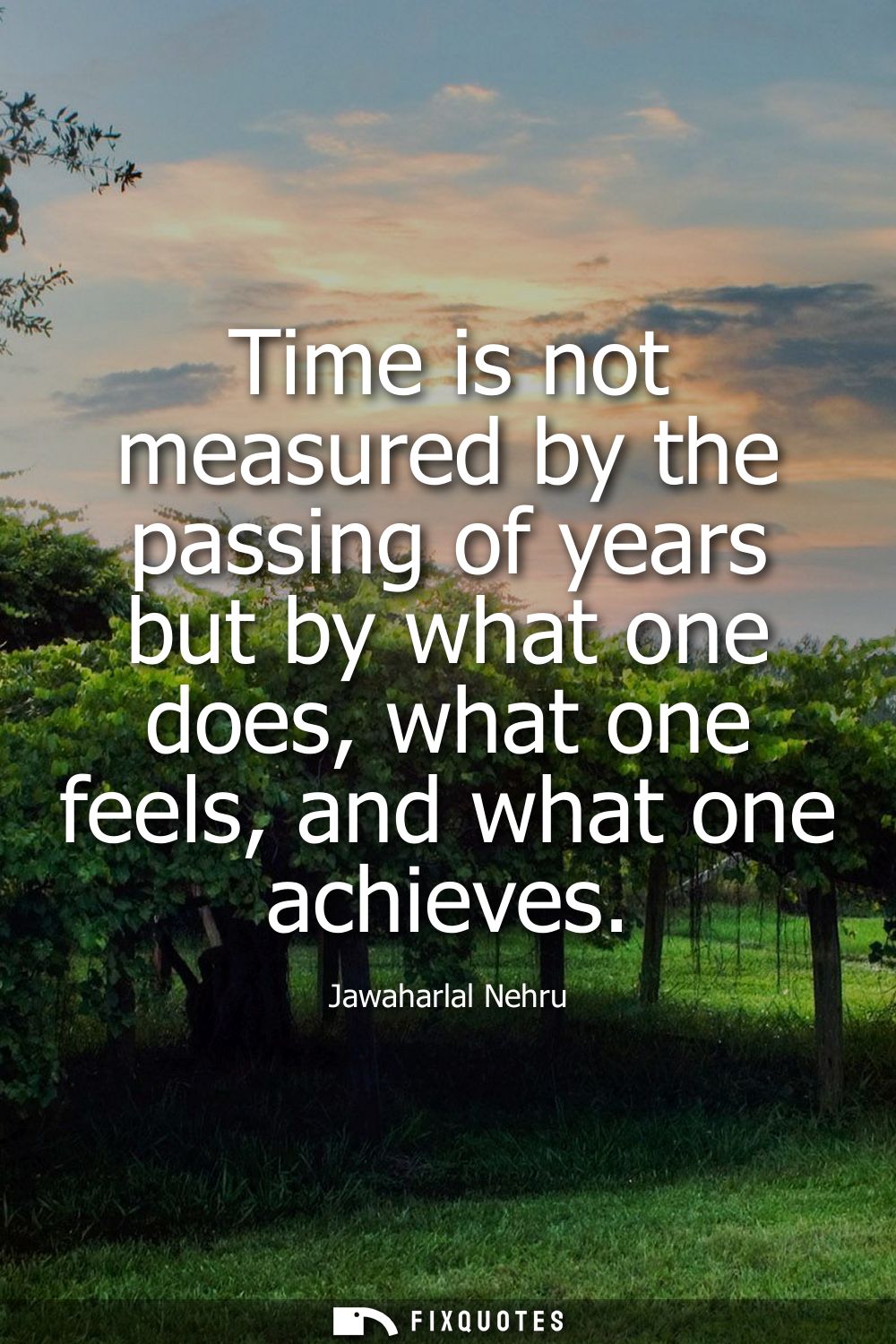
"Time is not measured by the passing of years but by what one does, what one feels, and what one achieves"
About this Quote
The phrasing does three kinds of work. "What one does" asserts political responsibility: action matters more than longevity. "What one feels" is the surprising hinge, smuggling in an argument that inner life is not a bourgeois luxury but part of citizenship. In the context of Partition's trauma and nation-building's demand for hard decisions, feeling is not sentimentality; it's a claim about empathy as a civic resource, a check on technocratic coldness. Then "what one achieves" restores the leader's obsession with outcomes, but places achievement after action and feeling, implying that results without purpose or humanity are hollow.
Subtext: this is also self-justification. Nehru, educated in the West yet committed to forging a modern Indian state, frames progress as lived intensity and collective accomplishment rather than as mere survival. It's a rebuke to passive endurance and a warning to posterity: don't mistake the length of a regime for the value of a life, or the age of a nation for the depth of its freedom.
Quote Details
| Topic | Time |
|---|---|
| Source | Help us find the source |
| Cite |
Citation Formats
APA Style (7th ed.)
Nehru, Jawaharlal. (2026, January 17). Time is not measured by the passing of years but by what one does, what one feels, and what one achieves. FixQuotes. https://fixquotes.com/quotes/time-is-not-measured-by-the-passing-of-years-but-33270/
Chicago Style
Nehru, Jawaharlal. "Time is not measured by the passing of years but by what one does, what one feels, and what one achieves." FixQuotes. January 17, 2026. https://fixquotes.com/quotes/time-is-not-measured-by-the-passing-of-years-but-33270/.
MLA Style (9th ed.)
"Time is not measured by the passing of years but by what one does, what one feels, and what one achieves." FixQuotes, 17 Jan. 2026, https://fixquotes.com/quotes/time-is-not-measured-by-the-passing-of-years-but-33270/. Accessed 14 Mar. 2026.