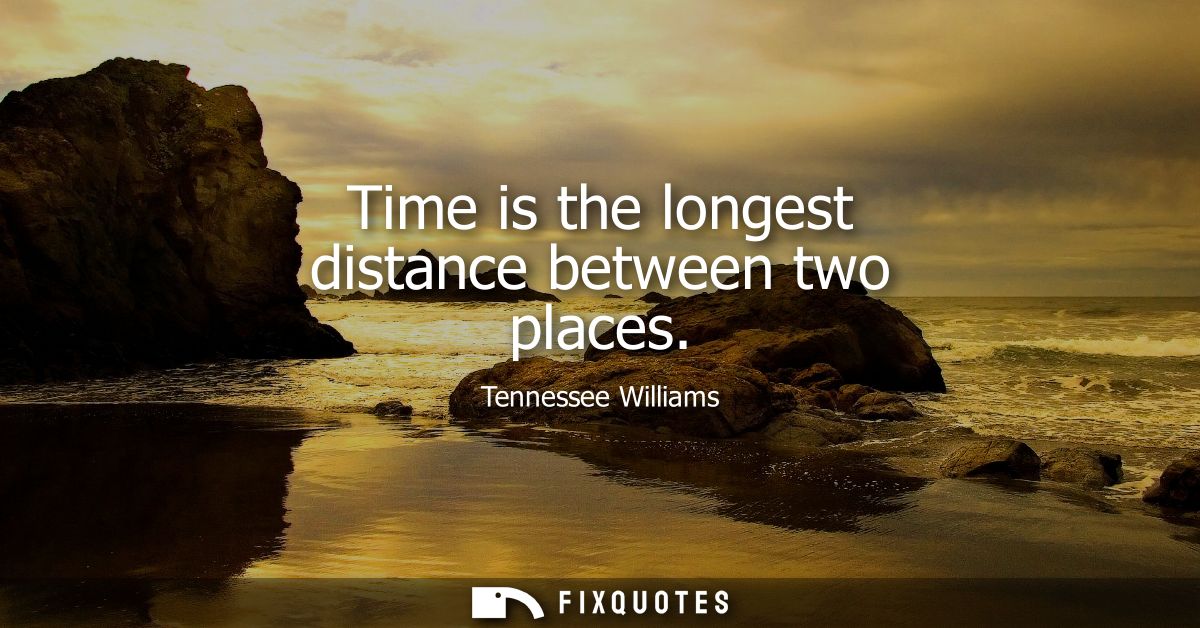
"Time is the longest distance between two places"
About this Quote
Time isn’t a clock in Tennessee Williams; it’s a hallway you’re forced to walk barefoot. “Time is the longest distance between two places” turns a neutral measurement into something bodily and cruel, the way his characters experience life: not as progress, but as separation. The line has the compressed fatalism of his drama, where the real antagonist is often what can’t be reversed - youth spent, desire missed, a kinder version of the self now unreachable.
The “two places” aren’t just literal locations. They’re emotional coordinates: before and after a betrayal, the room where you felt wanted versus the room where you’re merely tolerated. Williams was obsessed with the difference between where people are and where they insist they still live - in memory, in fantasy, in an old romance preserved like a pressed flower. Time becomes the distance because it stretches that gap until it feels geographic. You can’t simply decide to return; you’d need to cross years, not miles.
Context matters: Williams wrote in a postwar America selling reinvention, while his plays keep exposing how reinvention is often denial with better lighting. His South is haunted, not quaint; his glamour is frayed at the edges. The sentence works because it’s deceptively simple, almost proverb-like, but it lands as a threat. Distance implies travel, and travel implies choice. Williams quietly removes that comfort: time moves, you don’t. The tragedy isn’t that people change. It’s that they don’t get to change back.
The “two places” aren’t just literal locations. They’re emotional coordinates: before and after a betrayal, the room where you felt wanted versus the room where you’re merely tolerated. Williams was obsessed with the difference between where people are and where they insist they still live - in memory, in fantasy, in an old romance preserved like a pressed flower. Time becomes the distance because it stretches that gap until it feels geographic. You can’t simply decide to return; you’d need to cross years, not miles.
Context matters: Williams wrote in a postwar America selling reinvention, while his plays keep exposing how reinvention is often denial with better lighting. His South is haunted, not quaint; his glamour is frayed at the edges. The sentence works because it’s deceptively simple, almost proverb-like, but it lands as a threat. Distance implies travel, and travel implies choice. Williams quietly removes that comfort: time moves, you don’t. The tragedy isn’t that people change. It’s that they don’t get to change back.
Quote Details
| Topic | Time |
|---|---|
| Source | The Glass Menagerie (play), Tennessee Williams, 1944 — opening stage direction/first line in published editions. |
| Cite |
Citation Formats
APA Style (7th ed.)
Williams, Tennessee. (2026, January 17). Time is the longest distance between two places. FixQuotes. https://fixquotes.com/quotes/time-is-the-longest-distance-between-two-places-36782/
Chicago Style
Williams, Tennessee. "Time is the longest distance between two places." FixQuotes. January 17, 2026. https://fixquotes.com/quotes/time-is-the-longest-distance-between-two-places-36782/.
MLA Style (9th ed.)
"Time is the longest distance between two places." FixQuotes, 17 Jan. 2026, https://fixquotes.com/quotes/time-is-the-longest-distance-between-two-places-36782/. Accessed 12 Feb. 2026.
More Quotes by Tennessee
Add to List