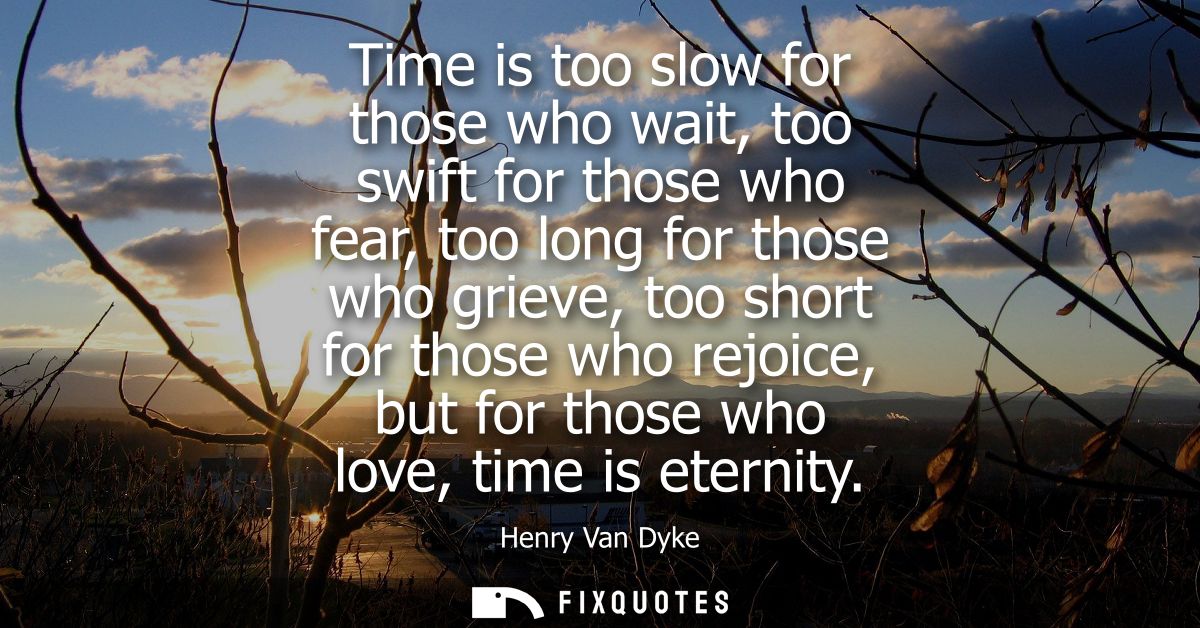
"Time is too slow for those who wait, too swift for those who fear, too long for those who grieve, too short for those who rejoice, but for those who love, time is eternity"
About this Quote
The structure matters. The repeated “too” works like a metronome that keeps changing speeds, and the parallel phrasing gives the line a sermon’s cadence without requiring doctrine. Then he flips the pattern: “but for those who love,” a pivot that refuses the earlier trap of “too much/too little.” Love doesn’t just distort time; it rewrites the measurement system. “Time is eternity” is deliberately paradoxical, a romantic coup that collapses the clock into something spacious, almost sacramental.
Context sharpens the intent. Van Dyke, a poet and Presbyterian minister writing at the turn of the 20th century, belonged to a culture that prized moral uplift and spiritual reassurance in public language. This reads like a consoling epigram meant for inscription - the kind of line that can sit at weddings and funerals alike - because it offers a way out of time’s cruelty: not by denying pain, but by proposing an emotional stance (love) that makes transience feel survivable, even meaningful.
Quote Details
| Topic | Love |
|---|---|
| Source | Verified source: The Oxford Dictionary of Quotations (Elizabeth M. Knowles, 1999)ISBN: 9780198601739 · ID: o6rFno1ffQoC
Evidence: ... Time is Too slow for those who wait , Too swift for those who fear , Too long for those who grieve , Too short for those who rejoice ; But for those who love , Time is eternity . ' Time is too slow for those who wait ' ( 1905 ) , read ... Other candidates (1) Music and Other Poems (Henry Van Dyke, 1904)50.0% Time is Too Slow for those who Wait, Too Swift for those who Fear, Too Long for those who Grieve, Too Short for those... |
| Cite |
Citation Formats
APA Style (7th ed.)
Dyke, Henry Van. (2026, March 13). Time is too slow for those who wait, too swift for those who fear, too long for those who grieve, too short for those who rejoice, but for those who love, time is eternity. FixQuotes. https://fixquotes.com/quotes/time-is-too-slow-for-those-who-wait-too-swift-for-134303/
Chicago Style
Dyke, Henry Van. "Time is too slow for those who wait, too swift for those who fear, too long for those who grieve, too short for those who rejoice, but for those who love, time is eternity." FixQuotes. March 13, 2026. https://fixquotes.com/quotes/time-is-too-slow-for-those-who-wait-too-swift-for-134303/.
MLA Style (9th ed.)
"Time is too slow for those who wait, too swift for those who fear, too long for those who grieve, too short for those who rejoice, but for those who love, time is eternity." FixQuotes, 13 Mar. 2026, https://fixquotes.com/quotes/time-is-too-slow-for-those-who-wait-too-swift-for-134303/. Accessed 30 Mar. 2026.