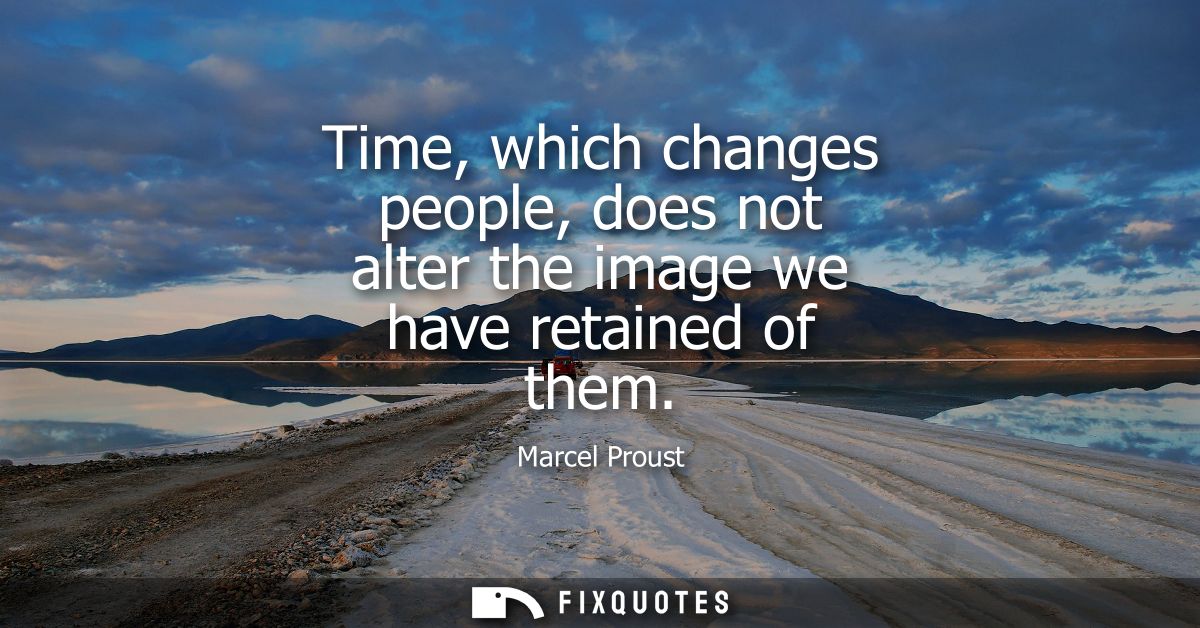
"Time, which changes people, does not alter the image we have retained of them"
About this Quote
Proust’s line lands like a quiet indictment of memory’s vanity: we pride ourselves on knowing people, then keep loving (or resenting) the version we first framed. Time, he concedes, is ruthless with bodies, opinions, even character. But it’s oddly gentle with our inner portraits, which harden into icons. The sting is that the permanence isn’t a tribute to the other person; it’s evidence of how self-centered remembrance can be.
The syntax does the work. “Time” is the grand, impersonal force, credited with the power to “change people.” Then Proust flips the expectation: the one thing time can’t touch is not the soul or essence, but our “retained” image. Retained implies custody, a grip. Memory isn’t a passive archive; it’s an act of keeping, a refusal to update. That refusal can look like loyalty, but it often functions as control: if the person changes beyond our picture of them, we experience it as betrayal.
In Proust’s world (and in the social theater of late 19th-century France), people are performed and perceived through salons, gossip, and desire; identity is less a stable truth than a set of impressions that circulate. The quote exposes how those impressions outlive their source. It also anticipates a modern problem: we relate to curated snapshots, old messages, “how they were” in our head. The past doesn’t simply persist; we keep it because it keeps us coherent. The image is a mirror we mistake for a window.
The syntax does the work. “Time” is the grand, impersonal force, credited with the power to “change people.” Then Proust flips the expectation: the one thing time can’t touch is not the soul or essence, but our “retained” image. Retained implies custody, a grip. Memory isn’t a passive archive; it’s an act of keeping, a refusal to update. That refusal can look like loyalty, but it often functions as control: if the person changes beyond our picture of them, we experience it as betrayal.
In Proust’s world (and in the social theater of late 19th-century France), people are performed and perceived through salons, gossip, and desire; identity is less a stable truth than a set of impressions that circulate. The quote exposes how those impressions outlive their source. It also anticipates a modern problem: we relate to curated snapshots, old messages, “how they were” in our head. The past doesn’t simply persist; we keep it because it keeps us coherent. The image is a mirror we mistake for a window.
Quote Details
| Topic | Nostalgia |
|---|
More Quotes by Marcel
Add to List