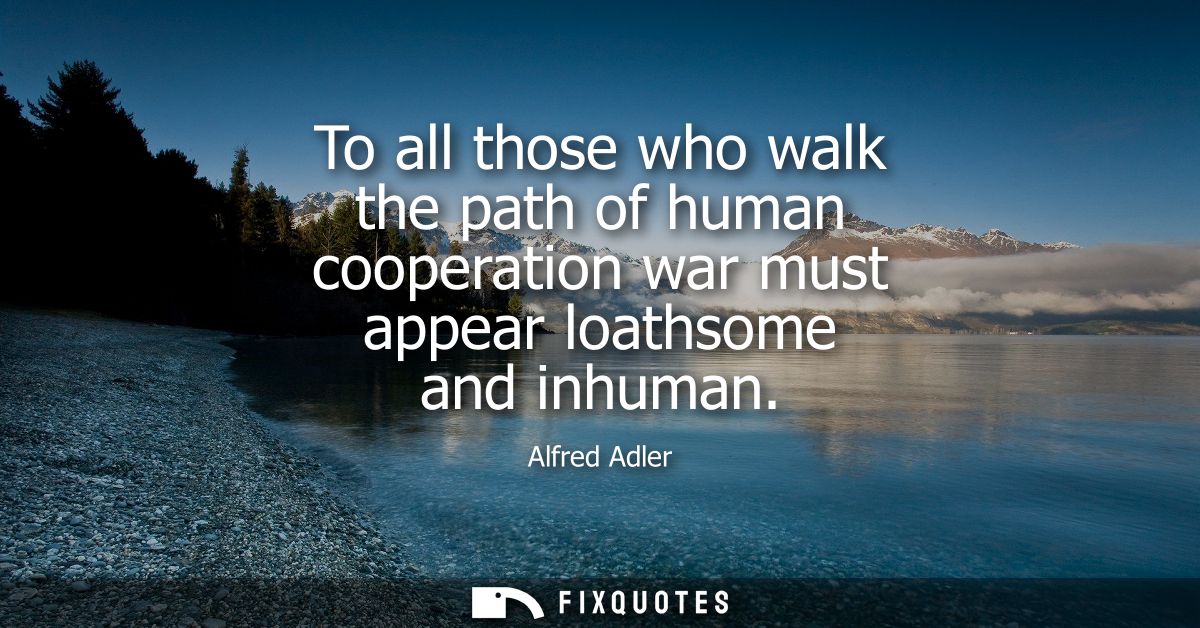
"To all those who walk the path of human cooperation, war must appear loathsome and inhuman"
About this Quote
The intent is corrective, almost diagnostic. Adler isn’t pleading for peace out of sentiment; he’s policing the boundary of the human. Cooperation is treated as the baseline condition of mental health and mature character; war is cast as an antisocial pathology, a collective acting-out of inferiority, fear, and compensatory aggression. The subtext is a challenge to the standard alibi that war is noble, necessary, or civilizationally productive. If you buy that romance, Adler implies, you’ve already stepped off the cooperative path.
Context matters: Adler wrote in the long shadow of World War I and the escalating nationalism that would culminate in World War II. As a Viennese Jewish psychologist watching mass politics weaponize belonging, he saw how easily "us" can be manufactured by inventing a threatening "them". The sentence works because it flips the moral spotlight: the problem isn’t a lack of patriotism, it’s a lack of psychological adulthood.
Quote Details
| Topic | Peace |
|---|---|
| Source | Help us find the source |
| Cite |
Citation Formats
APA Style (7th ed.)
Adler, Alfred. (2026, February 20). To all those who walk the path of human cooperation, war must appear loathsome and inhuman. FixQuotes. https://fixquotes.com/quotes/to-all-those-who-walk-the-path-of-human-17242/
Chicago Style
Adler, Alfred. "To all those who walk the path of human cooperation, war must appear loathsome and inhuman." FixQuotes. February 20, 2026. https://fixquotes.com/quotes/to-all-those-who-walk-the-path-of-human-17242/.
MLA Style (9th ed.)
"To all those who walk the path of human cooperation, war must appear loathsome and inhuman." FixQuotes, 20 Feb. 2026, https://fixquotes.com/quotes/to-all-those-who-walk-the-path-of-human-17242/. Accessed 23 Mar. 2026.