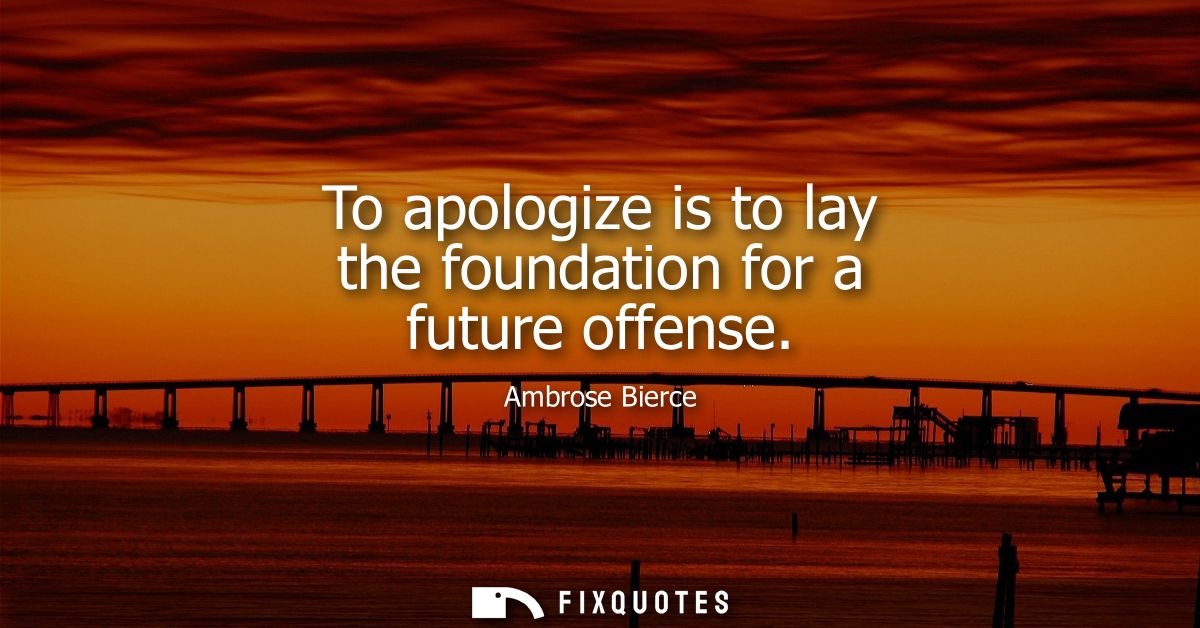
"To apologize is to lay the foundation for a future offense"
About this Quote
Bierce treats the apology not as moral hygiene but as a kind of down payment on your next bad act. The line lands because it reverses the pious script: where most Victorian etiquette framed apologizing as character repair, Bierce frames it as strategy. You don’t apologize because you’ve changed; you apologize because you’ve managed the fallout. The “foundation” metaphor is the knife twist. Foundations aren’t spontaneous bursts of remorse; they’re deliberate, engineered structures built to support what comes after. In Bierce’s cynical architecture, contrition is load-bearing.
The specific intent is to expose how social rituals can become tools for repeat offenders. An apology can reset the public ledger, soften outrage, and restore access to the same people and institutions you just harmed. That’s not merely hypocrisy; it’s a feedback loop. If “sorry” reliably reopens doors, it quietly subsidizes future misconduct. Bierce is also mocking the audience’s complicity: we prefer the theater of repentance to the inconvenience of consequences, so we reward the performance and call it closure.
Context matters. Bierce, a journalist with a satirist’s appetite for human vanity, wrote in an America polishing its respectability while booming with political graft, corporate power, and genteel doublespeak. In that world, the apology is a social lubricant: it keeps reputations intact and conflict containable. The subtext is bluntly modern: an apology is often less a moral turning point than a PR instrument, and when we treat it as redemption, we make recidivism easier.
The specific intent is to expose how social rituals can become tools for repeat offenders. An apology can reset the public ledger, soften outrage, and restore access to the same people and institutions you just harmed. That’s not merely hypocrisy; it’s a feedback loop. If “sorry” reliably reopens doors, it quietly subsidizes future misconduct. Bierce is also mocking the audience’s complicity: we prefer the theater of repentance to the inconvenience of consequences, so we reward the performance and call it closure.
Context matters. Bierce, a journalist with a satirist’s appetite for human vanity, wrote in an America polishing its respectability while booming with political graft, corporate power, and genteel doublespeak. In that world, the apology is a social lubricant: it keeps reputations intact and conflict containable. The subtext is bluntly modern: an apology is often less a moral turning point than a PR instrument, and when we treat it as redemption, we make recidivism easier.
Quote Details
| Topic | Sarcastic |
|---|---|
| Source | Help us find the source |
| Cite |
Citation Formats
APA Style (7th ed.)
Bierce, Ambrose. (2026, January 14). To apologize is to lay the foundation for a future offense. FixQuotes. https://fixquotes.com/quotes/to-apologize-is-to-lay-the-foundation-for-a-3727/
Chicago Style
Bierce, Ambrose. "To apologize is to lay the foundation for a future offense." FixQuotes. January 14, 2026. https://fixquotes.com/quotes/to-apologize-is-to-lay-the-foundation-for-a-3727/.
MLA Style (9th ed.)
"To apologize is to lay the foundation for a future offense." FixQuotes, 14 Jan. 2026, https://fixquotes.com/quotes/to-apologize-is-to-lay-the-foundation-for-a-3727/. Accessed 12 Feb. 2026.
More Quotes by Ambrose
Add to List