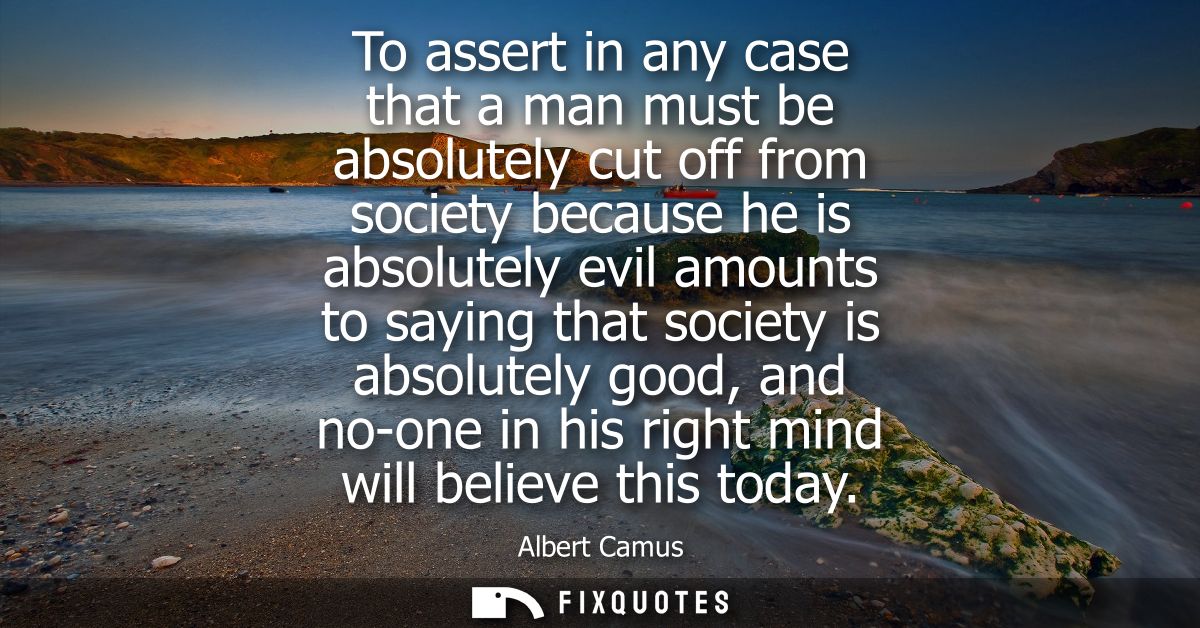
"To assert in any case that a man must be absolutely cut off from society because he is absolutely evil amounts to saying that society is absolutely good, and no-one in his right mind will believe this today"
About this Quote
The subtext is political as much as ethical. Writing in the shadow of fascism, Stalinism, war, and the bureaucratic efficiency of state killing, Camus is wary of any system that speaks in absolutes because absolutes authorize anything. Once a society crowns itself the embodiment of Good, it can banish, cage, or execute with a clear conscience - and history shows how quickly that conscience becomes a machine.
Rhetorically, the sentence weaponizes “amounts to saying”: it’s not a debate invitation, it’s a conversion of premises into consequences. He also leans on a sly modern realism in “today,” as if the 20th century has already supplied enough evidence that collective innocence is a childish story. The intent is to force moral self-implication: justice, if it’s to be human, has to admit contamination, ambiguity, and the uncomfortable fact that society’s hands are never clean when it decides who gets cast out.
Quote Details
| Topic | Ethics & Morality |
|---|---|
| Source | Help us find the source |
| Cite |
Citation Formats
APA Style (7th ed.)
Camus, Albert. (2026, January 15). To assert in any case that a man must be absolutely cut off from society because he is absolutely evil amounts to saying that society is absolutely good, and no-one in his right mind will believe this today. FixQuotes. https://fixquotes.com/quotes/to-assert-in-any-case-that-a-man-must-be-22906/
Chicago Style
Camus, Albert. "To assert in any case that a man must be absolutely cut off from society because he is absolutely evil amounts to saying that society is absolutely good, and no-one in his right mind will believe this today." FixQuotes. January 15, 2026. https://fixquotes.com/quotes/to-assert-in-any-case-that-a-man-must-be-22906/.
MLA Style (9th ed.)
"To assert in any case that a man must be absolutely cut off from society because he is absolutely evil amounts to saying that society is absolutely good, and no-one in his right mind will believe this today." FixQuotes, 15 Jan. 2026, https://fixquotes.com/quotes/to-assert-in-any-case-that-a-man-must-be-22906/. Accessed 12 Feb. 2026.