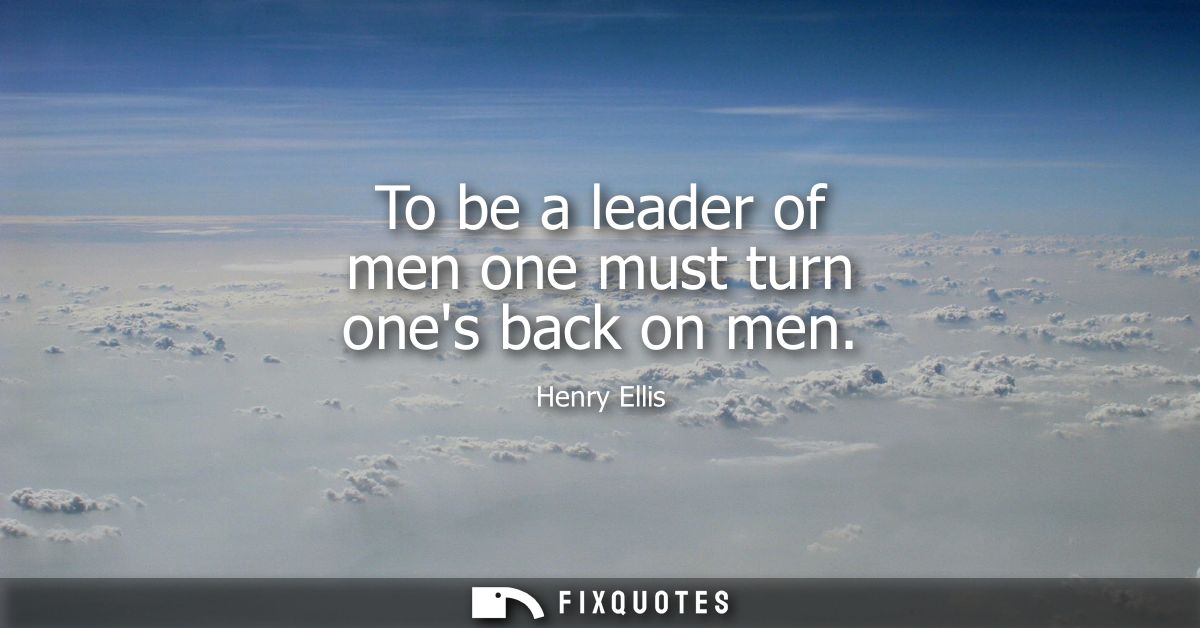
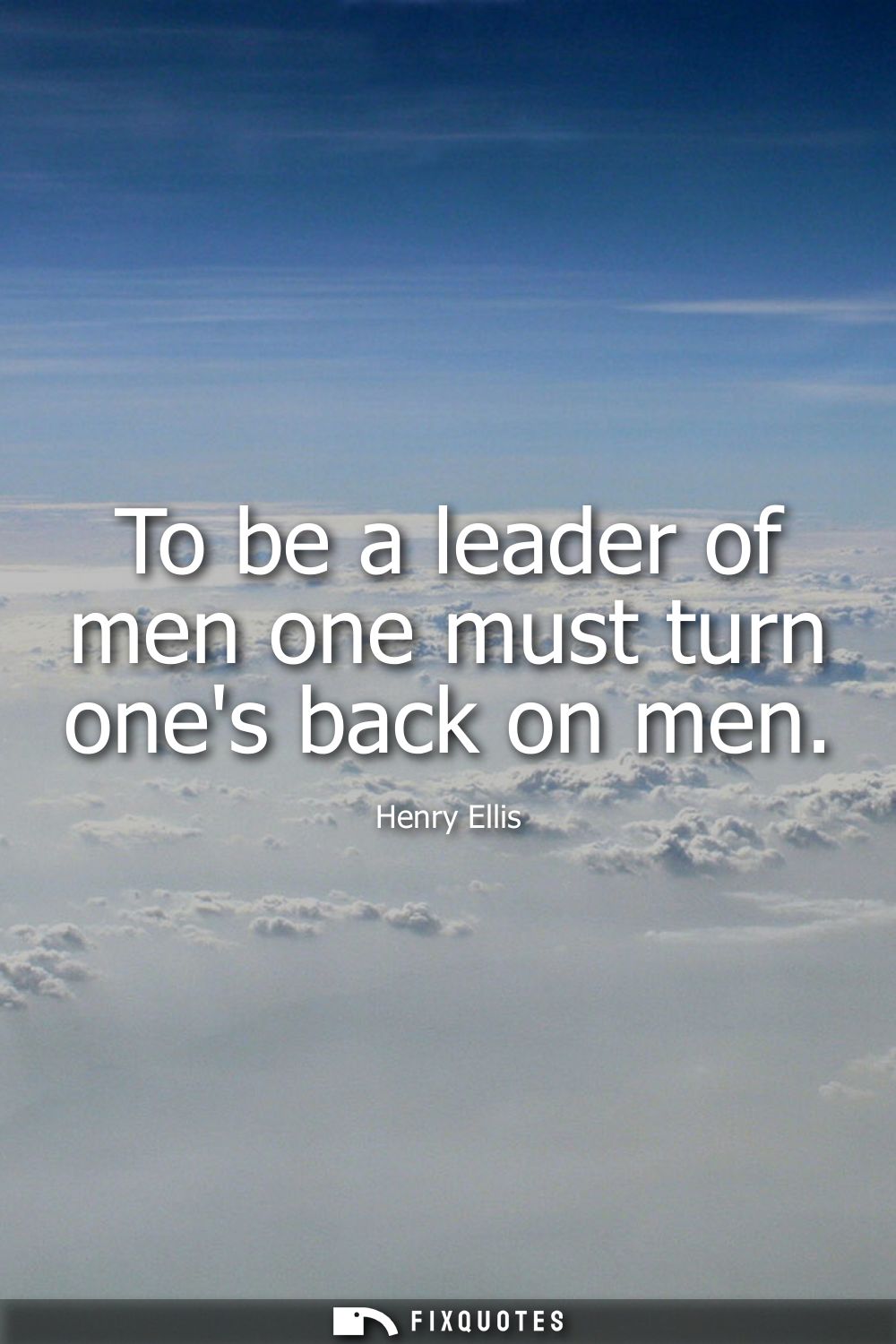
"To be a leader of men one must turn one's back on men"
About this Quote
Leadership, Ellis suggests, is a kind of chosen loneliness: the moment you try to represent people, you also have to stop echoing them. "Turn one's back" lands as deliberate provocation, because it violates the cozy modern story that good leaders are merely better listeners. Ellis is arguing the opposite kind of discipline: the leader who stays face-to-face with the crowd too long becomes a mirror, not a guide.
The intent is less misanthropy than insulation. To lead "men" is to make decisions that will, at least temporarily, disappoint them; the psychological trick is tolerating the backlash without folding. Ellis, writing in a period fascinated by mass behavior, heredity, and social conformity, is attuned to the way groups generate their own gravity. He’s warning that proximity breeds compliance: admiration, fear, and the desire to be liked are not just moral temptations but cognitive distortions. Turning your back is a posture of distance that lets you see the whole field, not just the faces demanding reassurance.
There’s also a chilly subtext about power. "Men" here reads as the mass, the many, the managed. Ellis implies that leadership requires an asymmetry: the leader cannot remain fully inside the group’s emotional economy and still steer it. The line works because it compresses an uncomfortable truth into a physical image: leadership as a refusal of the crowd’s gaze, a decision to be talked about rather than talked with.
The intent is less misanthropy than insulation. To lead "men" is to make decisions that will, at least temporarily, disappoint them; the psychological trick is tolerating the backlash without folding. Ellis, writing in a period fascinated by mass behavior, heredity, and social conformity, is attuned to the way groups generate their own gravity. He’s warning that proximity breeds compliance: admiration, fear, and the desire to be liked are not just moral temptations but cognitive distortions. Turning your back is a posture of distance that lets you see the whole field, not just the faces demanding reassurance.
There’s also a chilly subtext about power. "Men" here reads as the mass, the many, the managed. Ellis implies that leadership requires an asymmetry: the leader cannot remain fully inside the group’s emotional economy and still steer it. The line works because it compresses an uncomfortable truth into a physical image: leadership as a refusal of the crowd’s gaze, a decision to be talked about rather than talked with.
Quote Details
| Topic | Leadership |
|---|---|
| Source | Help us find the source |
| Cite |
Citation Formats
APA Style (7th ed.)
Ellis, Henry. (2026, January 15). To be a leader of men one must turn one's back on men. FixQuotes. https://fixquotes.com/quotes/to-be-a-leader-of-men-one-must-turn-ones-back-on-34032/
Chicago Style
Ellis, Henry. "To be a leader of men one must turn one's back on men." FixQuotes. January 15, 2026. https://fixquotes.com/quotes/to-be-a-leader-of-men-one-must-turn-ones-back-on-34032/.
MLA Style (9th ed.)
"To be a leader of men one must turn one's back on men." FixQuotes, 15 Jan. 2026, https://fixquotes.com/quotes/to-be-a-leader-of-men-one-must-turn-ones-back-on-34032/. Accessed 5 Apr. 2026.
More Quotes by Henry
Add to List