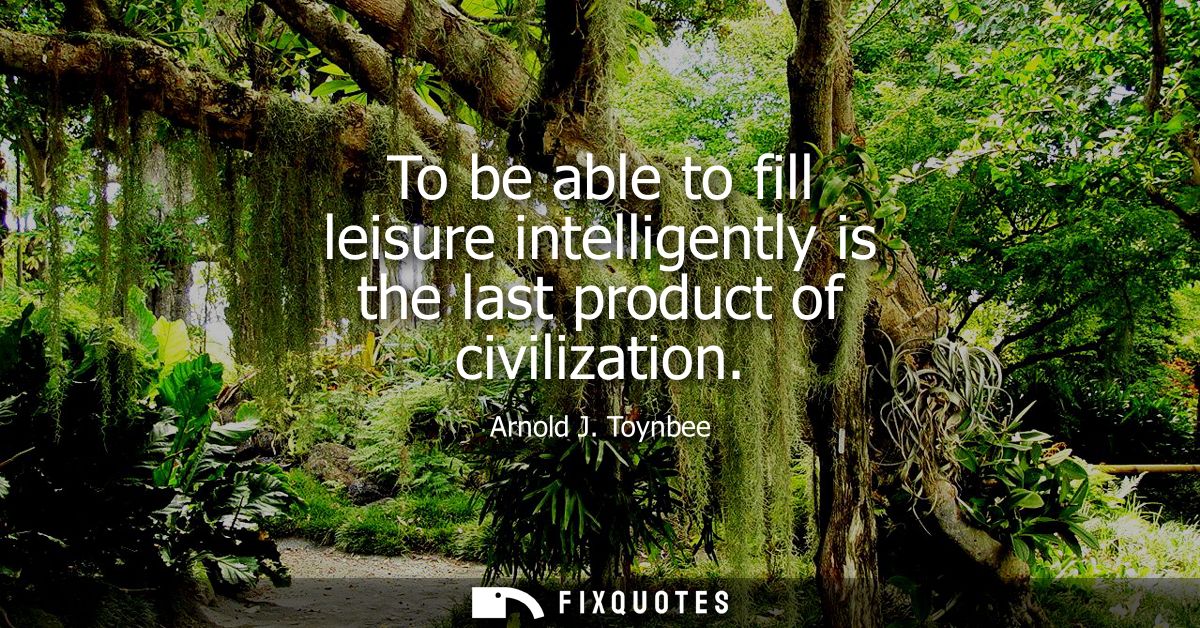
"To be able to fill leisure intelligently is the last product of civilization"
About this Quote
Toynbee’s intent is both diagnostic and moral. As a historian of “rise and fall” cycles, he’s interested in what happens once survival is no longer the main organizing principle. Leisure becomes the arena where character, education, and shared standards show up. “Intelligently” is doing heavy lifting: he doesn’t mean simply being busy or entertained, but choosing pursuits that deepen judgment, taste, and civic awareness. It’s an argument for culture as infrastructure, not decoration.
The subtext carries an implicit critique of modernity’s bargain: technology and wealth expand free time, then industries rush in to colonize it. A civilization can manufacture leisure and still fail at leisure, outsourcing meaning to spectacle. Toynbee is wary of that hollowing-out, the way comfort can erode the inner disciplines that made comfort possible.
Context matters. Writing in the shadow of world wars and mass society, Toynbee watched “advanced” nations use their sophistication for catastrophe. His metric for maturity isn’t power but self-governance at the most intimate level: attention. The last product of civilization, in his view, is not leisure itself, but a citizenry capable of handling freedom without wasting it.
Quote Details
| Topic | Wisdom |
|---|---|
| Source | Help us find the source |
| Cite |
Citation Formats
APA Style (7th ed.)
Toynbee, Arnold J. (2026, January 15). To be able to fill leisure intelligently is the last product of civilization. FixQuotes. https://fixquotes.com/quotes/to-be-able-to-fill-leisure-intelligently-is-the-4368/
Chicago Style
Toynbee, Arnold J. "To be able to fill leisure intelligently is the last product of civilization." FixQuotes. January 15, 2026. https://fixquotes.com/quotes/to-be-able-to-fill-leisure-intelligently-is-the-4368/.
MLA Style (9th ed.)
"To be able to fill leisure intelligently is the last product of civilization." FixQuotes, 15 Jan. 2026, https://fixquotes.com/quotes/to-be-able-to-fill-leisure-intelligently-is-the-4368/. Accessed 30 Mar. 2026.