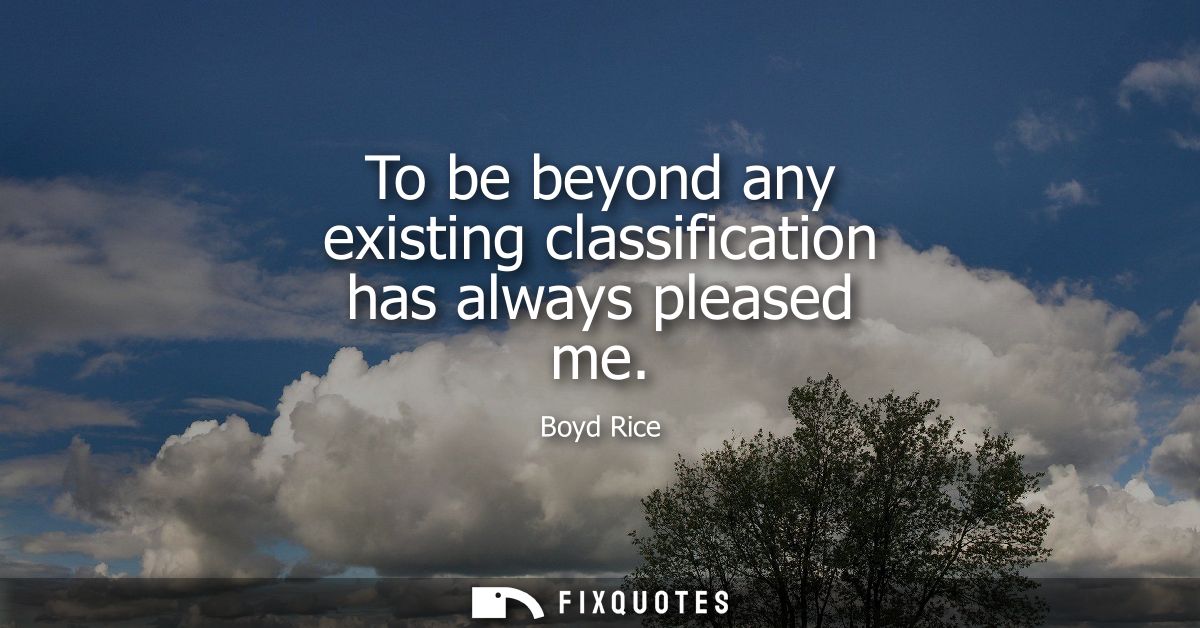
"To be beyond any existing classification has always pleased me"
About this Quote
There is a kind of dare tucked into Boyd Rice's line: not just refusing a label, but taking pleasure in slipping out of the categories that would make him legible. "Beyond any existing classification" reads like a badge and a weapon at once. The intent is self-mythmaking, but the subtext is about control. If you can't pin me down, you can't easily indict me, recruit me, or safely consume me.
Rice comes out of postwar counterculture where provocation is a medium, not a side effect. In late-20th-century art and music scenes, "unclassifiable" often signals creative range; with Rice, it also signals calculated friction. The pleasure he describes isn't the quiet satisfaction of nuance. It's the thrill of evading the moral filing cabinet. Classification is how institutions, scenes, and audiences sort artists into predictable narratives: punk, industrial, performance, extremist, provocateur, harmless eccentric. Rice's career has frequently leaned into the discomfort zone where those labels either fail or become accusations. So the line functions as preemptive framing: whatever you think I am, I'm not that - and the misfit is intentional.
The syntax matters, too. "Has always pleased me" suggests a long-running disposition, not a recent pose. It's a subtle claim of authenticity: I didn't become ambiguous to survive the discourse; I built my identity around being unsortable. In an era when branding rewards crisp categories, Rice treats ambiguity as an aesthetic of refusal - and as a way to keep the audience perpetually off-balance.
Rice comes out of postwar counterculture where provocation is a medium, not a side effect. In late-20th-century art and music scenes, "unclassifiable" often signals creative range; with Rice, it also signals calculated friction. The pleasure he describes isn't the quiet satisfaction of nuance. It's the thrill of evading the moral filing cabinet. Classification is how institutions, scenes, and audiences sort artists into predictable narratives: punk, industrial, performance, extremist, provocateur, harmless eccentric. Rice's career has frequently leaned into the discomfort zone where those labels either fail or become accusations. So the line functions as preemptive framing: whatever you think I am, I'm not that - and the misfit is intentional.
The syntax matters, too. "Has always pleased me" suggests a long-running disposition, not a recent pose. It's a subtle claim of authenticity: I didn't become ambiguous to survive the discourse; I built my identity around being unsortable. In an era when branding rewards crisp categories, Rice treats ambiguity as an aesthetic of refusal - and as a way to keep the audience perpetually off-balance.
Quote Details
| Topic | Deep |
|---|---|
| Source | Help us find the source |
| Cite |
Citation Formats
APA Style (7th ed.)
Rice, Boyd. (2026, January 18). To be beyond any existing classification has always pleased me. FixQuotes. https://fixquotes.com/quotes/to-be-beyond-any-existing-classification-has-18478/
Chicago Style
Rice, Boyd. "To be beyond any existing classification has always pleased me." FixQuotes. January 18, 2026. https://fixquotes.com/quotes/to-be-beyond-any-existing-classification-has-18478/.
MLA Style (9th ed.)
"To be beyond any existing classification has always pleased me." FixQuotes, 18 Jan. 2026, https://fixquotes.com/quotes/to-be-beyond-any-existing-classification-has-18478/. Accessed 3 Apr. 2026.
More Quotes by Boyd
Add to List