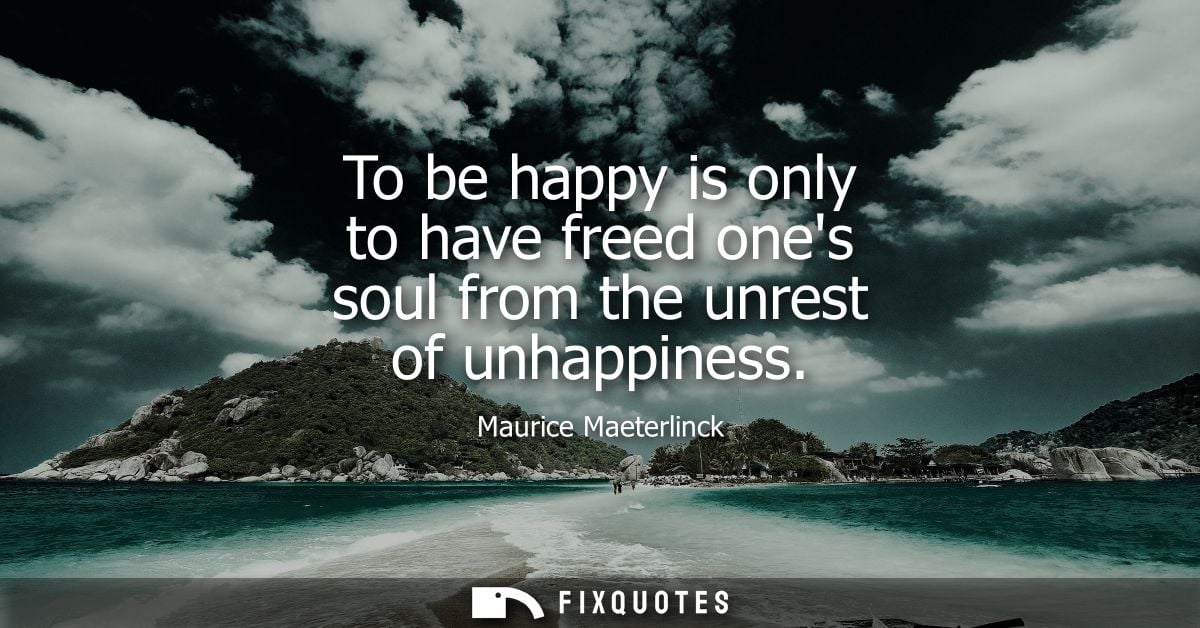
"To be happy is only to have freed one's soul from the unrest of unhappiness"
About this Quote
That move makes sense coming from a Symbolist dramatist whose work prized atmosphere, fate, and the invisible pressures that sit behind everyday speech. “Soul” here isn’t a pious flourish; it’s the seat of sensitivity, the part of a person that gets crowded by dread, envy, anticipation. “Unrest” implies not just sadness but a chronic vibration: the mind’s compulsion to rehearse losses and preempt future ones. Maeterlinck’s intent is quietly corrective, even suspicious of the culture of striving. If unhappiness is restless, then the chase for happiness can become another form of unrest - a performance of wanting.
The subtext is bracing: happiness may be less a peak than a release valve. That’s why the sentence works rhetorically. It’s taut, almost clinical, refusing sentimental imagery. It offers a stage direction more than a slogan: stop feeding the turbulence. In the early 20th-century European mood of anxiety and spiritual searching, Maeterlinck’s line reads like a minimalist antidote - not optimism, but unclenching.
Quote Details
| Topic | Happiness |
|---|---|
| Source | Help us find the source |
| Cite |
Citation Formats
APA Style (7th ed.)
Maeterlinck, Maurice. (2026, January 15). To be happy is only to have freed one's soul from the unrest of unhappiness. FixQuotes. https://fixquotes.com/quotes/to-be-happy-is-only-to-have-freed-ones-soul-from-150962/
Chicago Style
Maeterlinck, Maurice. "To be happy is only to have freed one's soul from the unrest of unhappiness." FixQuotes. January 15, 2026. https://fixquotes.com/quotes/to-be-happy-is-only-to-have-freed-ones-soul-from-150962/.
MLA Style (9th ed.)
"To be happy is only to have freed one's soul from the unrest of unhappiness." FixQuotes, 15 Jan. 2026, https://fixquotes.com/quotes/to-be-happy-is-only-to-have-freed-ones-soul-from-150962/. Accessed 7 Apr. 2026.