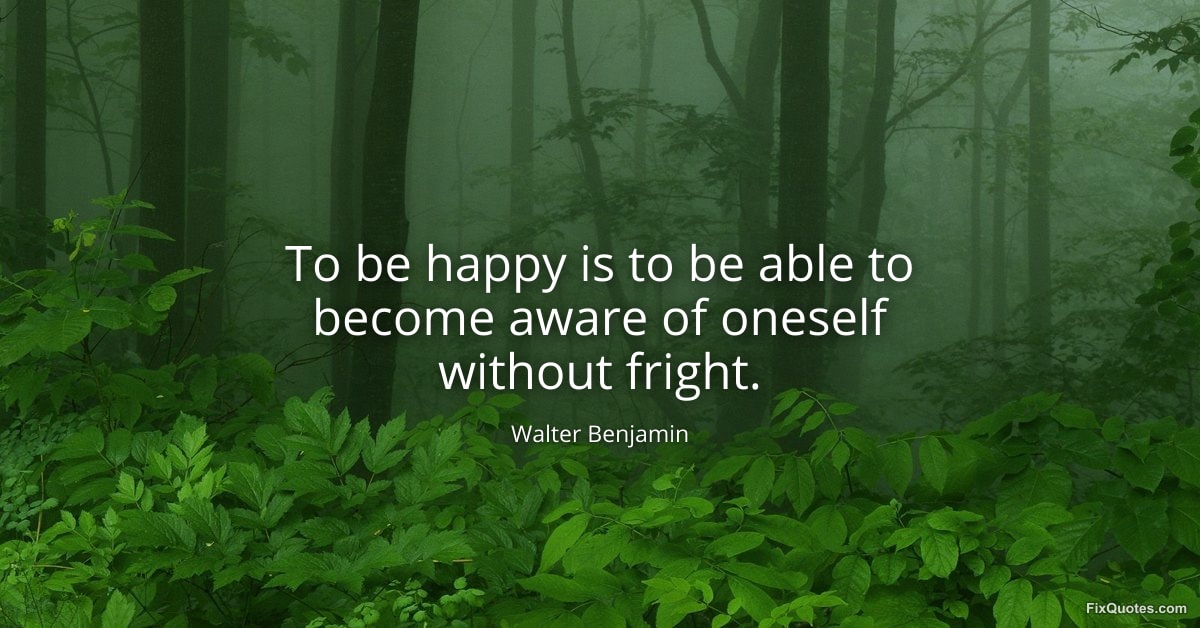
"To be happy is to be able to become aware of oneself without fright"
About this Quote
Happiness, for Walter Benjamin, isn’t the warm glow of satisfaction so much as a nervous system finally standing down. The line turns inwardness into a stress test: can you look directly at yourself - not the curated self you perform, but the raw, unedited consciousness - without panic? Benjamin’s genius is the quiet reversal. We usually treat self-awareness as a virtue and fear as a weakness. He treats fear as the diagnostic: if self-recognition triggers dread, something in the world has made the self feel unsafe.
That “without fright” matters because Benjamin wrote under the long shadow of European catastrophe: the mechanized shocks of modern city life, the rise of fascism, the tightening vise on Jewish intellectuals like him. His work repeatedly argues that modernity trains us to live in fragments, absorbing stimuli while staying half-absent from ourselves. In that context, happiness becomes less a mood than a condition of interior asylum - the rare ability to be present without needing to flee.
The subtext is political as much as psychological. A society that runs on surveillance, propaganda, and economic precarity doesn’t just police bodies; it colonizes inner life, making self-scrutiny feel dangerous. Benjamin’s phrasing suggests that freedom starts at the threshold of attention: the moment you can acknowledge your own thoughts and contradictions without the reflex to flinch. It’s a severe, bracing standard of joy - one measured not by pleasure, but by the absence of terror in the face of truth.
That “without fright” matters because Benjamin wrote under the long shadow of European catastrophe: the mechanized shocks of modern city life, the rise of fascism, the tightening vise on Jewish intellectuals like him. His work repeatedly argues that modernity trains us to live in fragments, absorbing stimuli while staying half-absent from ourselves. In that context, happiness becomes less a mood than a condition of interior asylum - the rare ability to be present without needing to flee.
The subtext is political as much as psychological. A society that runs on surveillance, propaganda, and economic precarity doesn’t just police bodies; it colonizes inner life, making self-scrutiny feel dangerous. Benjamin’s phrasing suggests that freedom starts at the threshold of attention: the moment you can acknowledge your own thoughts and contradictions without the reflex to flinch. It’s a severe, bracing standard of joy - one measured not by pleasure, but by the absence of terror in the face of truth.
Quote Details
| Topic | Happiness |
|---|---|
| Source | Help us find the source |
| Cite |
Citation Formats
APA Style (7th ed.)
Benjamin, Walter. (2026, January 16). To be happy is to be able to become aware of oneself without fright. FixQuotes. https://fixquotes.com/quotes/to-be-happy-is-to-be-able-to-become-aware-of-107709/
Chicago Style
Benjamin, Walter. "To be happy is to be able to become aware of oneself without fright." FixQuotes. January 16, 2026. https://fixquotes.com/quotes/to-be-happy-is-to-be-able-to-become-aware-of-107709/.
MLA Style (9th ed.)
"To be happy is to be able to become aware of oneself without fright." FixQuotes, 16 Jan. 2026, https://fixquotes.com/quotes/to-be-happy-is-to-be-able-to-become-aware-of-107709/. Accessed 21 Mar. 2026.
More Quotes by Walter
Add to List