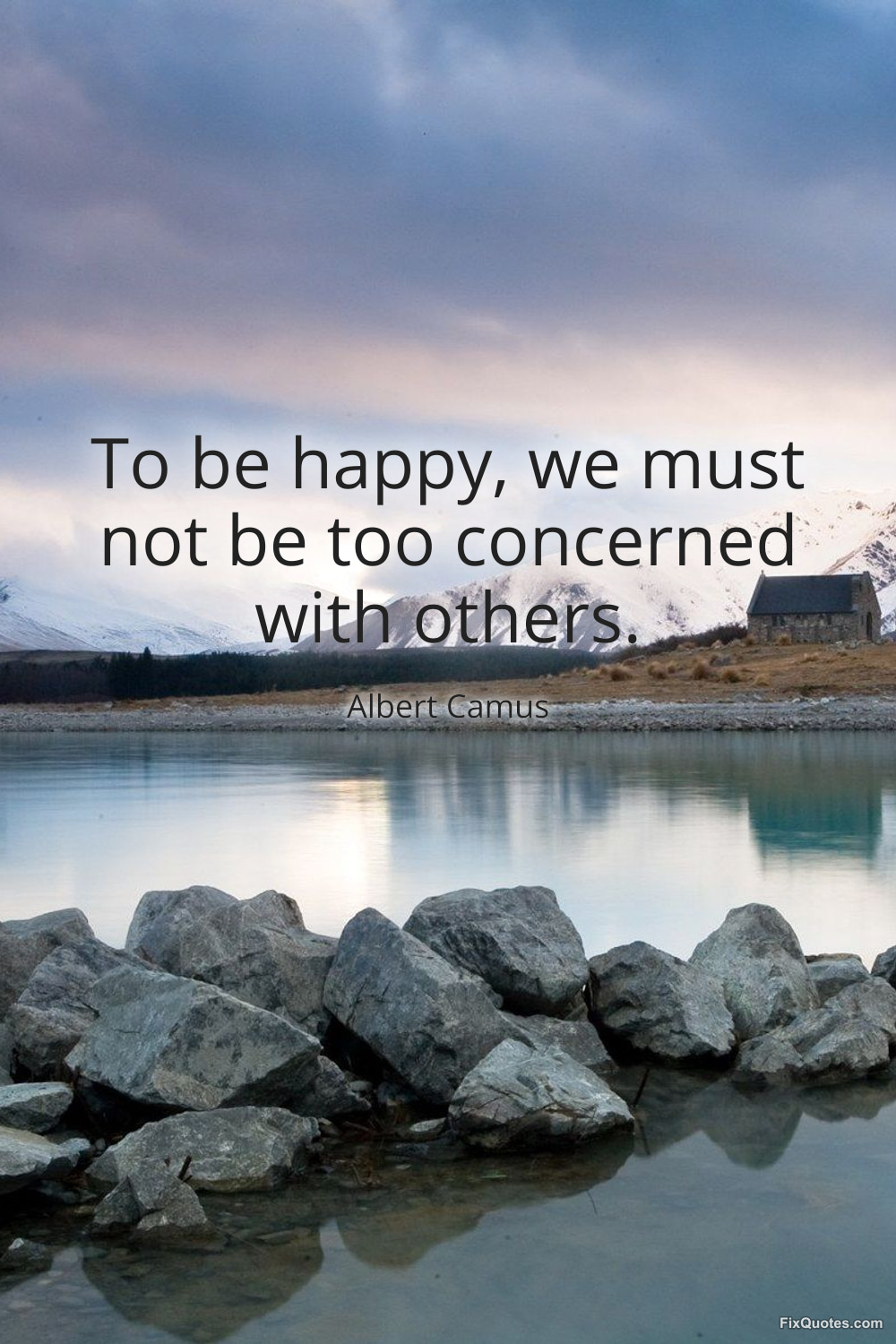
"To be happy, we must not be too concerned with others"
About this Quote
Camus slips a small bomb under the polite furniture of morality: happiness may require a certain selfishness. Not cruelty, not indifference to suffering, but a refusal to let other people’s expectations run your interior life. The phrasing matters. “Too concerned” is a pressure valve, acknowledging that some concern is necessary while diagnosing the point where empathy curdles into surveillance: the constant scanning of others for approval, the anxious accounting of who deserves what, the performative goodness that turns living into a public relations job.
The intent is less self-help than survival. Camus wrote in the shadow of war, occupation, and ideological certainty, when “others” weren’t just friends and neighbors but mass movements demanding allegiance and purity. In that climate, being “concerned with others” can become a pipeline to ressentiment and fanaticism: you live by comparison, by judgment, by the fantasy that your life will be justified if the crowd signs off on it. Camus’ broader project - the absurd, the refusal of false consolations - treats happiness as a modest, stubborn achievement: a clear-eyed yes to existence without outsourcing meaning to either God or the mob.
The subtext is an ethics of boundaries. If you want to act decently, you need a self that isn’t permanently hostage to other people’s reactions. Camus isn’t licensing apathy; he’s arguing that compulsive concern is a form of dependence. Happiness, here, is the byproduct of choosing your commitments rather than being drafted into them by other people’s noise.
The intent is less self-help than survival. Camus wrote in the shadow of war, occupation, and ideological certainty, when “others” weren’t just friends and neighbors but mass movements demanding allegiance and purity. In that climate, being “concerned with others” can become a pipeline to ressentiment and fanaticism: you live by comparison, by judgment, by the fantasy that your life will be justified if the crowd signs off on it. Camus’ broader project - the absurd, the refusal of false consolations - treats happiness as a modest, stubborn achievement: a clear-eyed yes to existence without outsourcing meaning to either God or the mob.
The subtext is an ethics of boundaries. If you want to act decently, you need a self that isn’t permanently hostage to other people’s reactions. Camus isn’t licensing apathy; he’s arguing that compulsive concern is a form of dependence. Happiness, here, is the byproduct of choosing your commitments rather than being drafted into them by other people’s noise.
Quote Details
| Topic | Happiness |
|---|---|
| Source | Help us find the source |
| Cite |
Citation Formats
APA Style (7th ed.)
Camus, Albert. (2026, February 16). To be happy, we must not be too concerned with others. FixQuotes. https://fixquotes.com/quotes/to-be-happy-we-must-not-be-too-concerned-with-22908/
Chicago Style
Camus, Albert. "To be happy, we must not be too concerned with others." FixQuotes. February 16, 2026. https://fixquotes.com/quotes/to-be-happy-we-must-not-be-too-concerned-with-22908/.
MLA Style (9th ed.)
"To be happy, we must not be too concerned with others." FixQuotes, 16 Feb. 2026, https://fixquotes.com/quotes/to-be-happy-we-must-not-be-too-concerned-with-22908/. Accessed 27 Mar. 2026.
More Quotes by Albert
Add to List