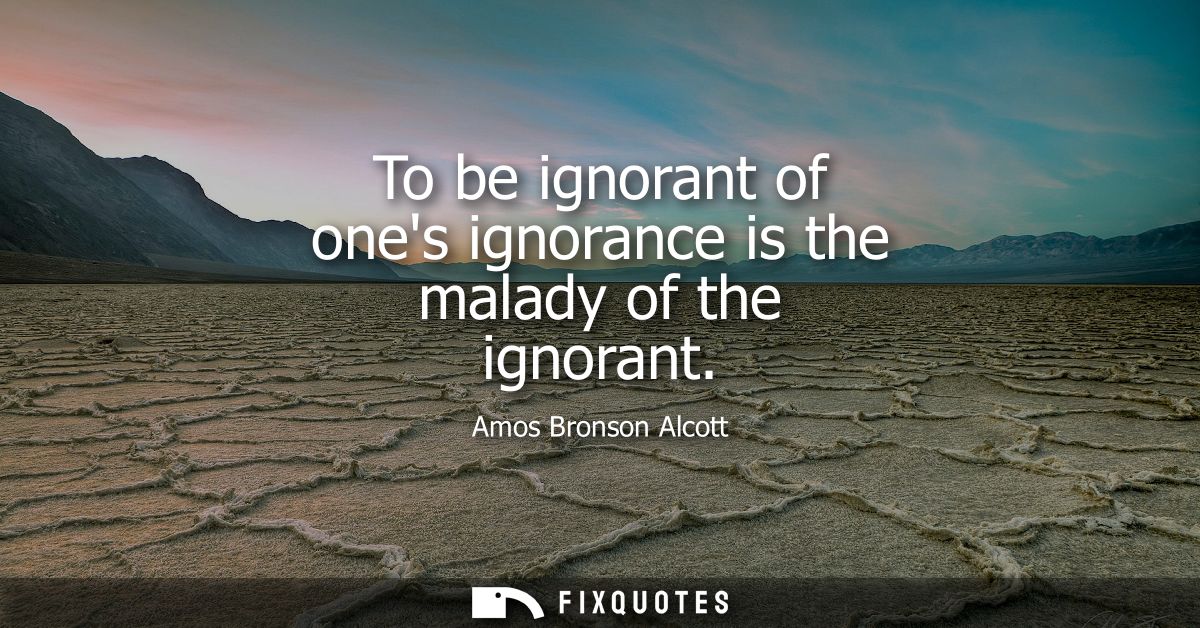
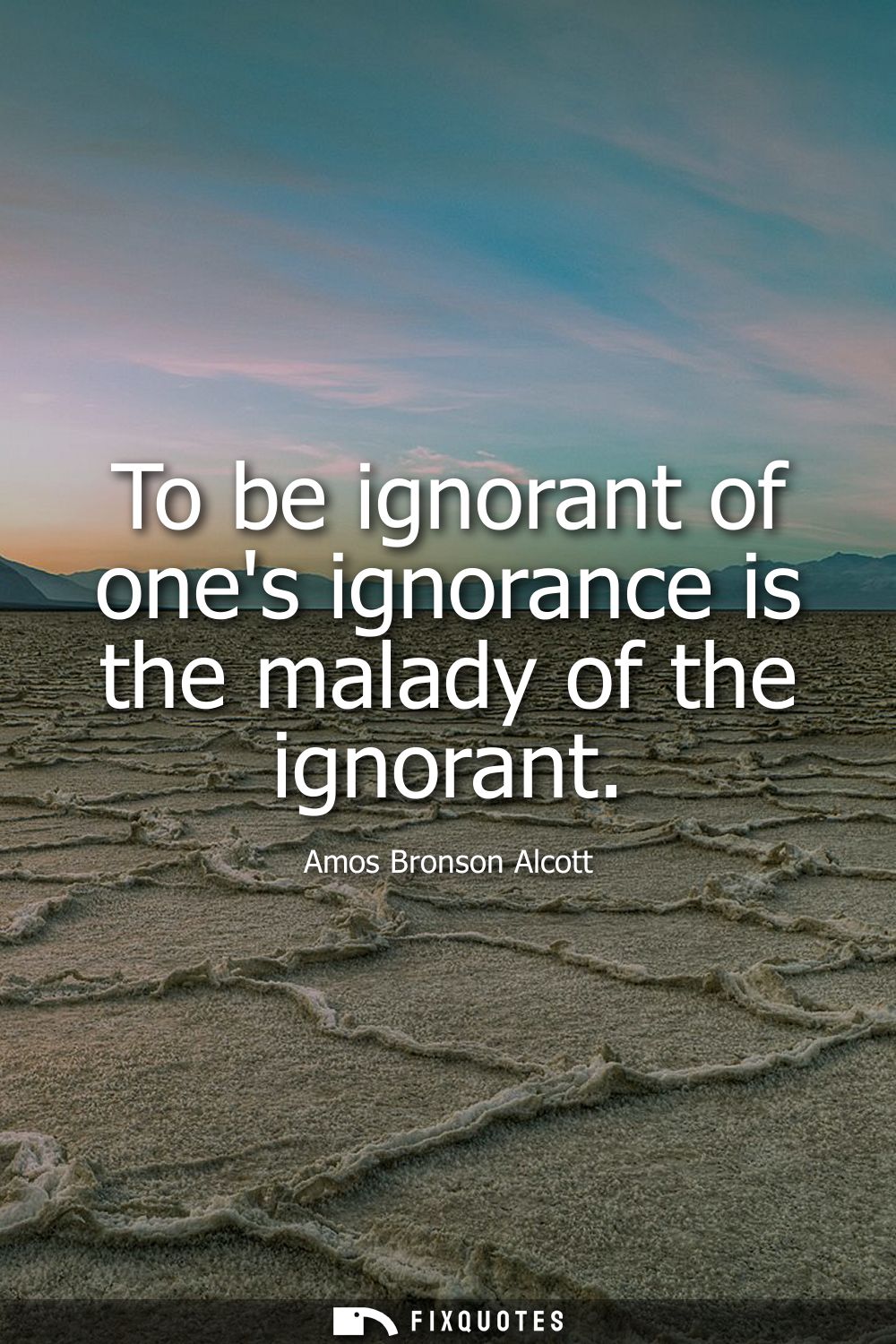
"To be ignorant of one's ignorance is the malady of the ignorant"
About this Quote
Ignorance is survivable; unawareness of it is the infection that spreads. Alcott’s line lands because it targets not a lack of information but the sealed-off mindset that can’t admit it has gaps. The phrasing is almost clinical: “malady” turns stupidity from a moral failing into a diagnosable condition, something that distorts perception from the inside. The cleverness is in the loop of “ignorant” and “ignorance” - a linguistic mirror that suggests the real danger isn’t what you don’t know, it’s the self-protective story you tell to avoid noticing you don’t know it.
As a 19th-century educator and Transcendentalist-adjacent thinker, Alcott was arguing against rote schooling and for moral-intellectual self-cultivation. In that context, the quote reads like a critique of conventional authority: institutions that reward certainty can produce students who confuse memorization with understanding, and adults who mistake social status for insight. The subtext is pedagogical and political at once: a democracy depends on citizens capable of self-correction, not just opinion.
The line also anticipates what we now recognize as confidence bias: the least informed can be the most certain, precisely because they lack the tools to recognize their own errors. Alcott’s intent isn’t to sneer at the “ignorant” so much as to name the one trait that makes ignorance durable - the refusal (or inability) to see oneself from the outside. It’s a demand for epistemic humility, framed as a health imperative rather than a virtue slogan.
As a 19th-century educator and Transcendentalist-adjacent thinker, Alcott was arguing against rote schooling and for moral-intellectual self-cultivation. In that context, the quote reads like a critique of conventional authority: institutions that reward certainty can produce students who confuse memorization with understanding, and adults who mistake social status for insight. The subtext is pedagogical and political at once: a democracy depends on citizens capable of self-correction, not just opinion.
The line also anticipates what we now recognize as confidence bias: the least informed can be the most certain, precisely because they lack the tools to recognize their own errors. Alcott’s intent isn’t to sneer at the “ignorant” so much as to name the one trait that makes ignorance durable - the refusal (or inability) to see oneself from the outside. It’s a demand for epistemic humility, framed as a health imperative rather than a virtue slogan.
Quote Details
| Topic | Wisdom |
|---|---|
| Source | Help us find the source |
| Cite |
Citation Formats
APA Style (7th ed.)
Alcott, Amos Bronson. (2026, January 15). To be ignorant of one's ignorance is the malady of the ignorant. FixQuotes. https://fixquotes.com/quotes/to-be-ignorant-of-ones-ignorance-is-the-malady-of-169250/
Chicago Style
Alcott, Amos Bronson. "To be ignorant of one's ignorance is the malady of the ignorant." FixQuotes. January 15, 2026. https://fixquotes.com/quotes/to-be-ignorant-of-ones-ignorance-is-the-malady-of-169250/.
MLA Style (9th ed.)
"To be ignorant of one's ignorance is the malady of the ignorant." FixQuotes, 15 Jan. 2026, https://fixquotes.com/quotes/to-be-ignorant-of-ones-ignorance-is-the-malady-of-169250/. Accessed 5 Feb. 2026.
More Quotes by Amos
Add to List