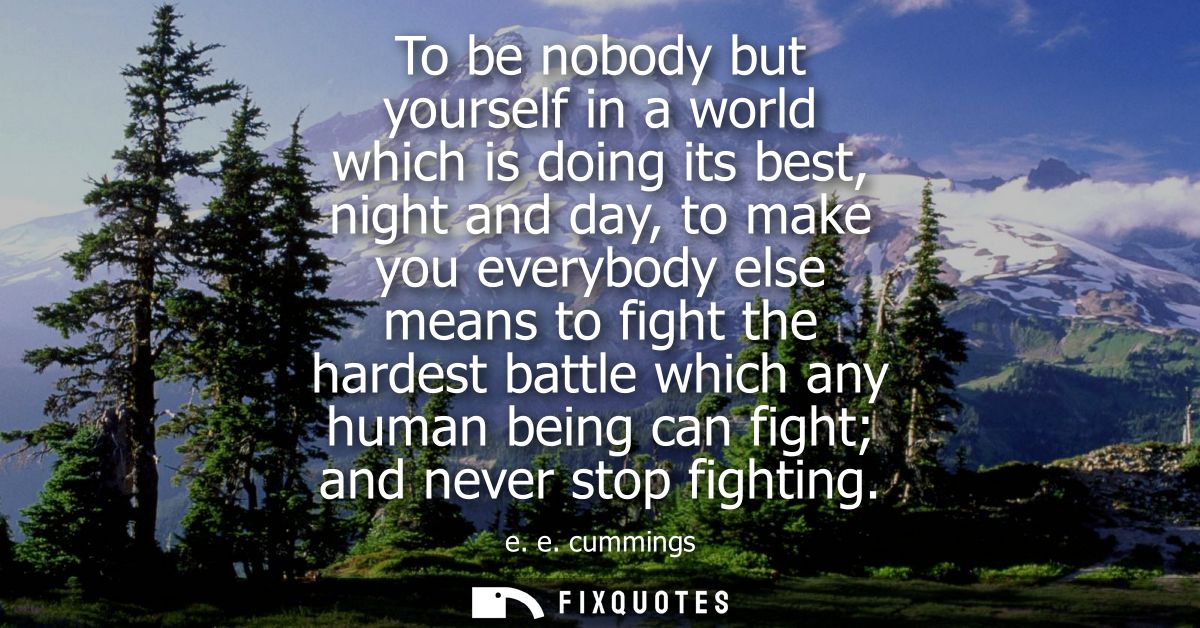
"To be nobody but yourself in a world which is doing its best, night and day, to make you everybody else means to fight the hardest battle which any human being can fight; and never stop fighting"
About this Quote
Cummings turns selfhood into a contact sport, then refuses to let it end. The line is built like a dare: not “be yourself” in the Hallmark sense, but “be nobody but yourself,” a deliberately awkward phrasing that makes identity feel singular, even lonely. “Nobody” isn’t self-erasure here; it’s a rejection of the pre-approved roles society hands out. He frames the world as an active opponent, “doing its best, night and day,” which smuggles in a bleak assumption: conformity isn’t occasional pressure, it’s the default weather.
The subtext is that modern life manufactures “everybody else” as a template. Cummings wrote in a century of mass advertising, bureaucratic standardization, and ideological sorting - the rise of the crowd as a technology. In that context, “everybody else” isn’t just peers; it’s institutions, fashions, patriotisms, and the subtle social incentives that reward the legible version of you. The “hardest battle” language is intentionally militarized, a rhetorical escalation that makes inner life sound like a war zone. It’s not therapy-speak; it’s trench-speak.
Then he lands the real twist: “and never stop fighting.” The sentence denies the fantasy of arrival, the idea that you can “find yourself” once and be done. Cummings’ intent isn’t comfort but stamina. Authenticity isn’t presented as a personality trait; it’s a practice under siege, requiring continual resistance against the easy seductions of belonging, praise, and safety.
The subtext is that modern life manufactures “everybody else” as a template. Cummings wrote in a century of mass advertising, bureaucratic standardization, and ideological sorting - the rise of the crowd as a technology. In that context, “everybody else” isn’t just peers; it’s institutions, fashions, patriotisms, and the subtle social incentives that reward the legible version of you. The “hardest battle” language is intentionally militarized, a rhetorical escalation that makes inner life sound like a war zone. It’s not therapy-speak; it’s trench-speak.
Then he lands the real twist: “and never stop fighting.” The sentence denies the fantasy of arrival, the idea that you can “find yourself” once and be done. Cummings’ intent isn’t comfort but stamina. Authenticity isn’t presented as a personality trait; it’s a practice under siege, requiring continual resistance against the easy seductions of belonging, praise, and safety.
Quote Details
| Topic | Confidence |
|---|
More Quotes by E. Cummings
Add to List