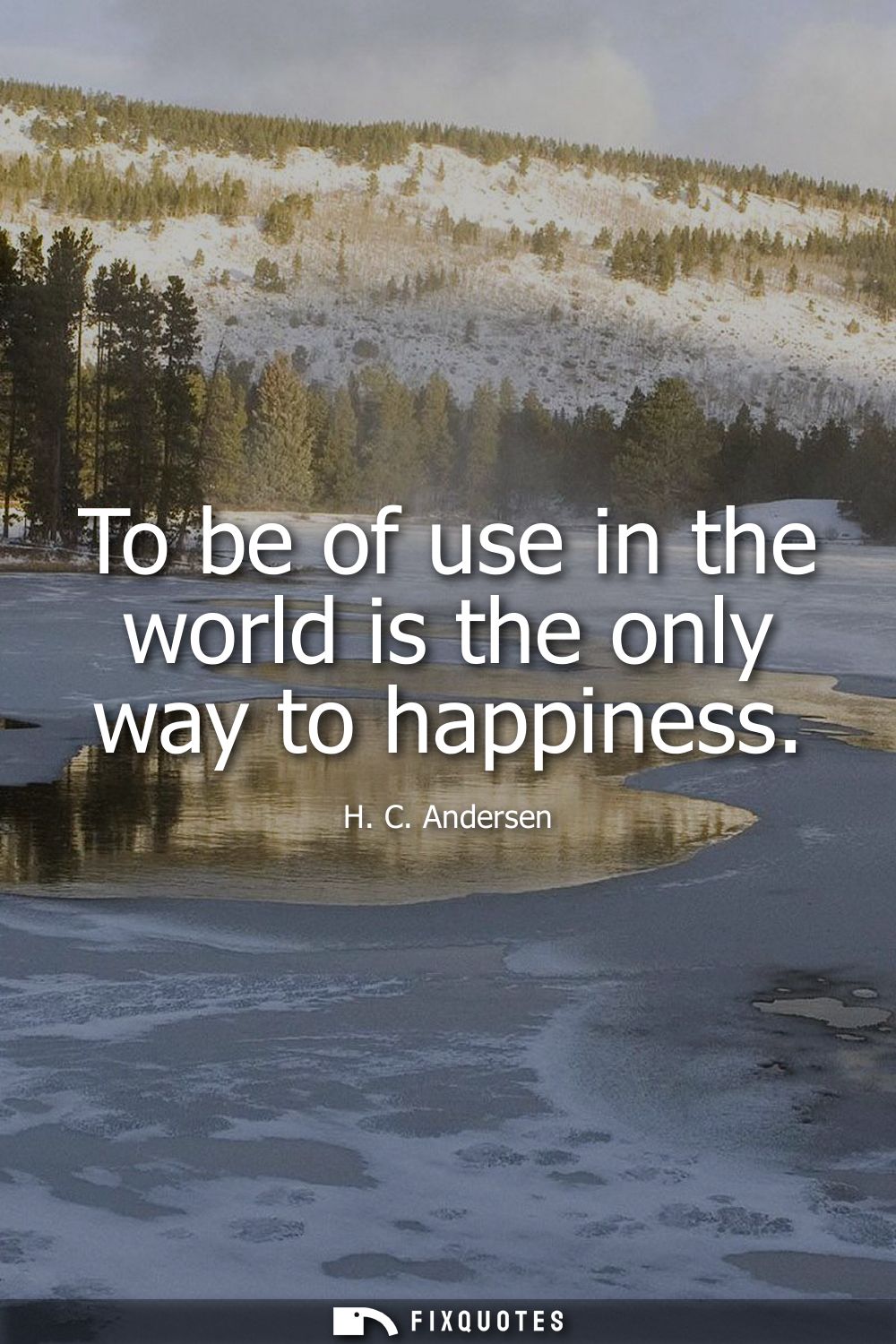
"To be of use in the world is the only way to happiness"
About this Quote
Happiness, Andersen suggests, isn’t a mood you hunt down; it’s a byproduct you earn by becoming necessary to someone else’s life. The line has the neat, fable-like snap you’d expect from a writer who built whole moral universes out of tin soldiers and match girls. It reads almost puritanical in its simplicity, but the craft is in the pivot: he doesn’t praise virtue for virtue’s sake, or insist on self-denial. He makes happiness contingent on usefulness, as if joy is less an inner treasure than a social function.
The intent feels corrective. Andersen grew up poor, socially precarious, and acutely aware of status; he knew how easily “happiness” becomes a luxury word used by people insulated from consequences. “To be of use” reframes worth away from pedigree and toward contribution. It’s also a quiet rebuttal to romantic fantasies of fulfillment through pure feeling. In Andersen’s world, feelings are often intense, sincere, and still insufficient; what matters is what those feelings do in the world.
The subtext carries both comfort and pressure. Comfort, because it offers an attainable route to meaning: you don’t need genius or greatness to matter, just a place where your effort lands. Pressure, because it makes happiness a kind of moral KPI, measured in impact. That tension mirrors the 19th-century shift into modern social life: industrializing societies needed roles, labor, and usefulness; Andersen turns that demand into a personal ethic, smoothing necessity into purpose.
The intent feels corrective. Andersen grew up poor, socially precarious, and acutely aware of status; he knew how easily “happiness” becomes a luxury word used by people insulated from consequences. “To be of use” reframes worth away from pedigree and toward contribution. It’s also a quiet rebuttal to romantic fantasies of fulfillment through pure feeling. In Andersen’s world, feelings are often intense, sincere, and still insufficient; what matters is what those feelings do in the world.
The subtext carries both comfort and pressure. Comfort, because it offers an attainable route to meaning: you don’t need genius or greatness to matter, just a place where your effort lands. Pressure, because it makes happiness a kind of moral KPI, measured in impact. That tension mirrors the 19th-century shift into modern social life: industrializing societies needed roles, labor, and usefulness; Andersen turns that demand into a personal ethic, smoothing necessity into purpose.
Quote Details
| Topic | Happiness |
|---|---|
| Source | Help us find the source |
| Cite |
Citation Formats
APA Style (7th ed.)
Andersen, H. C. (2026, January 15). To be of use in the world is the only way to happiness. FixQuotes. https://fixquotes.com/quotes/to-be-of-use-in-the-world-is-the-only-way-to-171976/
Chicago Style
Andersen, H. C. "To be of use in the world is the only way to happiness." FixQuotes. January 15, 2026. https://fixquotes.com/quotes/to-be-of-use-in-the-world-is-the-only-way-to-171976/.
MLA Style (9th ed.)
"To be of use in the world is the only way to happiness." FixQuotes, 15 Jan. 2026, https://fixquotes.com/quotes/to-be-of-use-in-the-world-is-the-only-way-to-171976/. Accessed 6 Apr. 2026.
More Quotes by C. Andersen
Add to List