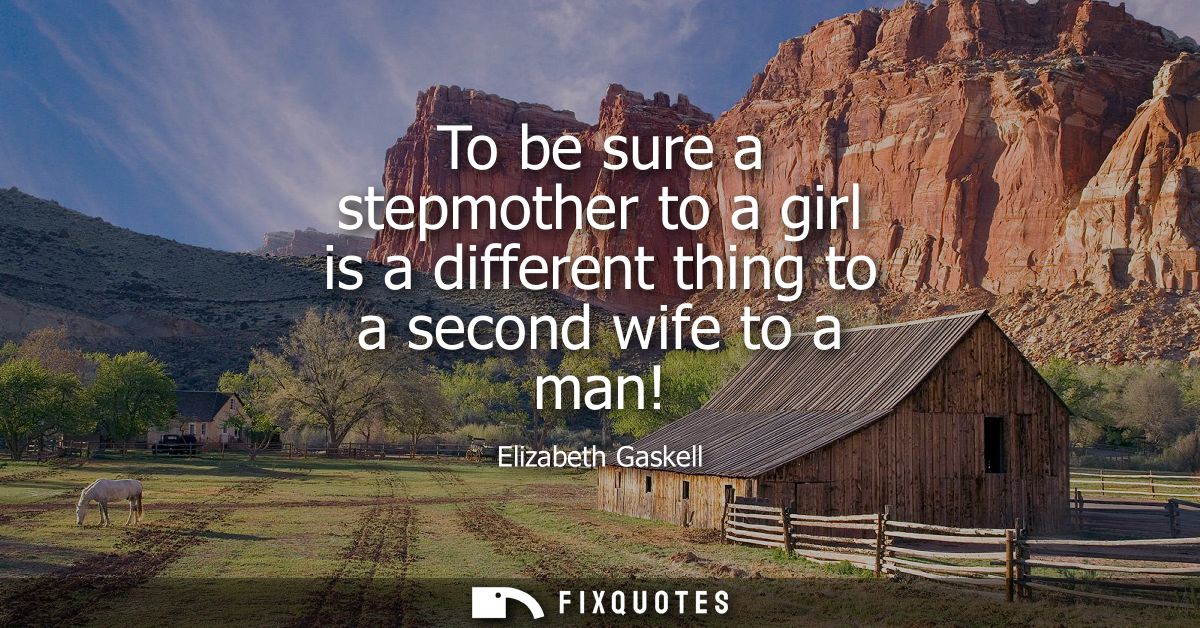
"To be sure, a stepmother to a girl is a different thing to a second wife to a man!"
About this Quote
The line’s force comes from its neat imbalance: the man gets a euphemism, the girl gets a threat. Gaskell, a novelist of interiors, understands that families are also reputational machines. A man remarries and gains legitimacy; a girl gains a stranger with power over her body, her routine, her prospects. The stepmother isn’t simply “not the mother.” She’s a newcomer competing with a dead woman’s halo, navigating affection that can’t be demanded and obedience that can be. If the girl resists, she’s ungrateful; if the stepmother disciplines, she’s cruel. There’s no winning script.
Contextually, it’s pure Gaskell: the domestic sphere as a pressure chamber where class, gender, and money leak through the wallpaper. The sentence quietly indicts a culture that treats women as interchangeable caretakers for men, while treating girls as precarious dependents whose safety hinges on the character of whoever replaces “mother.” The exclamation isn’t delight. It’s alarm dressed as common sense.
Quote Details
| Topic | Mother |
|---|---|
| Source | Help us find the source |
| Cite |
Citation Formats
APA Style (7th ed.)
Gaskell, Elizabeth. (2026, February 16). To be sure, a stepmother to a girl is a different thing to a second wife to a man! FixQuotes. https://fixquotes.com/quotes/to-be-sure-a-stepmother-to-a-girl-is-a-different-117443/
Chicago Style
Gaskell, Elizabeth. "To be sure, a stepmother to a girl is a different thing to a second wife to a man!" FixQuotes. February 16, 2026. https://fixquotes.com/quotes/to-be-sure-a-stepmother-to-a-girl-is-a-different-117443/.
MLA Style (9th ed.)
"To be sure, a stepmother to a girl is a different thing to a second wife to a man!" FixQuotes, 16 Feb. 2026, https://fixquotes.com/quotes/to-be-sure-a-stepmother-to-a-girl-is-a-different-117443/. Accessed 8 Mar. 2026.