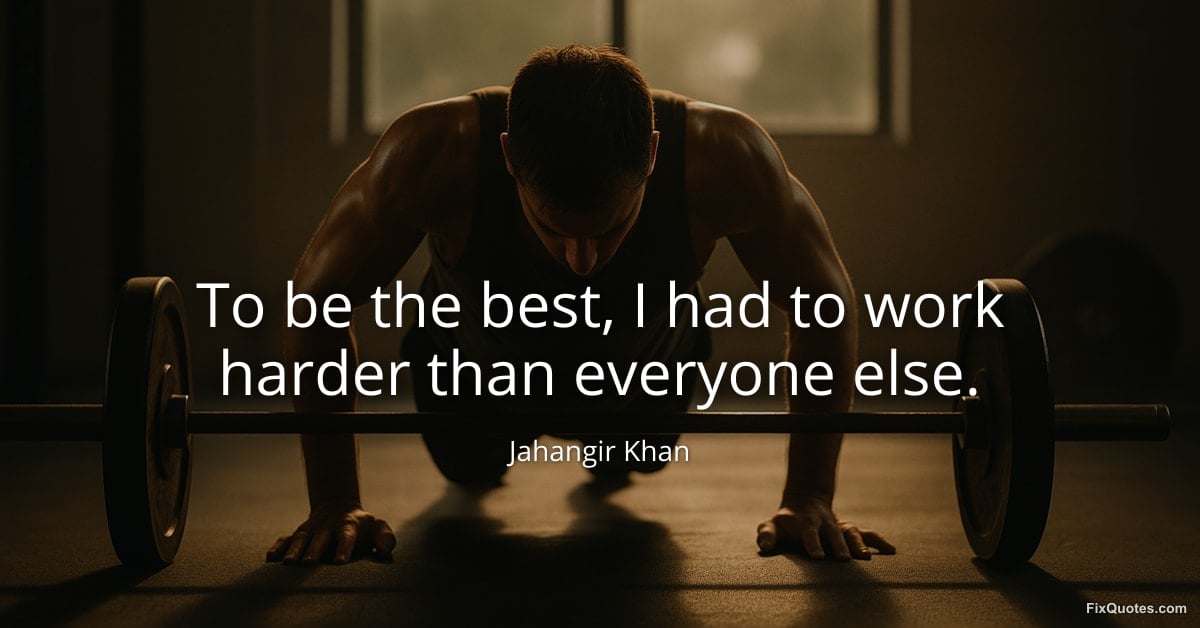
"To be the best, I had to work harder than everyone else"
About this Quote
“To be the best, I had to work harder than everyone else” sounds like the clean, motivational slogan you’d find taped to a locker. Coming from Jahangir Khan, it lands less as a platitude and more as a brutally specific job description. This is the man who turned squash into something closer to a controlled demolition, running up a record unbeaten streak that still feels like a typo. In that context, “had to” isn’t humblebragging; it’s an admission that greatness, for him, wasn’t a vibe. It was a non-negotiable operating system.
The intent is simple: reframe dominance as labor, not luck. Athletes often credit “talent” when they want to seem gifted but relatable. Khan does the opposite. He points to effort as the differentiator, but the subtext is harsher: everyone else was working, too. So “harder” implies a kind of daily extremism - the willingness to out-suffer peers when nobody’s watching and the scoreboard isn’t offering immediate validation.
There’s cultural weight here, too. Khan emerged from Pakistan’s storied squash pipeline, where legacy and expectation can be as heavy as any opponent. His line quietly rejects the romantic myth of destiny. He’s not saying he was chosen; he’s saying he chose it, repeatedly, at a cost.
What makes the quote work is its austerity. No talk of passion, no cinematic breakthrough. Just a blunt equation: supremacy requires an unequal share of discipline. It’s motivational, yes, but it’s also a warning.
The intent is simple: reframe dominance as labor, not luck. Athletes often credit “talent” when they want to seem gifted but relatable. Khan does the opposite. He points to effort as the differentiator, but the subtext is harsher: everyone else was working, too. So “harder” implies a kind of daily extremism - the willingness to out-suffer peers when nobody’s watching and the scoreboard isn’t offering immediate validation.
There’s cultural weight here, too. Khan emerged from Pakistan’s storied squash pipeline, where legacy and expectation can be as heavy as any opponent. His line quietly rejects the romantic myth of destiny. He’s not saying he was chosen; he’s saying he chose it, repeatedly, at a cost.
What makes the quote work is its austerity. No talk of passion, no cinematic breakthrough. Just a blunt equation: supremacy requires an unequal share of discipline. It’s motivational, yes, but it’s also a warning.
Quote Details
| Topic | Work Ethic |
|---|---|
| Source | Help us find the source |
| Featured | This quote was our Quote of the Day on January 14, 2026 |
| Cite |
Citation Formats
APA Style (7th ed.)
Khan, Jahangir. (2026, January 13). To be the best, I had to work harder than everyone else. FixQuotes. https://fixquotes.com/quotes/to-be-the-best-i-had-to-work-harder-than-everyone-65147/
Chicago Style
Khan, Jahangir. "To be the best, I had to work harder than everyone else." FixQuotes. January 13, 2026. https://fixquotes.com/quotes/to-be-the-best-i-had-to-work-harder-than-everyone-65147/.
MLA Style (9th ed.)
"To be the best, I had to work harder than everyone else." FixQuotes, 13 Jan. 2026, https://fixquotes.com/quotes/to-be-the-best-i-had-to-work-harder-than-everyone-65147/. Accessed 18 Feb. 2026.
More Quotes by Jahangir
Add to List