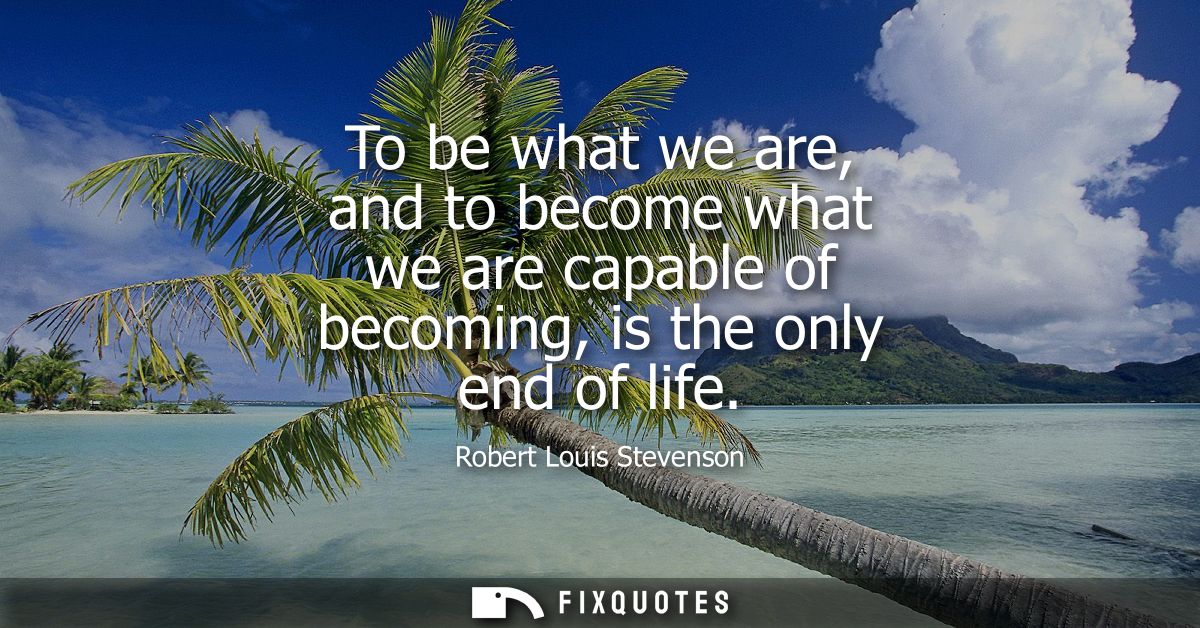
"To be what we are, and to become what we are capable of becoming, is the only end of life"
About this Quote
The subtext is quietly anti-Victorian. In a culture that prized propriety, respectability, and predetermined roles, Stevenson smuggles in a radical metric: fulfillment as growth, not compliance. Coming from a writer who lived with chronic illness and repeatedly escaped the expectations of class and profession (engineering, law, the dutiful Scottish son), the claim reads like self-justification sharpened into philosophy. It’s also a novelist’s credo: character is revealed by motion, not by labels.
The phrasing makes the argument feel inevitable. The repeated “what we are” works like a refrain, anchoring change to continuity so evolution doesn’t sound like betrayal. Stevenson’s trick is to frame ambition as fidelity: becoming more is not abandoning the self; it’s completing it.
Quote Details
| Topic | Meaning of Life |
|---|---|
| Source | Help us find the source |
| Cite |
Citation Formats
APA Style (7th ed.)
Stevenson, Robert Louis. (2026, January 14). To be what we are, and to become what we are capable of becoming, is the only end of life. FixQuotes. https://fixquotes.com/quotes/to-be-what-we-are-and-to-become-what-we-are-20850/
Chicago Style
Stevenson, Robert Louis. "To be what we are, and to become what we are capable of becoming, is the only end of life." FixQuotes. January 14, 2026. https://fixquotes.com/quotes/to-be-what-we-are-and-to-become-what-we-are-20850/.
MLA Style (9th ed.)
"To be what we are, and to become what we are capable of becoming, is the only end of life." FixQuotes, 14 Jan. 2026, https://fixquotes.com/quotes/to-be-what-we-are-and-to-become-what-we-are-20850/. Accessed 17 Feb. 2026.