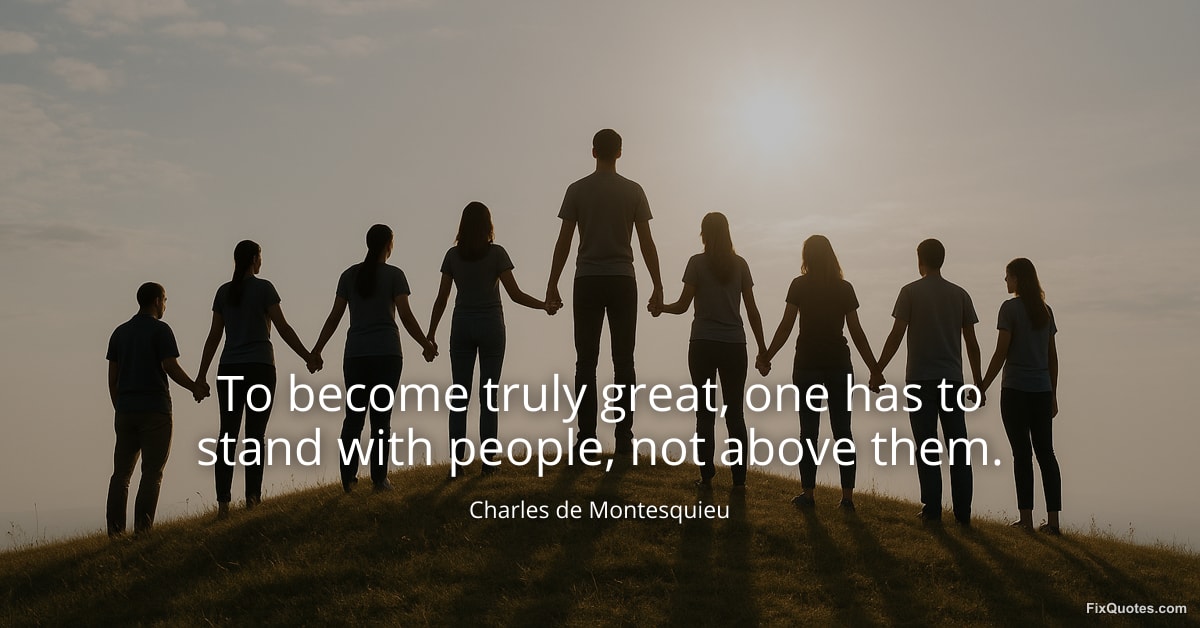
"To become truly great, one has to stand with people, not above them"
About this Quote
Greatness, Montesquieu suggests, is a proximity problem. The point isn’t that leaders should occasionally mingle with the masses for optics; it’s that authority curdles when it becomes altitude. “With people, not above them” reads like a moral instruction, but it’s really a political design principle: legitimacy comes from shared conditions, shared constraints, and a felt accountability that can’t survive in the thin air of courtly insulation.
The subtext is a jab at the ancien regime’s favorite illusion - that hierarchy itself is proof of merit. Montesquieu lived in a France where power was theatrical: monarchs and nobles staged superiority as destiny. Against that backdrop, “above” isn’t just spatial; it’s epistemic. The higher you climb, the less you know what laws actually do to bodies, wages, and daily risk. Standing “with” people becomes a method for seeing clearly, not just behaving kindly.
Context matters because Montesquieu is the theorist of constraints: separation of powers, checks, and the idea that institutions should assume human fallibility. This line echoes that worldview. True “greatness” isn’t the strongman’s fantasy of rising beyond the crowd; it’s the harder achievement of binding yourself to them, accepting limits, and earning authority through relationship rather than distance.
It works because it flips the usual aspiration. We’re trained to picture success as elevation. Montesquieu reframes it as solidarity - not sentimental, but structural.
The subtext is a jab at the ancien regime’s favorite illusion - that hierarchy itself is proof of merit. Montesquieu lived in a France where power was theatrical: monarchs and nobles staged superiority as destiny. Against that backdrop, “above” isn’t just spatial; it’s epistemic. The higher you climb, the less you know what laws actually do to bodies, wages, and daily risk. Standing “with” people becomes a method for seeing clearly, not just behaving kindly.
Context matters because Montesquieu is the theorist of constraints: separation of powers, checks, and the idea that institutions should assume human fallibility. This line echoes that worldview. True “greatness” isn’t the strongman’s fantasy of rising beyond the crowd; it’s the harder achievement of binding yourself to them, accepting limits, and earning authority through relationship rather than distance.
It works because it flips the usual aspiration. We’re trained to picture success as elevation. Montesquieu reframes it as solidarity - not sentimental, but structural.
Quote Details
| Topic | Servant Leadership |
|---|---|
| Source | Rejected source: Lettres persanes, tome I (Montesquieu, Charles de Secondat, bar..., 1755)EBook #30268
Evidence: agraph 1c below there are a lot of things you can do with project gutenberg elect Other candidates (2) Greatness (Don Yaeger, 2011) compilation95.0% ... To become truly great , one has to stand with people , not above them . —CHARLES DE MONTESQUIEU ( French politici... January 18 (Charles de Montesquieu) compilation35.8% the winter grow its feathered hexagons of snow and drives the bee to match at hom |
| Featured | This quote was our Quote of the Day on October 18, 2025 |
More Quotes by Charles
Add to List