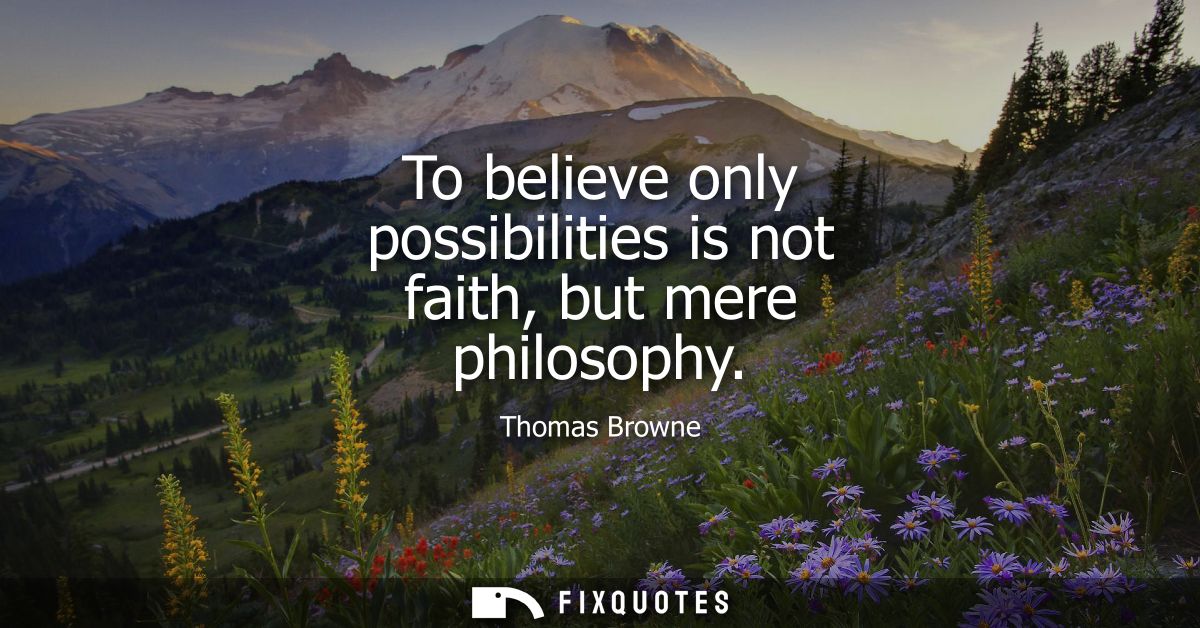
"To believe only possibilities is not faith, but mere philosophy"
About this Quote
Faith, Browne insists, begins where the mind’s safety rails end. “To believe only possibilities” is a jab at the cautious intellectual posture that accepts only what can be plausibly argued, probabilistically inferred, or hedged with conditions. That posture may be rigorous, even admirable, but Browne demotes it to “mere philosophy” because it never risks the embarrassment of commitment. Possibility is a roomy category: you can “believe” in it without being changed by it.
The line works because it turns the prestige of reason against itself. In an age when “new philosophy” meant Baconian method, telescopes, and anatomies, Browne - a working physician who also wrote with baroque piety - draws a boundary between explanation and surrender. Philosophy, in his framing, is the intellect staying in its lane, sorting what might be true. Faith is an existential leap: assent without the paperwork of proof, trust that has consequences, not just opinions.
Subtextually, Browne isn’t arguing for stupidity; he’s arguing against a kind of cleverness that mistakes skepticism for depth. “Only possibilities” describes a mind trained to keep every door ajar so it never has to walk through one. His target is the early modern temptation to let method colonize meaning: if something can’t be experimentally secured, treat it as optional.
Context matters: 17th-century England is rife with religious conflict and scientific ferment. Browne’s provocation defends belief as a distinct human mode, not a primitive version of science - and it needles the rising class of rationalists by suggesting their restraint is, spiritually speaking, a refusal to pay the price of certainty.
The line works because it turns the prestige of reason against itself. In an age when “new philosophy” meant Baconian method, telescopes, and anatomies, Browne - a working physician who also wrote with baroque piety - draws a boundary between explanation and surrender. Philosophy, in his framing, is the intellect staying in its lane, sorting what might be true. Faith is an existential leap: assent without the paperwork of proof, trust that has consequences, not just opinions.
Subtextually, Browne isn’t arguing for stupidity; he’s arguing against a kind of cleverness that mistakes skepticism for depth. “Only possibilities” describes a mind trained to keep every door ajar so it never has to walk through one. His target is the early modern temptation to let method colonize meaning: if something can’t be experimentally secured, treat it as optional.
Context matters: 17th-century England is rife with religious conflict and scientific ferment. Browne’s provocation defends belief as a distinct human mode, not a primitive version of science - and it needles the rising class of rationalists by suggesting their restraint is, spiritually speaking, a refusal to pay the price of certainty.
Quote Details
| Topic | Faith |
|---|---|
| Source | Help us find the source |
| Cite |
Citation Formats
APA Style (7th ed.)
Browne, Thomas. (2026, January 15). To believe only possibilities is not faith, but mere philosophy. FixQuotes. https://fixquotes.com/quotes/to-believe-only-possibilities-is-not-faith-but-78473/
Chicago Style
Browne, Thomas. "To believe only possibilities is not faith, but mere philosophy." FixQuotes. January 15, 2026. https://fixquotes.com/quotes/to-believe-only-possibilities-is-not-faith-but-78473/.
MLA Style (9th ed.)
"To believe only possibilities is not faith, but mere philosophy." FixQuotes, 15 Jan. 2026, https://fixquotes.com/quotes/to-believe-only-possibilities-is-not-faith-but-78473/. Accessed 26 Mar. 2026.
More Quotes by Thomas
Add to List