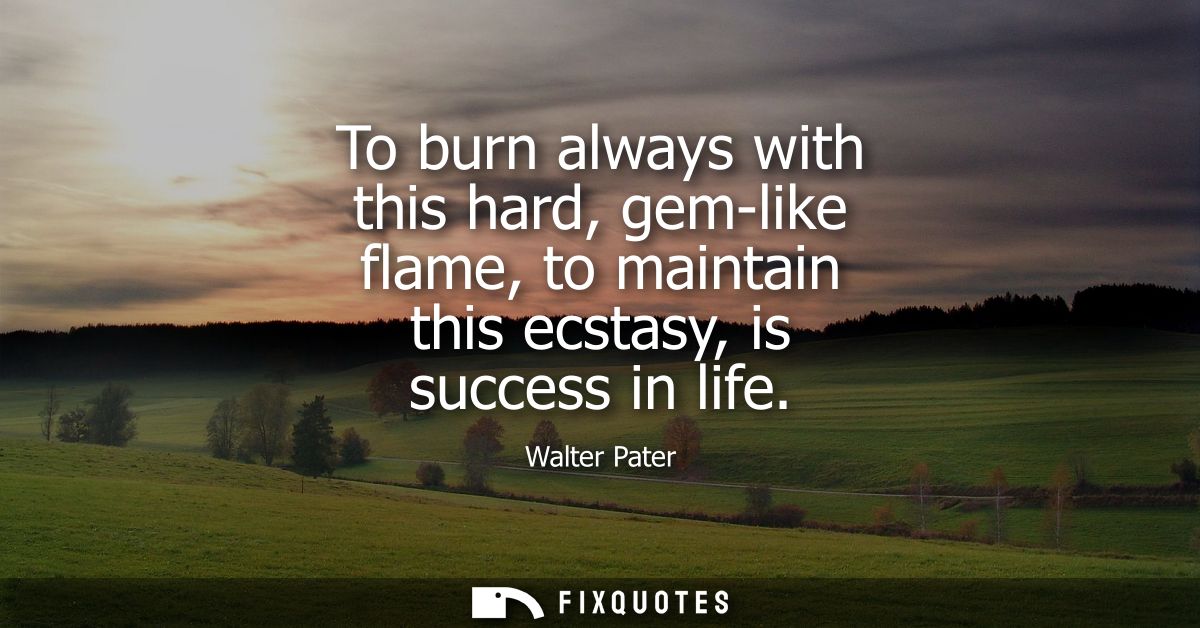
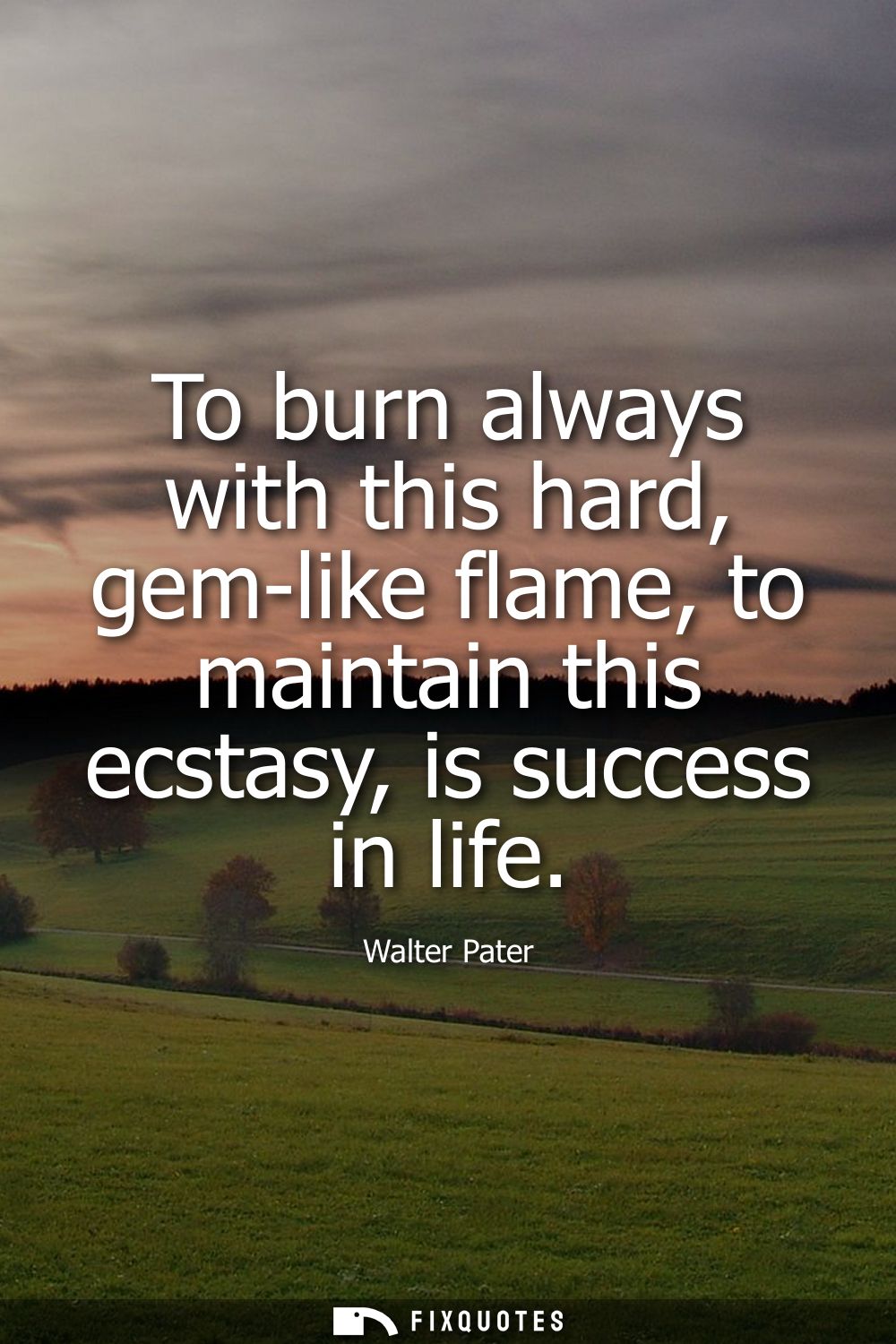
"To burn always with this hard, gem-like flame, to maintain this ecstasy, is success in life"
About this Quote
The subtext is quietly insurgent against Victorian moral bookkeeping. In a culture obsessed with duty, progress, and respectable narratives of self-improvement, Pater reframes “success” as private, interior, and basically non-transferable. It’s not social climbing or moral purity; it’s sustained aliveness. The provocation is in “maintain.” Ecstasy isn’t an accident here, it’s upkeep. That word smuggles in labor: attention, taste, self-curation, and a refusal to let habit blunt the senses.
Context matters: this comes out of The Renaissance (1873), the aesthetic movement’s manifesto-adjacent zone, where art’s purpose shifts from instruction to experience. Pater’s critics heard decadence; his admirers heard liberation. Either way, the line works because it compresses a whole philosophy into a tactile image: a flame you can see and a gem you can turn in your hand. It flatters the reader with a harder task than virtue: to live deliberately, intensely, and without outsourcing value to the crowd.
Quote Details
| Topic | Meaning of Life |
|---|---|
| Source | Verified source: Studies in the History of the Renaissance (Walter Pater, 1873)
Evidence: To burn always with this hard, gem-like flame, to maintain this ecstasy, is success in life. (Conclusion, page 194). The quote appears in Walter Pater's own book Studies in the History of the Renaissance (first edition, 1873), in the closing essay titled "Conclusion." Google Books bibliographic data for the 1873 Macmillan edition shows the book title, publisher, year, and that "Conclusion" begins on page 189; the same scanned record lists nearby passages from the conclusion on pages 193-196, placing this sentence on page 194. Later editions retitled the book The Renaissance: Studies in Art and Poetry, but the earliest verified primary-source appearance is the 1873 first edition. Other candidates (1) The Reception of Walter Pater in Europe (Stephen Bann, 2004) compilation93.8% ... Pater's famous ' To burn always with this hard , gem - like flame , to maintain this ecstasy , is success in life... |
| Cite |
Citation Formats
APA Style (7th ed.)
Pater, Walter. (2026, March 7). To burn always with this hard, gem-like flame, to maintain this ecstasy, is success in life. FixQuotes. https://fixquotes.com/quotes/to-burn-always-with-this-hard-gem-like-flame-to-102881/
Chicago Style
Pater, Walter. "To burn always with this hard, gem-like flame, to maintain this ecstasy, is success in life." FixQuotes. March 7, 2026. https://fixquotes.com/quotes/to-burn-always-with-this-hard-gem-like-flame-to-102881/.
MLA Style (9th ed.)
"To burn always with this hard, gem-like flame, to maintain this ecstasy, is success in life." FixQuotes, 7 Mar. 2026, https://fixquotes.com/quotes/to-burn-always-with-this-hard-gem-like-flame-to-102881/. Accessed 3 Apr. 2026.