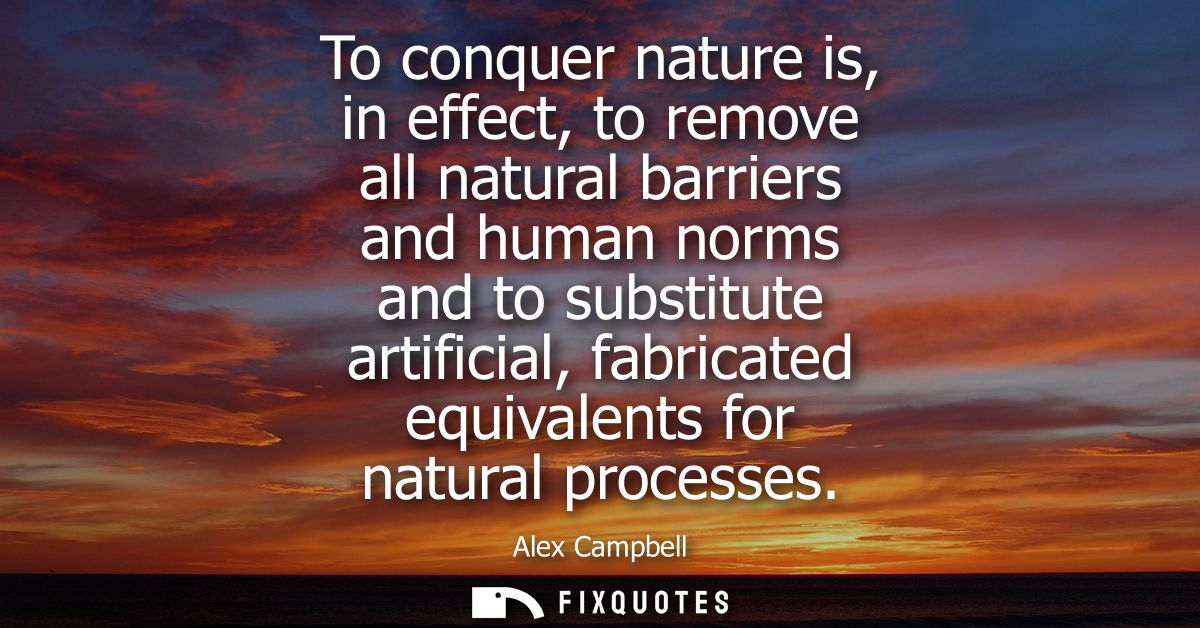
"To conquer nature is, in effect, to remove all natural barriers and human norms and to substitute artificial, fabricated equivalents for natural processes"
About this Quote
The line’s bite is in its pairing of "natural barriers" with "human norms". Campbell implies that nature isn’t merely external scenery; it’s an old co-author of culture. Seasons, scarcity, distance, disease, and geography have historically disciplined behavior and shaped morals, family structures, work rhythms, even political expectations. When technology erases those constraints, it also quietly unhooks the social agreements built around them. The "artificial, fabricated equivalents" aren’t neutral tools; they are new regimes - engineered systems with owners, maintenance costs, failure modes, and politics.
As a politician, Campbell’s likely intent is cautionary rather than anti-modern: a reminder that every act of environmental "progress" creates dependency on infrastructure and expertise, and shifts power toward whoever controls the replacement systems. The subtext is risk: when you swap resilient natural processes for brittle human-made ones, you inherit the obligation to keep the machine running forever - and the bill comes due in crises, inequities, and contested authority.
Quote Details
| Topic | Technology |
|---|---|
| Source | Help us find the source |
| Cite |
Citation Formats
APA Style (7th ed.)
Campbell, Alex. (2026, January 17). To conquer nature is, in effect, to remove all natural barriers and human norms and to substitute artificial, fabricated equivalents for natural processes. FixQuotes. https://fixquotes.com/quotes/to-conquer-nature-is-in-effect-to-remove-all-42466/
Chicago Style
Campbell, Alex. "To conquer nature is, in effect, to remove all natural barriers and human norms and to substitute artificial, fabricated equivalents for natural processes." FixQuotes. January 17, 2026. https://fixquotes.com/quotes/to-conquer-nature-is-in-effect-to-remove-all-42466/.
MLA Style (9th ed.)
"To conquer nature is, in effect, to remove all natural barriers and human norms and to substitute artificial, fabricated equivalents for natural processes." FixQuotes, 17 Jan. 2026, https://fixquotes.com/quotes/to-conquer-nature-is-in-effect-to-remove-all-42466/. Accessed 12 Feb. 2026.