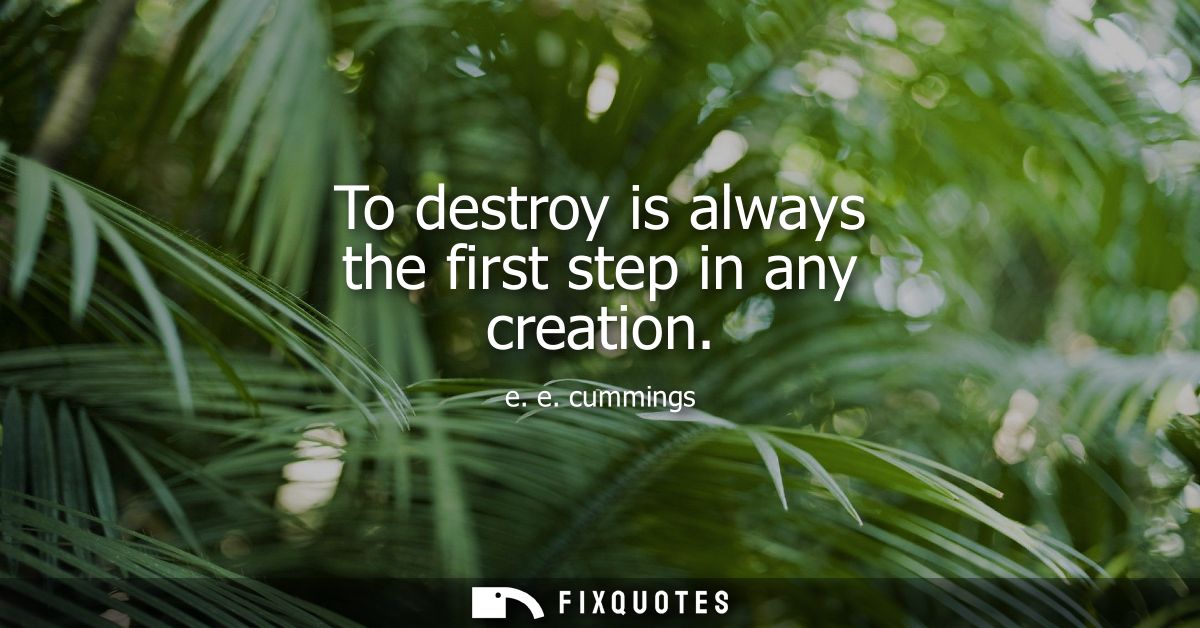
"To destroy is always the first step in any creation"
About this Quote
Creation doesn’t stroll in politely; it kicks the door in. Cummings’s line treats destruction not as a regrettable side effect but as the opening move, the necessary clearing of space before anything genuinely new can happen. Coming from a poet who made a career out of breaking the rules of English typography and syntax, the statement reads less like a gloomy aphorism and more like an artistic manifesto: you don’t get new music by playing old scales perfectly, you get it by snapping the scale in half and listening for what survives.
The subtext is an attack on complacent “craft” that mistakes polish for invention. “Always” is the provocation: not sometimes, not for the avant-garde only, but as a law of making. Cummings is smuggling in a theory of attention. We’re so trained to read, feel, and think along inherited grooves that the first act of creativity is subtraction: scraping off the automatic responses, demolishing the pre-made meanings, refusing the polite sentence that arrives already socialized. Destruction here isn’t nihilism; it’s editing with teeth.
Context matters. Cummings lived through World War I, served as an ambulance driver, and was swept into the modernist revolt that followed the era’s mechanical slaughter and spiritual exhaustion. When the old orders revealed their rot, artists stopped trusting continuity. So the line carries an ethical edge: if the existing forms are complicit - in dead language, dead politics, dead feeling - then breaking them becomes a kind of honesty. The risk, of course, is mistaking demolition for architecture. Cummings’s best work answers that by turning wreckage into a new grammar of intimacy.
The subtext is an attack on complacent “craft” that mistakes polish for invention. “Always” is the provocation: not sometimes, not for the avant-garde only, but as a law of making. Cummings is smuggling in a theory of attention. We’re so trained to read, feel, and think along inherited grooves that the first act of creativity is subtraction: scraping off the automatic responses, demolishing the pre-made meanings, refusing the polite sentence that arrives already socialized. Destruction here isn’t nihilism; it’s editing with teeth.
Context matters. Cummings lived through World War I, served as an ambulance driver, and was swept into the modernist revolt that followed the era’s mechanical slaughter and spiritual exhaustion. When the old orders revealed their rot, artists stopped trusting continuity. So the line carries an ethical edge: if the existing forms are complicit - in dead language, dead politics, dead feeling - then breaking them becomes a kind of honesty. The risk, of course, is mistaking demolition for architecture. Cummings’s best work answers that by turning wreckage into a new grammar of intimacy.
Quote Details
| Topic | Change |
|---|---|
| Source | Help us find the source |
| Cite |
Citation Formats
APA Style (7th ed.)
Cummings, E. E. (2026, January 17). To destroy is always the first step in any creation. FixQuotes. https://fixquotes.com/quotes/to-destroy-is-always-the-first-step-in-any-29025/
Chicago Style
Cummings, E. E. "To destroy is always the first step in any creation." FixQuotes. January 17, 2026. https://fixquotes.com/quotes/to-destroy-is-always-the-first-step-in-any-29025/.
MLA Style (9th ed.)
"To destroy is always the first step in any creation." FixQuotes, 17 Jan. 2026, https://fixquotes.com/quotes/to-destroy-is-always-the-first-step-in-any-29025/. Accessed 28 Mar. 2026.
More Quotes by E. Cummings
Add to List