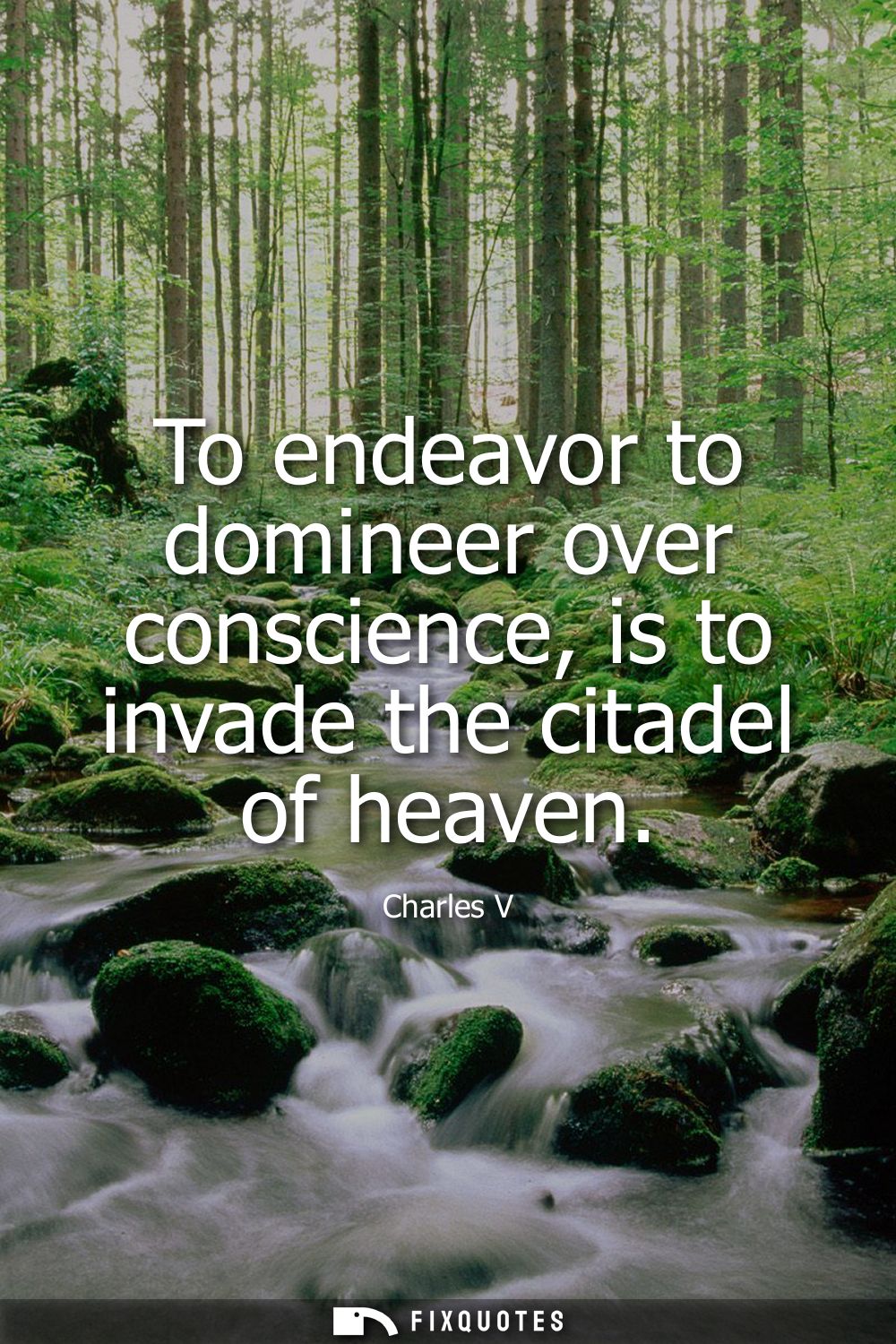
"To endeavor to domineer over conscience is to invade the citadel of heaven"
About this Quote
That’s an especially loaded posture for Charles V, the Holy Roman Emperor presiding over Europe as it tore itself apart in the Reformation. His reign sat at the collision point of Catholic universality, Protestant rupture, and the early modern state’s growing temptation to standardize faith as a tool of stability. The quote reads like a pious limit on coercion, a warning to princes (and to himself) that the legitimacy of rule has a ceiling: you can tax bodies and draft armies, but you can’t conscript souls without trespassing into divine jurisdiction.
The subtext is strategic as much as spiritual. By declaring conscience off-limits, Charles invokes a higher court than politics, one that can restrain fanaticism while still protecting the aura of sacred monarchy. It’s a line that tries to save order by conceding an inner frontier the state cannot safely occupy.
Quote Details
| Topic | Ethics & Morality |
|---|---|
| Source | Help us find the source |
| Cite |
Citation Formats
APA Style (7th ed.)
V, Charles. (2026, February 16). To endeavor to domineer over conscience is to invade the citadel of heaven. FixQuotes. https://fixquotes.com/quotes/to-endeavor-to-domineer-over-conscience-is-to-145620/
Chicago Style
V, Charles. "To endeavor to domineer over conscience is to invade the citadel of heaven." FixQuotes. February 16, 2026. https://fixquotes.com/quotes/to-endeavor-to-domineer-over-conscience-is-to-145620/.
MLA Style (9th ed.)
"To endeavor to domineer over conscience is to invade the citadel of heaven." FixQuotes, 16 Feb. 2026, https://fixquotes.com/quotes/to-endeavor-to-domineer-over-conscience-is-to-145620/. Accessed 22 Mar. 2026.