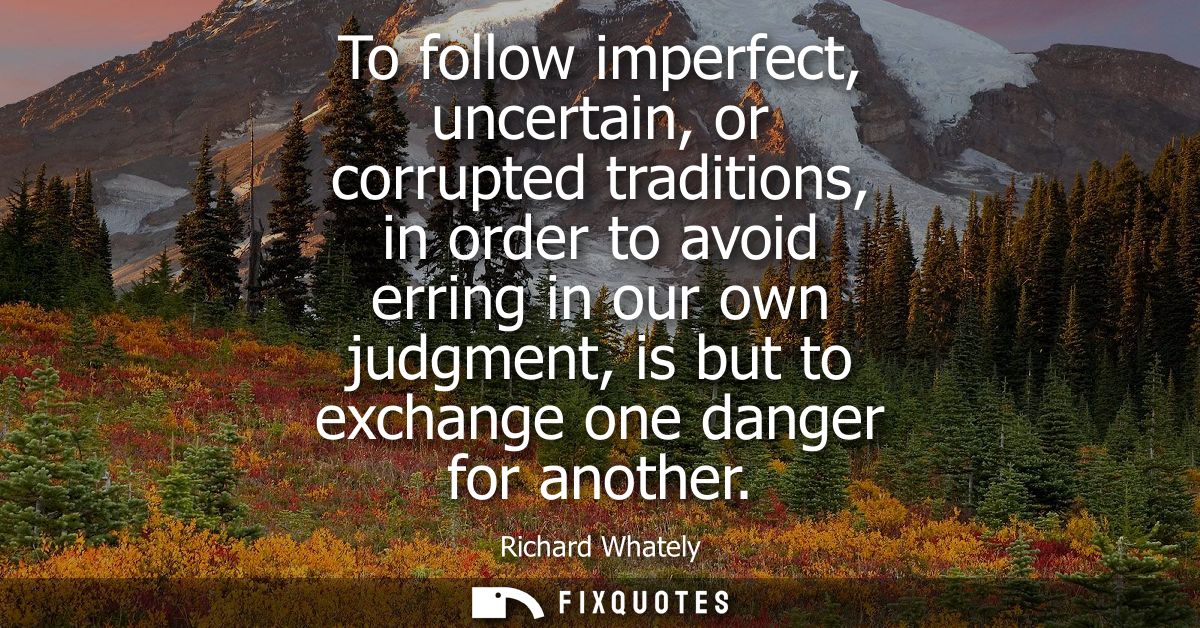
"To follow imperfect, uncertain, or corrupted traditions, in order to avoid erring in our own judgment, is but to exchange one danger for another"
About this Quote
The phrasing does a lot of quiet work. “To follow” suggests momentum and habit, not active assent. The pile-up of adjectives - imperfect, uncertain, corrupted - widens the net from harmless flaws to outright moral rot, implying that traditions can degrade without losing their authority’s sheen. Then comes the psychological tell: “in order to avoid erring in our own judgment.” He’s naming the motive as fear, not wisdom. The punch lands in the final clause, which refuses the fantasy of a risk-free option: you’re not choosing between danger and safety, only between dangers.
Context matters. Whately, an Anglican thinker writing in a Britain wrestling with reform, Catholic emancipation, and the authority of church and institution, is speaking to a culture that often treated inherited practice as self-justifying. His subtext is not anarchic iconoclasm; it’s accountability. If you hide behind precedent, you still own the consequences. The moral burden doesn’t vanish when you cite tradition - it just moves to a different filing cabinet.
Quote Details
| Topic | Reason & Logic |
|---|---|
| Source | Help us find the source |
| Cite |
Citation Formats
APA Style (7th ed.)
Whately, Richard. (2026, January 16). To follow imperfect, uncertain, or corrupted traditions, in order to avoid erring in our own judgment, is but to exchange one danger for another. FixQuotes. https://fixquotes.com/quotes/to-follow-imperfect-uncertain-or-corrupted-105884/
Chicago Style
Whately, Richard. "To follow imperfect, uncertain, or corrupted traditions, in order to avoid erring in our own judgment, is but to exchange one danger for another." FixQuotes. January 16, 2026. https://fixquotes.com/quotes/to-follow-imperfect-uncertain-or-corrupted-105884/.
MLA Style (9th ed.)
"To follow imperfect, uncertain, or corrupted traditions, in order to avoid erring in our own judgment, is but to exchange one danger for another." FixQuotes, 16 Jan. 2026, https://fixquotes.com/quotes/to-follow-imperfect-uncertain-or-corrupted-105884/. Accessed 12 Feb. 2026.