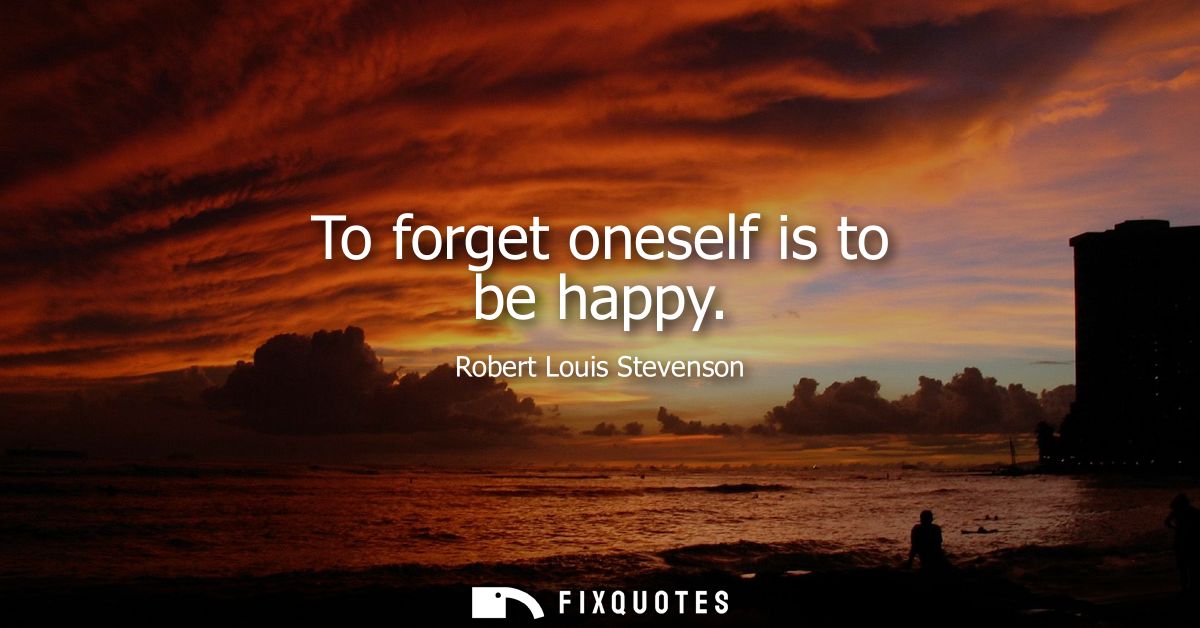
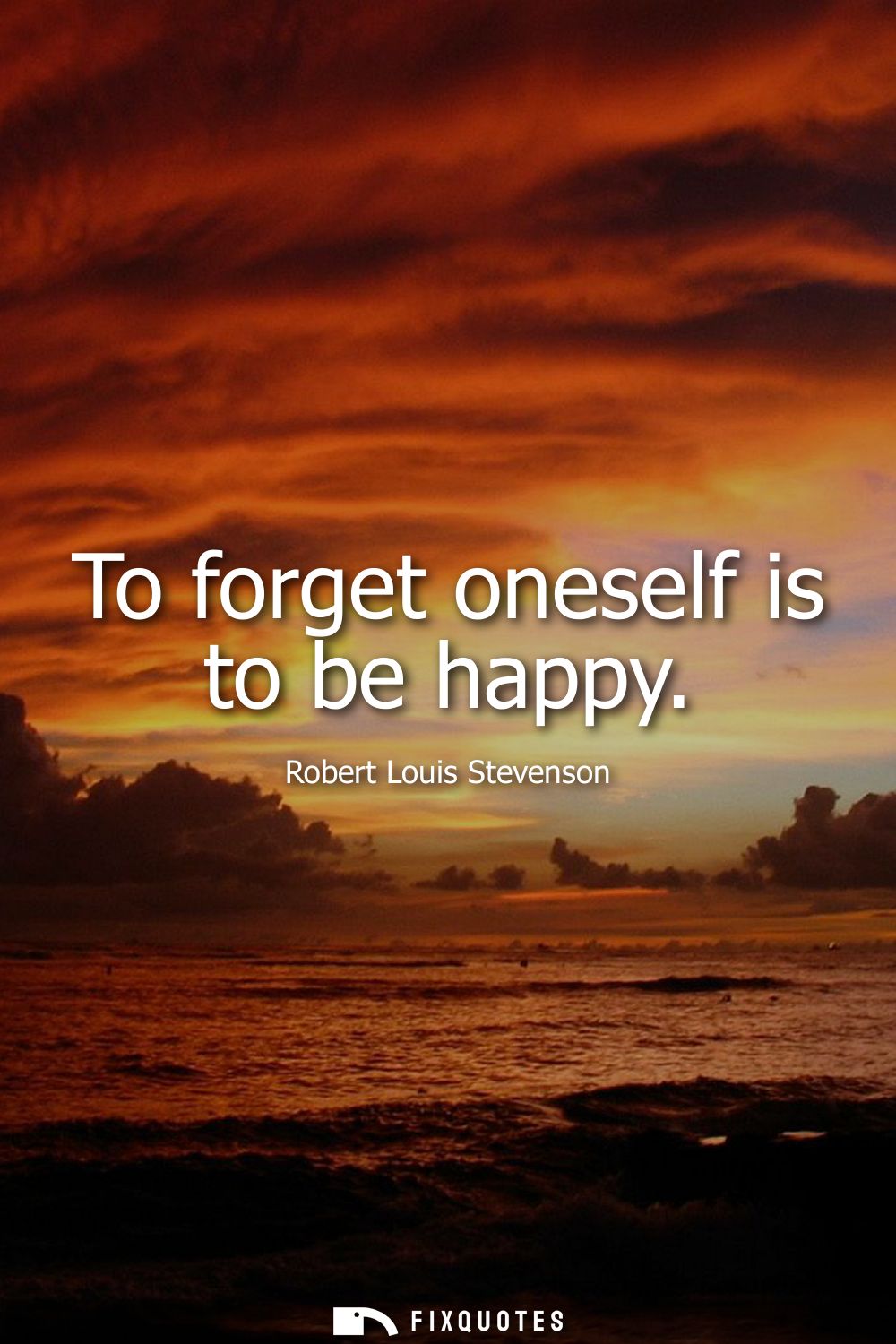
"To forget oneself is to be happy"
About this Quote
Happiness, Stevenson suggests, isn`t something you hunt down by staring harder at your own feelings; it arrives when you stop making yourself the main character. "To forget oneself" reads like a small act of escape, but it`s really a discipline: attention redirected outward, away from the anxious bookkeeping of ego. The line works because it`s counterintuitive in a culture that treats self-knowledge as the royal road to well-being. Stevenson flips that script. The self, in his framing, isn`t a treasure to excavate so much as a trap to step out of.
The subtext is quietly moral. Forgetting oneself isn`t self-erasure or denial; it`s a refusal of vanity, rumination, and the kind of introspection that curdles into performance. It`s also an aesthetic credo. Stevenson, a novelist who built worlds and characters, understood how absorbing it is to leave your own head and inhabit another life, another landscape. There`s a writerly conviction here that attention is finite, and where you spend it determines whether you feel expanded or pinched.
Context sharpens the stakes. Late-Victorian Britain was steeped in self-improvement, propriety, and the emerging language of psychology. Stevenson, often ill and perpetually in motion, had reasons to distrust the inward gaze: sickness can make the self inescapably loud. Against that backdrop, the aphorism lands as a practical counterspell. Stop narrating yourself. Do the work, make the thing, love someone, walk outside. Happiness, for Stevenson, isn`t a mood you manufacture; it`s the byproduct of temporarily losing the obsession with "me."
The subtext is quietly moral. Forgetting oneself isn`t self-erasure or denial; it`s a refusal of vanity, rumination, and the kind of introspection that curdles into performance. It`s also an aesthetic credo. Stevenson, a novelist who built worlds and characters, understood how absorbing it is to leave your own head and inhabit another life, another landscape. There`s a writerly conviction here that attention is finite, and where you spend it determines whether you feel expanded or pinched.
Context sharpens the stakes. Late-Victorian Britain was steeped in self-improvement, propriety, and the emerging language of psychology. Stevenson, often ill and perpetually in motion, had reasons to distrust the inward gaze: sickness can make the self inescapably loud. Against that backdrop, the aphorism lands as a practical counterspell. Stop narrating yourself. Do the work, make the thing, love someone, walk outside. Happiness, for Stevenson, isn`t a mood you manufacture; it`s the byproduct of temporarily losing the obsession with "me."
Quote Details
| Topic | Happiness |
|---|---|
| Source | Help us find the source |
| Cite |
Citation Formats
APA Style (7th ed.)
Stevenson, Robert Louis. (2026, January 18). To forget oneself is to be happy. FixQuotes. https://fixquotes.com/quotes/to-forget-oneself-is-to-be-happy-20853/
Chicago Style
Stevenson, Robert Louis. "To forget oneself is to be happy." FixQuotes. January 18, 2026. https://fixquotes.com/quotes/to-forget-oneself-is-to-be-happy-20853/.
MLA Style (9th ed.)
"To forget oneself is to be happy." FixQuotes, 18 Jan. 2026, https://fixquotes.com/quotes/to-forget-oneself-is-to-be-happy-20853/. Accessed 8 Apr. 2026.
More Quotes by Robert
Add to List