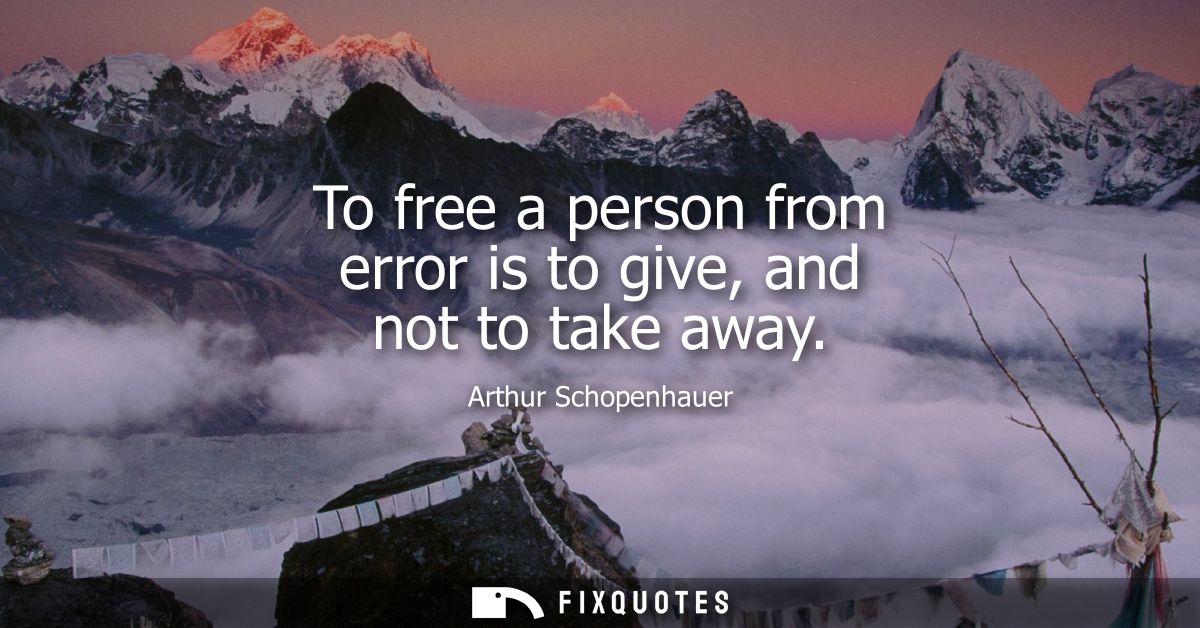
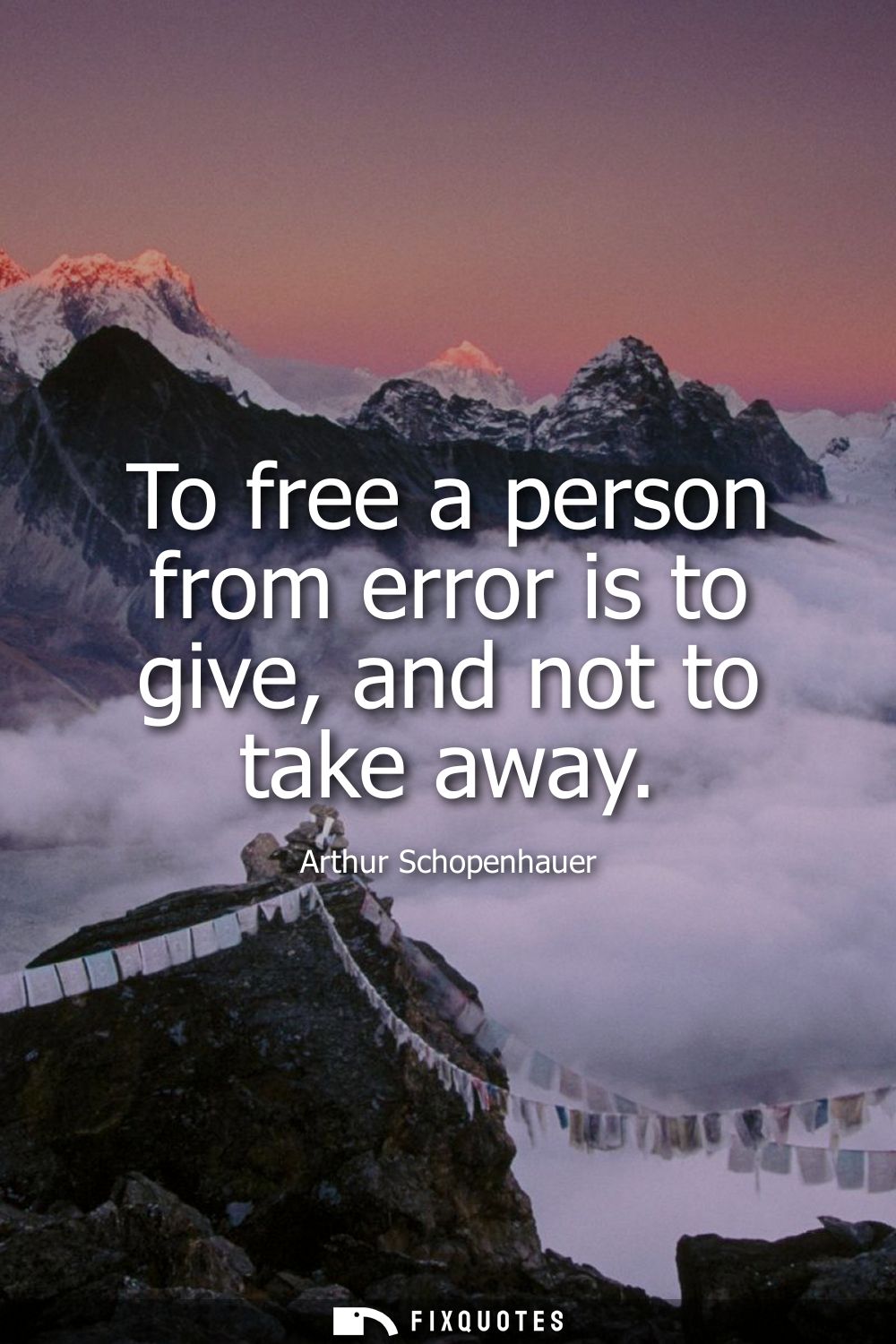
"To free a person from error is to give, and not to take away"
About this Quote
Schopenhauer flips the usual drama of being corrected. We treat error like property: mine, hard-won, part of my identity. Strip it away and you’ve committed a small theft. His line insists on the opposite moral accounting. If someone is living inside a mistake, the correction isn’t deprivation; it’s a gift - a transfer of clarity, agency, and options.
The intent is quietly combative. Schopenhauer knows how correction lands in real life: as humiliation, as status loss, as an assault on pride. So he reframes the act as generosity, not domination. That shift isn’t just etiquette; it’s strategy. If truth is going to be heard, it needs a social wrapper that doesn’t trigger the ego’s immune system. The subtext: we cling to error because it protects us. It offers coherence, excuses, a story where we’re not wrong. Pulling that support away can feel like tearing down a shelter. Schopenhauer argues that shelter is also a cage.
Context matters because Schopenhauer is not a sunny Enlightenment booster. His philosophy is famously pessimistic about human rationality and our willingness to see things plainly. Precisely because people are driven by will, vanity, and self-deception, freeing someone from error becomes an ethical act with real cost. It requires patience, tact, and sometimes the courage to be disliked. The line carries an implicit rebuke to smug “debunking”: if you’re truly giving, you’re responsible for how the gift is delivered - and for the human who has to live without the comforting lie.
The intent is quietly combative. Schopenhauer knows how correction lands in real life: as humiliation, as status loss, as an assault on pride. So he reframes the act as generosity, not domination. That shift isn’t just etiquette; it’s strategy. If truth is going to be heard, it needs a social wrapper that doesn’t trigger the ego’s immune system. The subtext: we cling to error because it protects us. It offers coherence, excuses, a story where we’re not wrong. Pulling that support away can feel like tearing down a shelter. Schopenhauer argues that shelter is also a cage.
Context matters because Schopenhauer is not a sunny Enlightenment booster. His philosophy is famously pessimistic about human rationality and our willingness to see things plainly. Precisely because people are driven by will, vanity, and self-deception, freeing someone from error becomes an ethical act with real cost. It requires patience, tact, and sometimes the courage to be disliked. The line carries an implicit rebuke to smug “debunking”: if you’re truly giving, you’re responsible for how the gift is delivered - and for the human who has to live without the comforting lie.
Quote Details
| Topic | Truth |
|---|---|
| Source | Help us find the source |
| Cite |
Citation Formats
APA Style (7th ed.)
Schopenhauer, Arthur. (2026, January 17). To free a person from error is to give, and not to take away. FixQuotes. https://fixquotes.com/quotes/to-free-a-person-from-error-is-to-give-and-not-to-35127/
Chicago Style
Schopenhauer, Arthur. "To free a person from error is to give, and not to take away." FixQuotes. January 17, 2026. https://fixquotes.com/quotes/to-free-a-person-from-error-is-to-give-and-not-to-35127/.
MLA Style (9th ed.)
"To free a person from error is to give, and not to take away." FixQuotes, 17 Jan. 2026, https://fixquotes.com/quotes/to-free-a-person-from-error-is-to-give-and-not-to-35127/. Accessed 23 Mar. 2026.
More Quotes by Arthur
Add to List