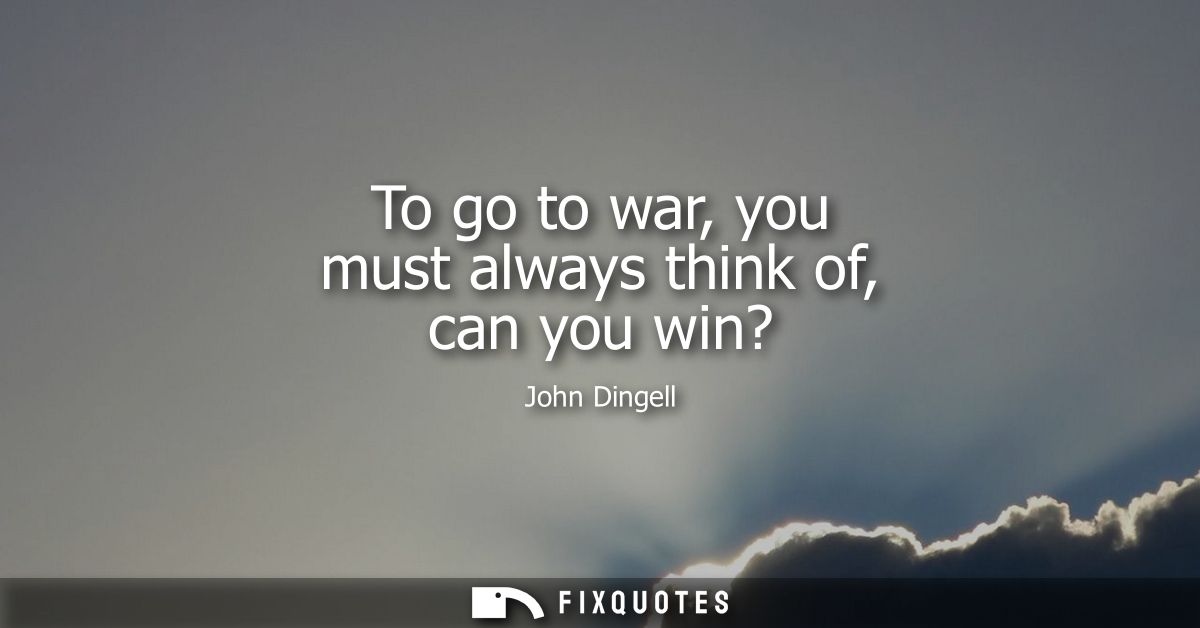
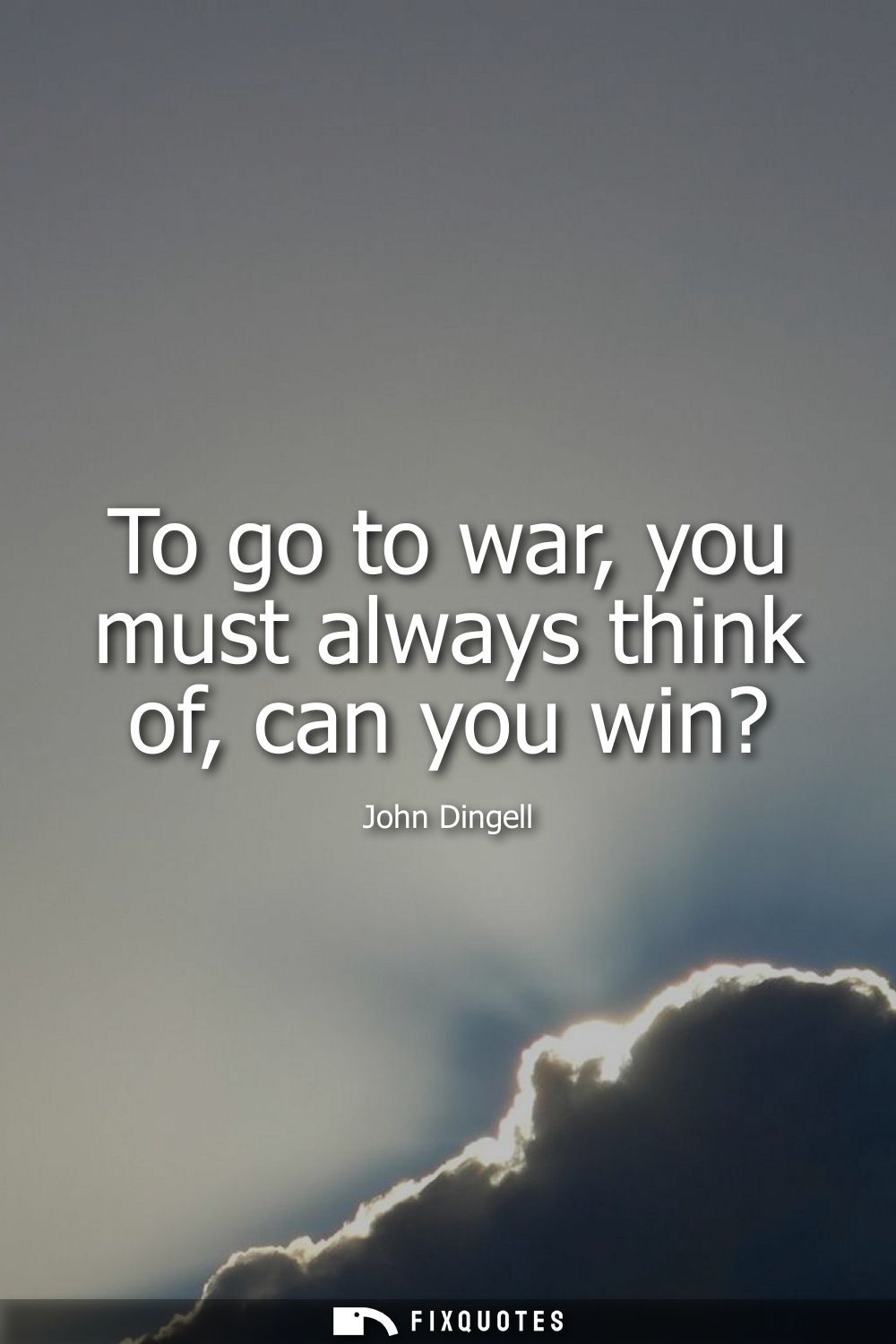
"To go to war, you must always think of, can you win?"
About this Quote
War isn’t framed here as destiny or moral theater; it’s framed as a competence test. Dingell’s line slices through the intoxicating language that often sells military action - honor, resolve, credibility - and drags the question back to something blunt: winning. Coming from a politician who spent decades watching administrations justify conflicts with lofty abstractions, the sentence reads like a rebuke to the Washington habit of treating war as a posture rather than an outcome.
The intent is preventative. It’s not pacifism, exactly; it’s a demand that leaders do the grown-up work before the first vote, briefing, or flag-draped speech. “Must always” is doing heavy lifting: it signals that this isn’t situational advice but a standing rule, the kind learned from history’s repeat offenders. The subtext is that the U.S. too often starts wars on faith - faith that technology will substitute for strategy, that alliances will hold, that local politics will cooperate, that “shock and awe” will become stability on autopilot.
The phrasing matters. Dingell doesn’t say “Should we win?” but “can you win?” It’s a question about capability, clarity, and costs: What does winning mean? Who defines it? How long will it take? What happens after? In the late-20th and early-21st century American context - Vietnam’s lesson, Iraq’s hangover, Afghanistan’s drift - it’s a quiet indictment of wars launched with maximal confidence and minimal definition. He’s warning that the most dangerous lie in politics is that war is something you can start precisely and end vaguely.
The intent is preventative. It’s not pacifism, exactly; it’s a demand that leaders do the grown-up work before the first vote, briefing, or flag-draped speech. “Must always” is doing heavy lifting: it signals that this isn’t situational advice but a standing rule, the kind learned from history’s repeat offenders. The subtext is that the U.S. too often starts wars on faith - faith that technology will substitute for strategy, that alliances will hold, that local politics will cooperate, that “shock and awe” will become stability on autopilot.
The phrasing matters. Dingell doesn’t say “Should we win?” but “can you win?” It’s a question about capability, clarity, and costs: What does winning mean? Who defines it? How long will it take? What happens after? In the late-20th and early-21st century American context - Vietnam’s lesson, Iraq’s hangover, Afghanistan’s drift - it’s a quiet indictment of wars launched with maximal confidence and minimal definition. He’s warning that the most dangerous lie in politics is that war is something you can start precisely and end vaguely.
Quote Details
| Topic | War |
|---|---|
| Source | Help us find the source |
| Cite |
Citation Formats
APA Style (7th ed.)
Dingell, John. (2026, January 17). To go to war, you must always think of, can you win? FixQuotes. https://fixquotes.com/quotes/to-go-to-war-you-must-always-think-of-can-you-win-56774/
Chicago Style
Dingell, John. "To go to war, you must always think of, can you win?" FixQuotes. January 17, 2026. https://fixquotes.com/quotes/to-go-to-war-you-must-always-think-of-can-you-win-56774/.
MLA Style (9th ed.)
"To go to war, you must always think of, can you win?" FixQuotes, 17 Jan. 2026, https://fixquotes.com/quotes/to-go-to-war-you-must-always-think-of-can-you-win-56774/. Accessed 5 Feb. 2026.
More Quotes by John
Add to List