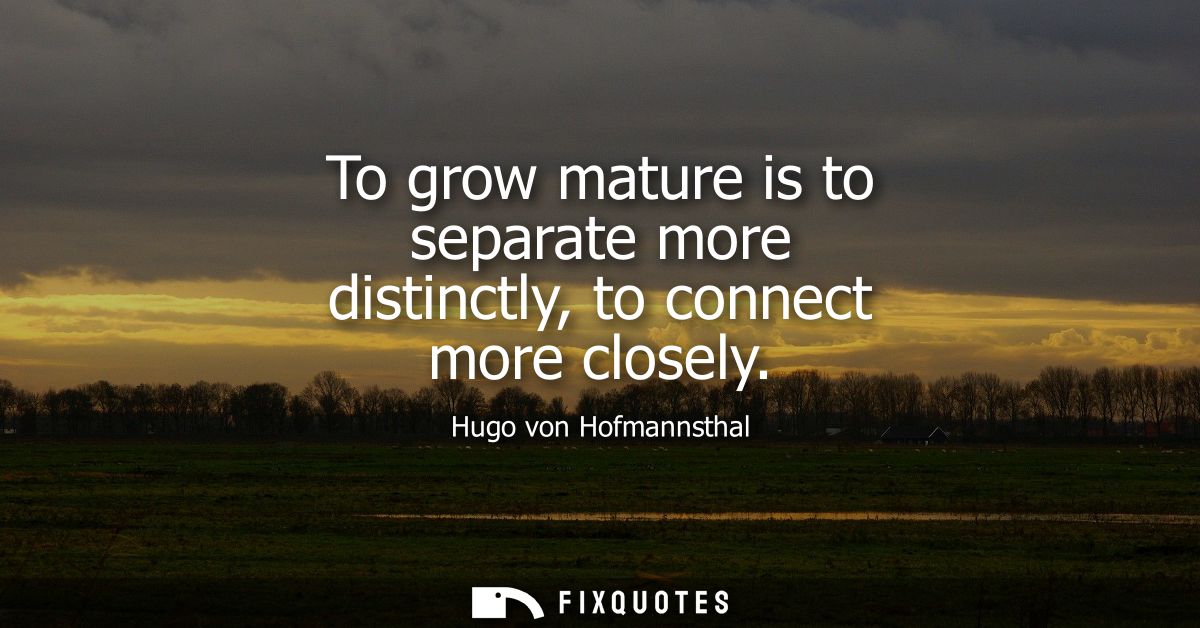
"To grow mature is to separate more distinctly, to connect more closely"
About this Quote
The intent is diagnostic, not inspirational. “Separate more distinctly” suggests the adult task of discrimination: between your desires and other people’s expectations, between roles you can perform and convictions you can’t betray, between mere intimacy and real allegiance. That’s not cynicism; it’s precision. The second clause is the payoff: once you can see clearly where you end, you can connect without self-erasure. Closeness becomes chosen rather than accidental.
The subtext has a fin-de-siecle bite. Hofmannsthal wrote in a culture anxious about the self: Vienna’s polished surfaces, social performance, and a growing sense that language itself was failing to carry inner life (his famous “Lord Chandos” crisis sits nearby). In that atmosphere, “mature” is a quiet revolt against both romantic over-identification and modern alienation. He sketches adulthood as an ethics of relation: separation that makes responsibility possible, connection that isn’t a costume. The sentence is balanced like a hinge, insisting that real community depends on a clarified self, not a diluted one.
Quote Details
| Topic | Self-Improvement |
|---|---|
| Source | Help us find the source |
| Cite |
Citation Formats
APA Style (7th ed.)
Hofmannsthal, Hugo von. (2026, January 16). To grow mature is to separate more distinctly, to connect more closely. FixQuotes. https://fixquotes.com/quotes/to-grow-mature-is-to-separate-more-distinctly-to-126945/
Chicago Style
Hofmannsthal, Hugo von. "To grow mature is to separate more distinctly, to connect more closely." FixQuotes. January 16, 2026. https://fixquotes.com/quotes/to-grow-mature-is-to-separate-more-distinctly-to-126945/.
MLA Style (9th ed.)
"To grow mature is to separate more distinctly, to connect more closely." FixQuotes, 16 Jan. 2026, https://fixquotes.com/quotes/to-grow-mature-is-to-separate-more-distinctly-to-126945/. Accessed 28 Mar. 2026.