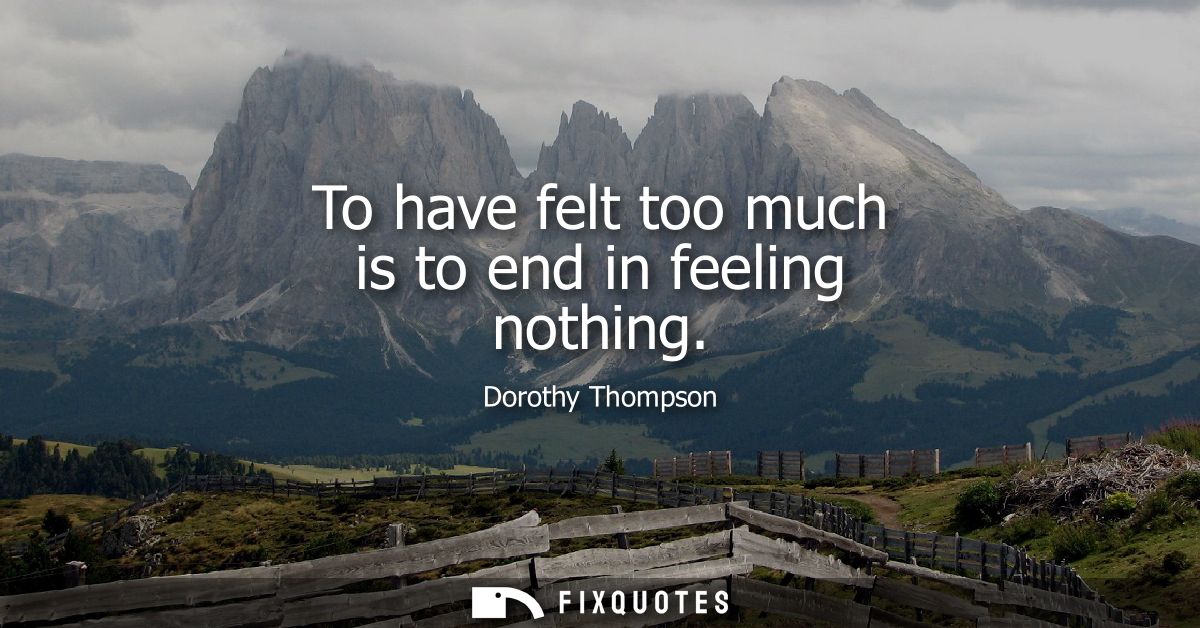
"To have felt too much is to end in feeling nothing"
About this Quote
Emotional exhaustion is the quiet punchline hiding inside Thompson's line: a warning that intensity, ungoverned, curdles into numbness. Coming from a journalist who made her career out of witnessing catastrophe up close, it reads less like a romantic sigh and more like occupational diagnosis. The sentence is built like a trap. "To have felt too much" sounds, at first blush, like moral praise - empathy, sensitivity, the good liberal virtues. Then Thompson snaps the hinge: the destination isn't wisdom, it's deadness.
The subtext is about limits, and about the costs of constant exposure to human suffering as spectacle and news. Thompson reported in an era when mass politics and mass media were fusing into something volatile: fascism, propaganda, the machinery of fear. In that climate, feeling becomes both fuel and weapon. Public emotion is stoked to mobilize crowds; private emotion is drained by relentless crisis. The line anticipates what we'd now call compassion fatigue, but it lands harder because it refuses the therapeutic framing. "Feeling nothing" isn't self-care; it's a kind of defeat, a protective shell that also looks like moral failure.
There's also an implicit critique of performative sensitivity: if your identity is built on how deeply you react, you can burn through your own capacity to care. Thompson's intent is bracingly pragmatic. She isn't arguing for coldness; she's arguing for sustainability. In a world that profits from keeping you upset, the radical act may be rationing your feelings so they don't get rationed for you.
The subtext is about limits, and about the costs of constant exposure to human suffering as spectacle and news. Thompson reported in an era when mass politics and mass media were fusing into something volatile: fascism, propaganda, the machinery of fear. In that climate, feeling becomes both fuel and weapon. Public emotion is stoked to mobilize crowds; private emotion is drained by relentless crisis. The line anticipates what we'd now call compassion fatigue, but it lands harder because it refuses the therapeutic framing. "Feeling nothing" isn't self-care; it's a kind of defeat, a protective shell that also looks like moral failure.
There's also an implicit critique of performative sensitivity: if your identity is built on how deeply you react, you can burn through your own capacity to care. Thompson's intent is bracingly pragmatic. She isn't arguing for coldness; she's arguing for sustainability. In a world that profits from keeping you upset, the radical act may be rationing your feelings so they don't get rationed for you.
Quote Details
| Topic | Sadness |
|---|---|
| Source | Later attribution: American Cassandra: The Life of Dorothy Thompson (Peter Kurth, 2019) modern compilationID: kz2oDwAAQBAJ
Evidence:
... To have felt too much is to end in feeling nothing . Four years of loneliness and agony and work , all anodynes . The last terrible remembering in London ... But now it is the ratification of something that has been over and done with ... |
| Cite |
Citation Formats
APA Style (7th ed.)
Thompson, Dorothy. (2026, February 24). To have felt too much is to end in feeling nothing. FixQuotes. https://fixquotes.com/quotes/to-have-felt-too-much-is-to-end-in-feeling-nothing-59269/
Chicago Style
Thompson, Dorothy. "To have felt too much is to end in feeling nothing." FixQuotes. February 24, 2026. https://fixquotes.com/quotes/to-have-felt-too-much-is-to-end-in-feeling-nothing-59269/.
MLA Style (9th ed.)
"To have felt too much is to end in feeling nothing." FixQuotes, 24 Feb. 2026, https://fixquotes.com/quotes/to-have-felt-too-much-is-to-end-in-feeling-nothing-59269/. Accessed 18 Mar. 2026.
More Quotes by Dorothy
Add to List