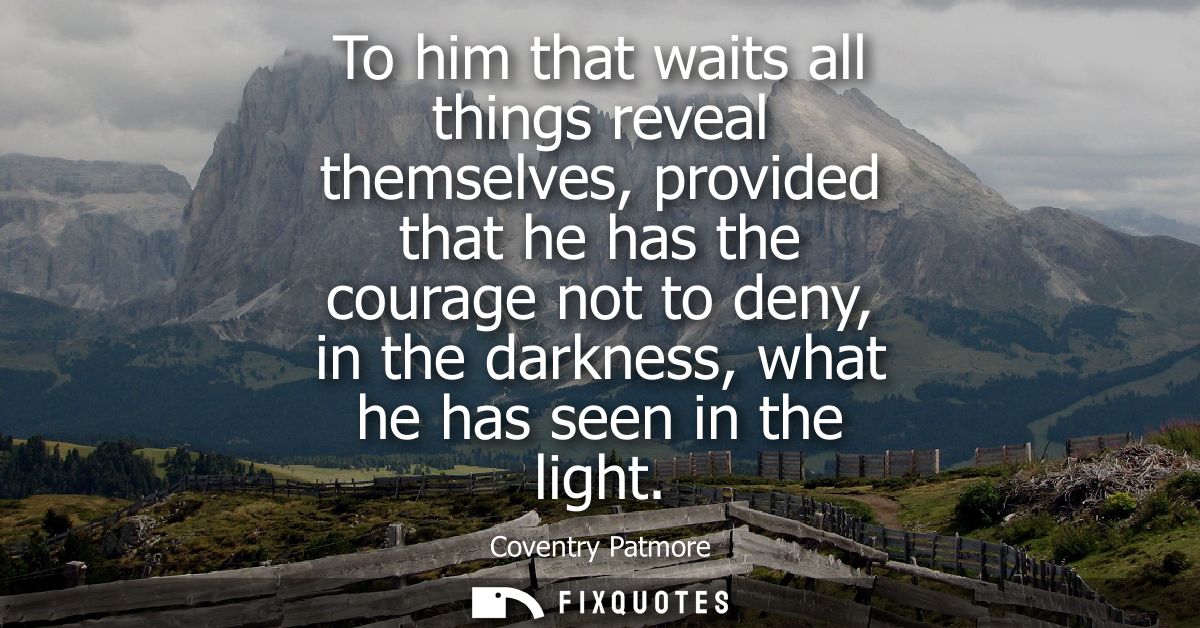
"To him that waits, all things reveal themselves, provided that he has the courage not to deny, in the darkness, what he has seen in the light"
About this Quote
The line’s emotional engine is its lighting metaphor. “Light” is the moment of clarity: conviction, love, faith, the sudden recognition that you know what you know. “Darkness” is everything that follows: social pressure, loneliness, doubt, the slow erosion of certainty. Patmore’s subtext is that the world doesn’t usually attack truth head-on; it invites you to deny it yourself. Denial becomes an act of self-protection, a way to avoid the consequences of what you once saw clearly.
As a poet writing in a century anxious about belief (science rising, religious confidence fraying, moral codes tightening), Patmore isn’t offering self-help so much as a spiritual psychology. He frames time as a revealer, but only if you don’t sabotage the process by capitulating to night-logic. Waiting, in this view, is not delay; it’s endurance. The real enemy isn’t ignorance. It’s the temptation to edit the past to make the present feel safer.
Quote Details
| Topic | Truth |
|---|---|
| Source | Help us find the source |
| Cite |
Citation Formats
APA Style (7th ed.)
Patmore, Coventry. (2026, February 16). To him that waits, all things reveal themselves, provided that he has the courage not to deny, in the darkness, what he has seen in the light. FixQuotes. https://fixquotes.com/quotes/to-him-that-waits-all-things-reveal-themselves-127388/
Chicago Style
Patmore, Coventry. "To him that waits, all things reveal themselves, provided that he has the courage not to deny, in the darkness, what he has seen in the light." FixQuotes. February 16, 2026. https://fixquotes.com/quotes/to-him-that-waits-all-things-reveal-themselves-127388/.
MLA Style (9th ed.)
"To him that waits, all things reveal themselves, provided that he has the courage not to deny, in the darkness, what he has seen in the light." FixQuotes, 16 Feb. 2026, https://fixquotes.com/quotes/to-him-that-waits-all-things-reveal-themselves-127388/. Accessed 30 Mar. 2026.