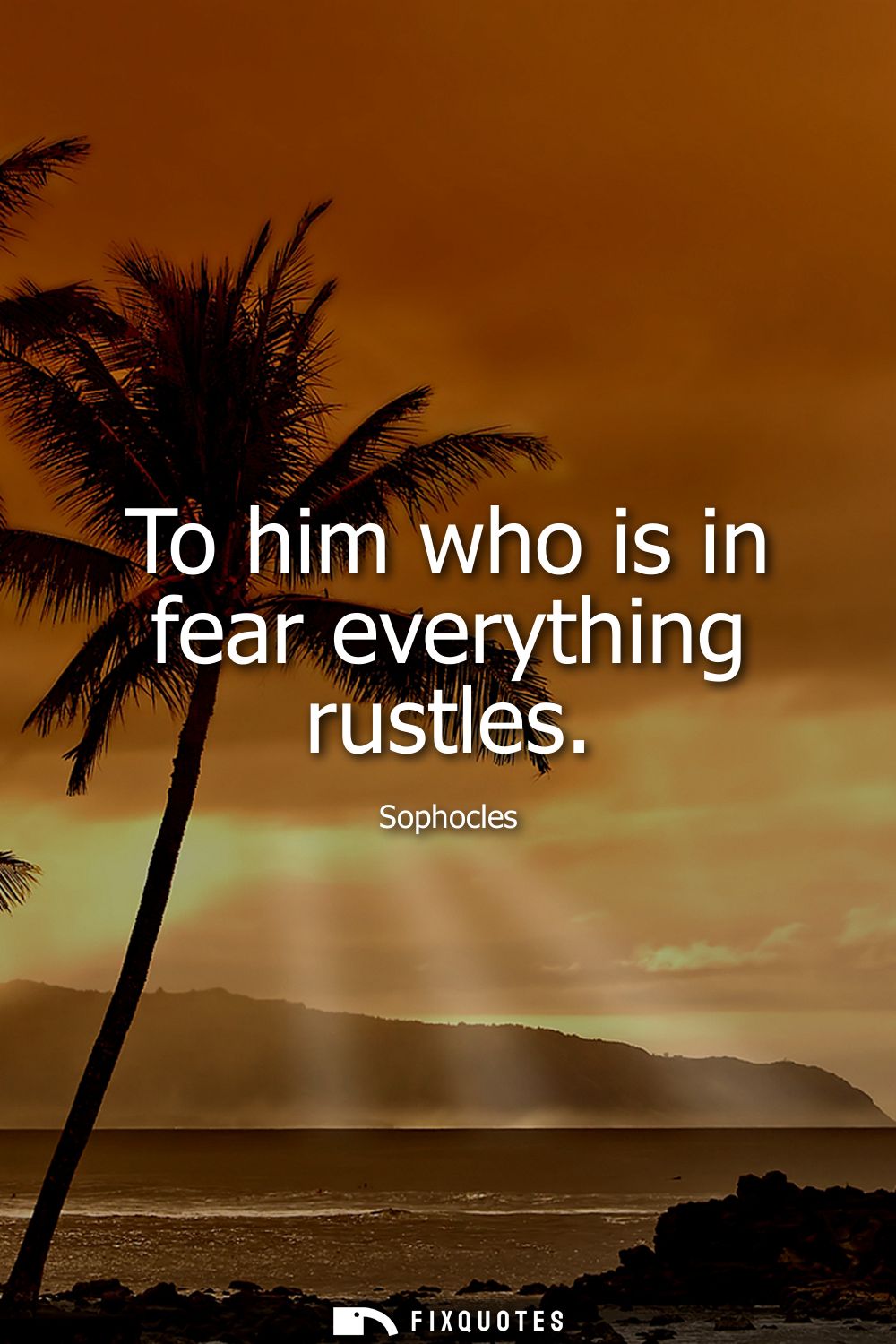
"To him who is in fear everything rustles"
About this Quote
Fear doesn’t just distort judgment; it turns the whole world into a conspiracy of small noises. Sophocles’ line is brutally economical: “everything rustles” takes a harmless, everyday sound and makes it feel like a threat advancing through the bushes. The genius is in the verb. Rustling is ambiguous by nature - wind, animals, strangers, the stir of something unseen. In a fearful mind, ambiguity isn’t neutral; it’s evidence.
The intent isn’t to scold fear as weakness so much as to diagnose it as a total sensory regime. Once fear takes over, perception stops being a tool for navigating reality and becomes a machine for producing alarms. Sophocles, writing for an Athenian audience steeped in war, civic instability, and the fragility of fortune, understood that terror is rarely about the thing in front of you. It’s about the expectation that harm is imminent and the conviction that you won’t see it coming.
The subtext is political as much as psychological. Fear makes people suggestible: if everything “rustles,” then anyone can be cast as the hidden attacker, and any authority promising safety can demand obedience. Tragedy repeatedly stages this dynamic - characters misread signs, assume hostile intent, and act preemptively, turning anxious interpretation into self-fulfilling catastrophe.
Sophocles’ warning lands because it refuses melodrama. No monsters, no prophecies, just the ordinary world turned loud. That’s how fear actually works: it doesn’t add new facts; it rewrites the meaning of the ones you already have.
The intent isn’t to scold fear as weakness so much as to diagnose it as a total sensory regime. Once fear takes over, perception stops being a tool for navigating reality and becomes a machine for producing alarms. Sophocles, writing for an Athenian audience steeped in war, civic instability, and the fragility of fortune, understood that terror is rarely about the thing in front of you. It’s about the expectation that harm is imminent and the conviction that you won’t see it coming.
The subtext is political as much as psychological. Fear makes people suggestible: if everything “rustles,” then anyone can be cast as the hidden attacker, and any authority promising safety can demand obedience. Tragedy repeatedly stages this dynamic - characters misread signs, assume hostile intent, and act preemptively, turning anxious interpretation into self-fulfilling catastrophe.
Sophocles’ warning lands because it refuses melodrama. No monsters, no prophecies, just the ordinary world turned loud. That’s how fear actually works: it doesn’t add new facts; it rewrites the meaning of the ones you already have.
Quote Details
| Topic | Fear |
|---|---|
| Source | Help us find the source |
| Cite |
Citation Formats
APA Style (7th ed.)
Sophocles. (2026, January 14). To him who is in fear everything rustles. FixQuotes. https://fixquotes.com/quotes/to-him-who-is-in-fear-everything-rustles-34219/
Chicago Style
Sophocles. "To him who is in fear everything rustles." FixQuotes. January 14, 2026. https://fixquotes.com/quotes/to-him-who-is-in-fear-everything-rustles-34219/.
MLA Style (9th ed.)
"To him who is in fear everything rustles." FixQuotes, 14 Jan. 2026, https://fixquotes.com/quotes/to-him-who-is-in-fear-everything-rustles-34219/. Accessed 12 Feb. 2026.
More Quotes by Sophocles
Add to List