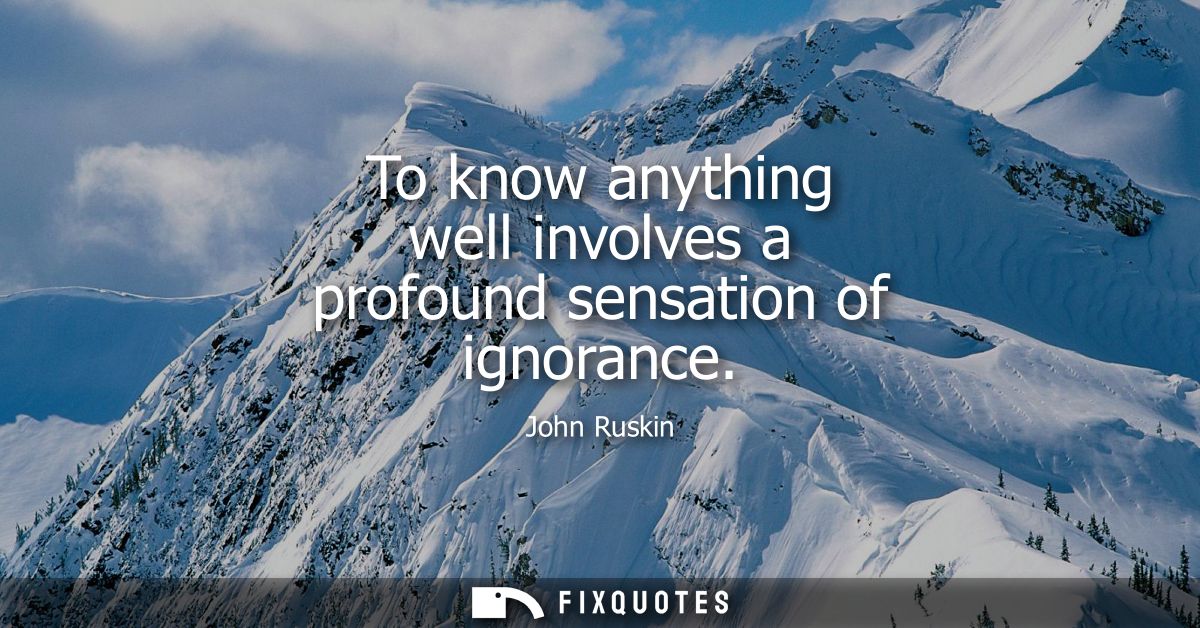
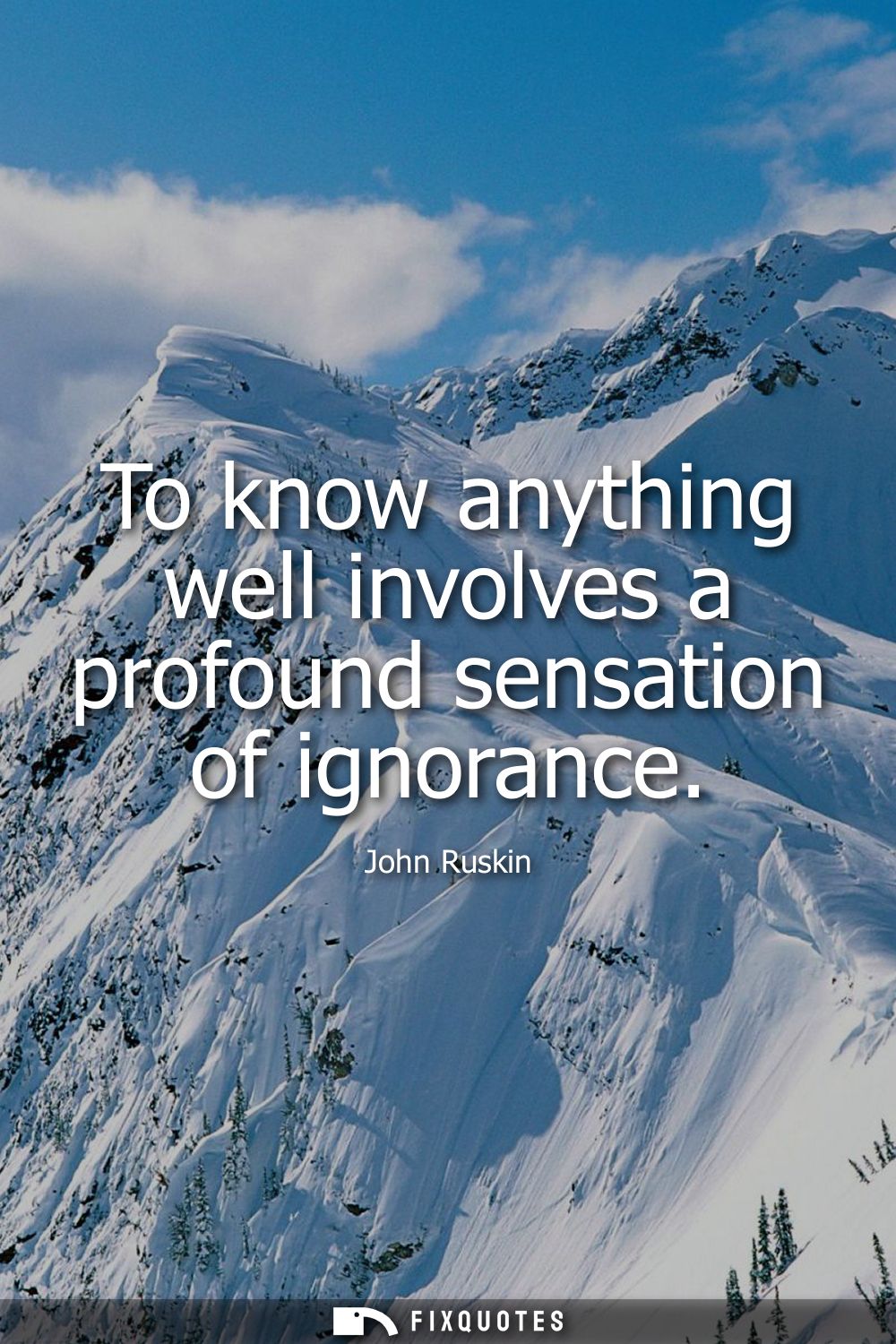
"To know anything well involves a profound sensation of ignorance"
About this Quote
Mastery, Ruskin insists, is not the end of uncertainty but its most intense form. The line flips the usual brag of expertise on its head: the reward for knowing something well is not confidence, but a sharpened awareness of everything you still dont grasp. That reversal is the engine of the quote. It lands because it names a feeling most people learn to hide - the vertigo that arrives precisely when you stop skating on the surface.
Ruskin wrote in an age drunk on classification: museums swelling, sciences hardening into disciplines, industry promising that the world could be measured, optimized, and owned. As a Victorian critic of art and political economy, he distrusted that neat, proprietary idea of knowledge. His best work keeps circling the moral stakes of perception: to really see a painting, a building, a landscape, you have to submit to its complexity rather than conquer it. The "profound sensation" matters. This is not casual doubt; it is bodily, humbling, almost devotional. He makes ignorance an ethical state, a guardrail against the arrogance that can turn learning into domination.
The subtext is a warning to both the dilettante and the specialist. Superficial familiarity breeds loud certainty; deep attention breeds quieter speech. If you can read this as an early sketch of what we now call the Dunning-Kruger effect, Ruskin is after something more demanding: the moment you truly know a subject is the moment it grows larger than you, and you have the honesty to admit it.
Ruskin wrote in an age drunk on classification: museums swelling, sciences hardening into disciplines, industry promising that the world could be measured, optimized, and owned. As a Victorian critic of art and political economy, he distrusted that neat, proprietary idea of knowledge. His best work keeps circling the moral stakes of perception: to really see a painting, a building, a landscape, you have to submit to its complexity rather than conquer it. The "profound sensation" matters. This is not casual doubt; it is bodily, humbling, almost devotional. He makes ignorance an ethical state, a guardrail against the arrogance that can turn learning into domination.
The subtext is a warning to both the dilettante and the specialist. Superficial familiarity breeds loud certainty; deep attention breeds quieter speech. If you can read this as an early sketch of what we now call the Dunning-Kruger effect, Ruskin is after something more demanding: the moment you truly know a subject is the moment it grows larger than you, and you have the honesty to admit it.
Quote Details
| Topic | Knowledge |
|---|---|
| Source | Help us find the source |
| Cite |
Citation Formats
APA Style (7th ed.)
Ruskin, John. (2026, January 17). To know anything well involves a profound sensation of ignorance. FixQuotes. https://fixquotes.com/quotes/to-know-anything-well-involves-a-profound-71975/
Chicago Style
Ruskin, John. "To know anything well involves a profound sensation of ignorance." FixQuotes. January 17, 2026. https://fixquotes.com/quotes/to-know-anything-well-involves-a-profound-71975/.
MLA Style (9th ed.)
"To know anything well involves a profound sensation of ignorance." FixQuotes, 17 Jan. 2026, https://fixquotes.com/quotes/to-know-anything-well-involves-a-profound-71975/. Accessed 25 Mar. 2026.
More Quotes by John
Add to List