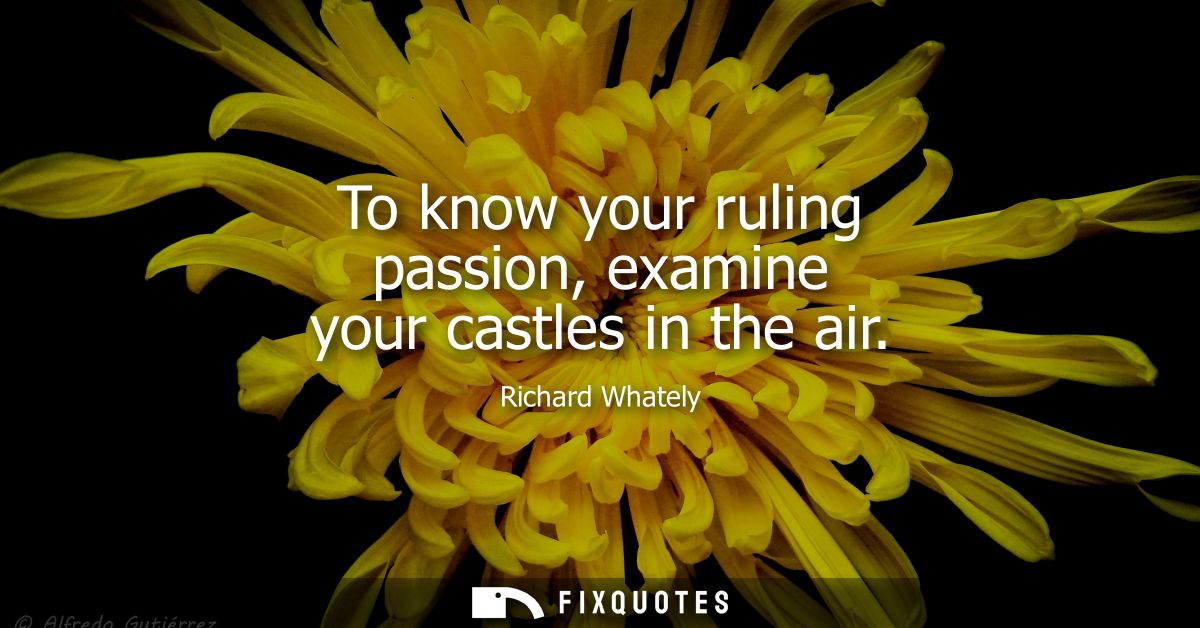
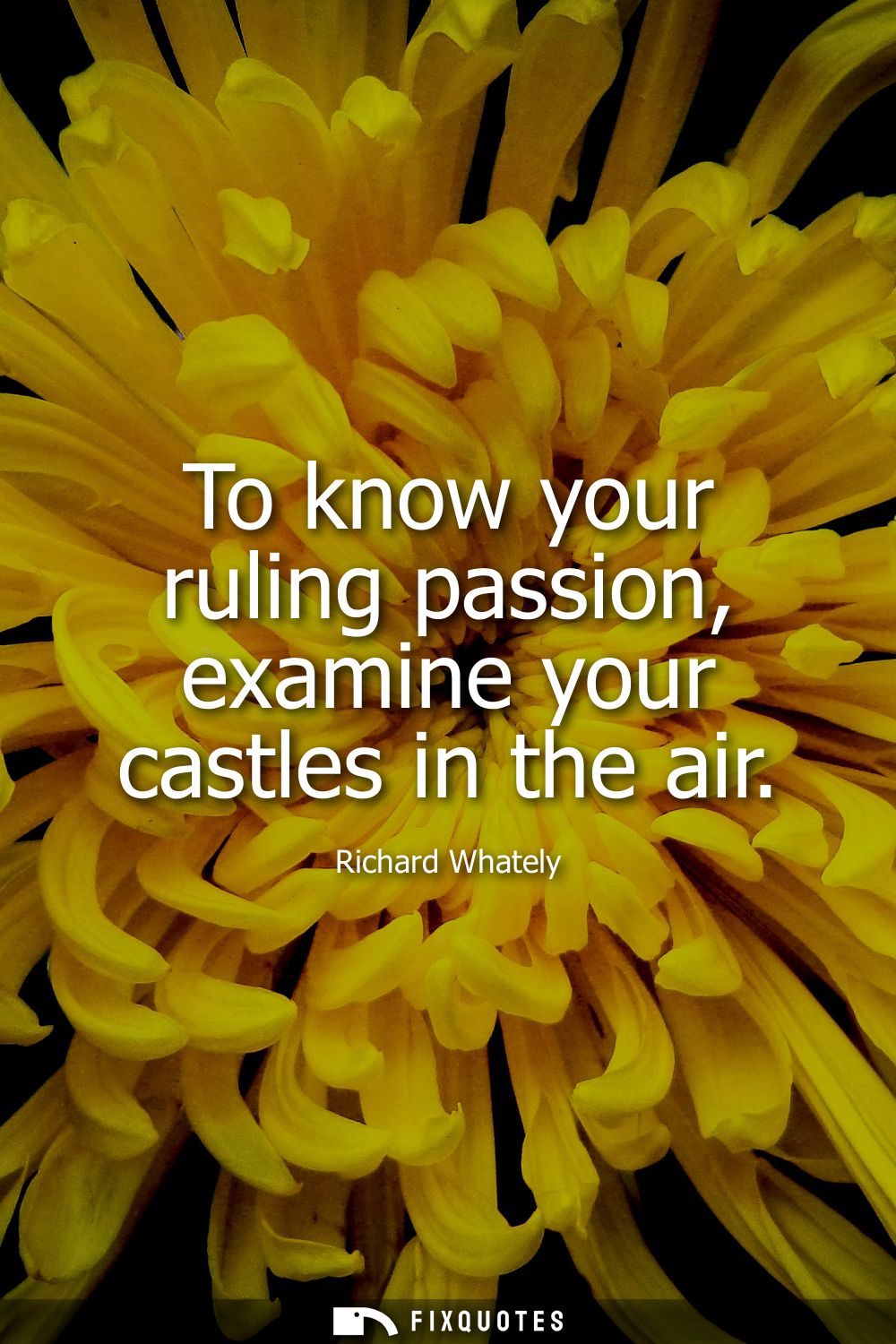
"To know your ruling passion, examine your castles in the air"
About this Quote
Daydreams are the mind’s unregulated spending habits, and Whately wants you to audit them. “Ruling passion” sounds lofty, almost heroic, but he doesn’t tell you to look at your virtues or your stated principles. He points you to your “castles in the air” - the private architecture you build when nobody is watching, when the constraints of reputation and practicality fall away. In that weightless space, desire stops performing and starts confessing.
The line works because it flips the usual moral order. We like to think character is proven by discipline: what you do, what you resist, what you endure. Whately, an Anglican thinker writing in a 19th-century culture obsessed with self-improvement and moral accounting, suggests the opposite diagnostic tool: fantasy. Not your fantasies as guilty pleasure, but as data. Your imagination, he implies, is less censored than your behavior, and therefore more honest.
There’s a sly warning tucked inside the elegance. A “castle” is grand, defensive, built to last; “in the air” makes it unserious, ungrounded, possibly delusional. Whately’s subtext: the passion that rules you may not be the one you’d put on a résumé, and it may be structurally unsound. If you keep picturing applause, you’re not “ambitious” in the abstract - you’re craving recognition. If you keep picturing escape, it’s not “freedom” as a principle - it’s avoidance with better branding.
He’s offering a method, not a mantra: follow the recurring set pieces of your inner theater, and you’ll find the desire that’s been directing the show.
The line works because it flips the usual moral order. We like to think character is proven by discipline: what you do, what you resist, what you endure. Whately, an Anglican thinker writing in a 19th-century culture obsessed with self-improvement and moral accounting, suggests the opposite diagnostic tool: fantasy. Not your fantasies as guilty pleasure, but as data. Your imagination, he implies, is less censored than your behavior, and therefore more honest.
There’s a sly warning tucked inside the elegance. A “castle” is grand, defensive, built to last; “in the air” makes it unserious, ungrounded, possibly delusional. Whately’s subtext: the passion that rules you may not be the one you’d put on a résumé, and it may be structurally unsound. If you keep picturing applause, you’re not “ambitious” in the abstract - you’re craving recognition. If you keep picturing escape, it’s not “freedom” as a principle - it’s avoidance with better branding.
He’s offering a method, not a mantra: follow the recurring set pieces of your inner theater, and you’ll find the desire that’s been directing the show.
Quote Details
| Topic | Wisdom |
|---|---|
| Source | Help us find the source |
| Cite |
Citation Formats
APA Style (7th ed.)
Whately, Richard. (2026, January 16). To know your ruling passion, examine your castles in the air. FixQuotes. https://fixquotes.com/quotes/to-know-your-ruling-passion-examine-your-castles-85128/
Chicago Style
Whately, Richard. "To know your ruling passion, examine your castles in the air." FixQuotes. January 16, 2026. https://fixquotes.com/quotes/to-know-your-ruling-passion-examine-your-castles-85128/.
MLA Style (9th ed.)
"To know your ruling passion, examine your castles in the air." FixQuotes, 16 Jan. 2026, https://fixquotes.com/quotes/to-know-your-ruling-passion-examine-your-castles-85128/. Accessed 10 Mar. 2026.
More Quotes by Richard
Add to List