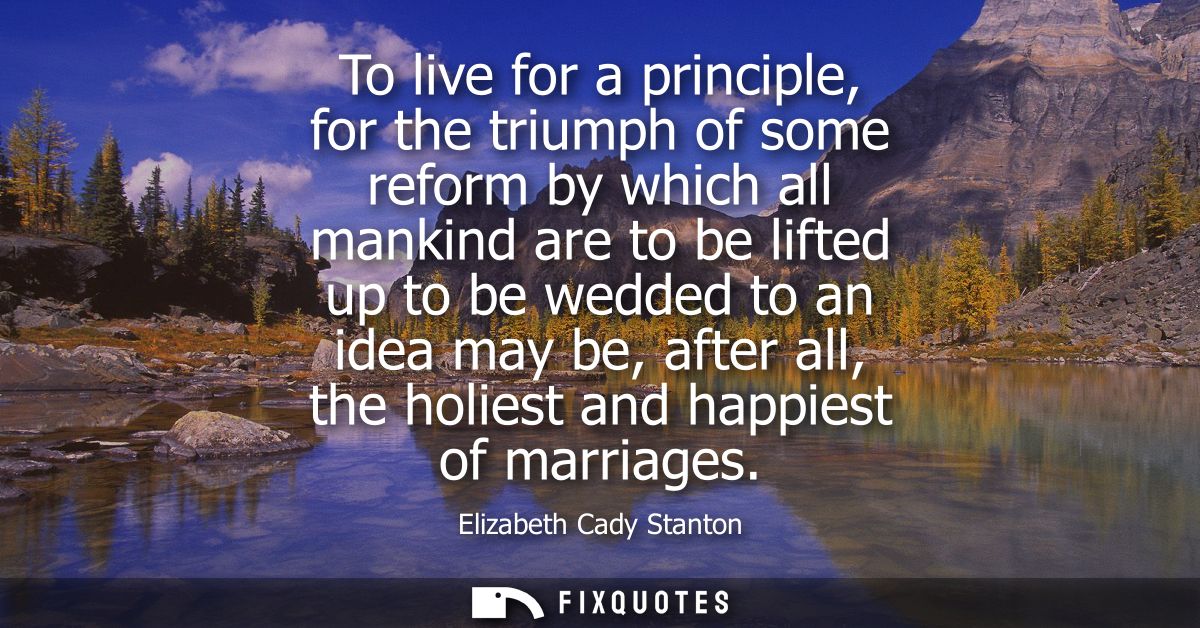
"To live for a principle, for the triumph of some reform by which all mankind are to be lifted up to be wedded to an idea may be, after all, the holiest and happiest of marriages"
About this Quote
The subtext is strategic and personal. Stanton is speaking into a culture that treated political ambition in women as unnatural, even obscene. By borrowing the language of sanctity, she raids the moral authority of religion and domesticity, then redirects it toward activism. “All mankind” is doing double duty: it sounds expansive and righteous, but it also exposes the rhetorical compromise of her time, when universal claims were often made in male terms even by women fighting for equality. The phrase “lifted up” leans into the abolitionist and evangelical reform idioms circulating through 19th-century America, where progress was framed as moral elevation.
Context matters: Stanton spent her life battling laws and customs that made marriage a legal trap - property rights, custody, bodily autonomy. Calling devotion to reform a “marriage” suggests an alternative covenant: chosen rather than assigned, productive rather than restrictive. She’s not dismissing intimacy; she’s insisting that women’s deepest loyalties can be civic, that a life organized around justice can be as legitimate - and as emotionally sustaining - as the domestic ideal used to contain them.
Quote Details
| Topic | Equality |
|---|---|
| Source | Help us find the source |
| Cite |
Citation Formats
APA Style (7th ed.)
Stanton, Elizabeth Cady. (2026, January 17). To live for a principle, for the triumph of some reform by which all mankind are to be lifted up to be wedded to an idea may be, after all, the holiest and happiest of marriages. FixQuotes. https://fixquotes.com/quotes/to-live-for-a-principle-for-the-triumph-of-some-78547/
Chicago Style
Stanton, Elizabeth Cady. "To live for a principle, for the triumph of some reform by which all mankind are to be lifted up to be wedded to an idea may be, after all, the holiest and happiest of marriages." FixQuotes. January 17, 2026. https://fixquotes.com/quotes/to-live-for-a-principle-for-the-triumph-of-some-78547/.
MLA Style (9th ed.)
"To live for a principle, for the triumph of some reform by which all mankind are to be lifted up to be wedded to an idea may be, after all, the holiest and happiest of marriages." FixQuotes, 17 Jan. 2026, https://fixquotes.com/quotes/to-live-for-a-principle-for-the-triumph-of-some-78547/. Accessed 24 Mar. 2026.