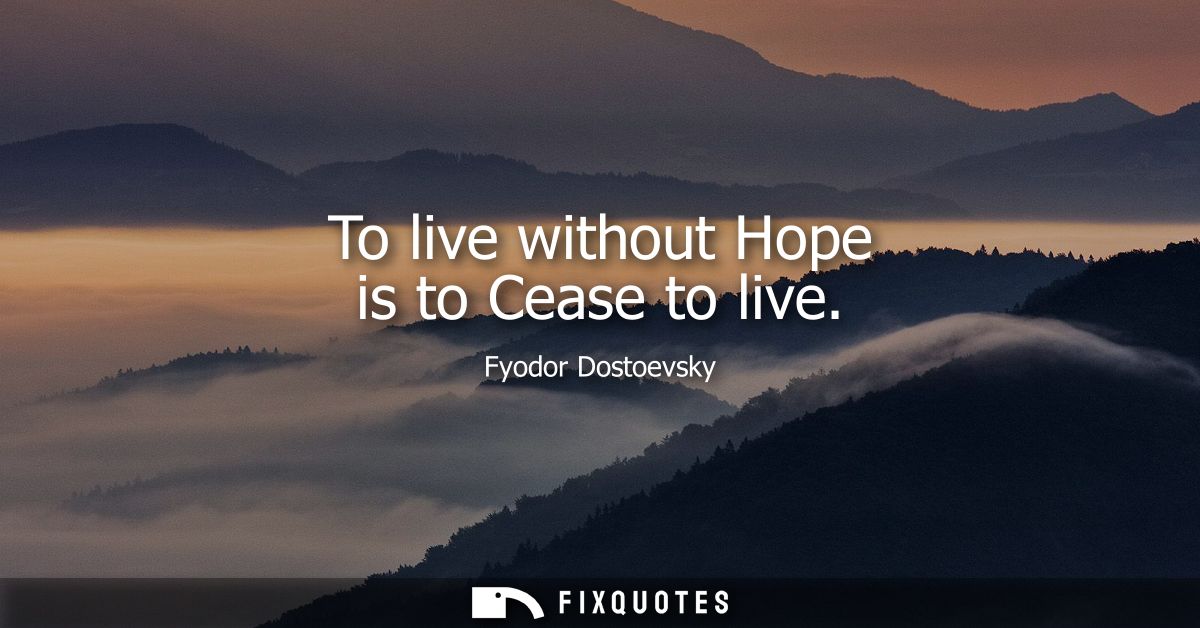
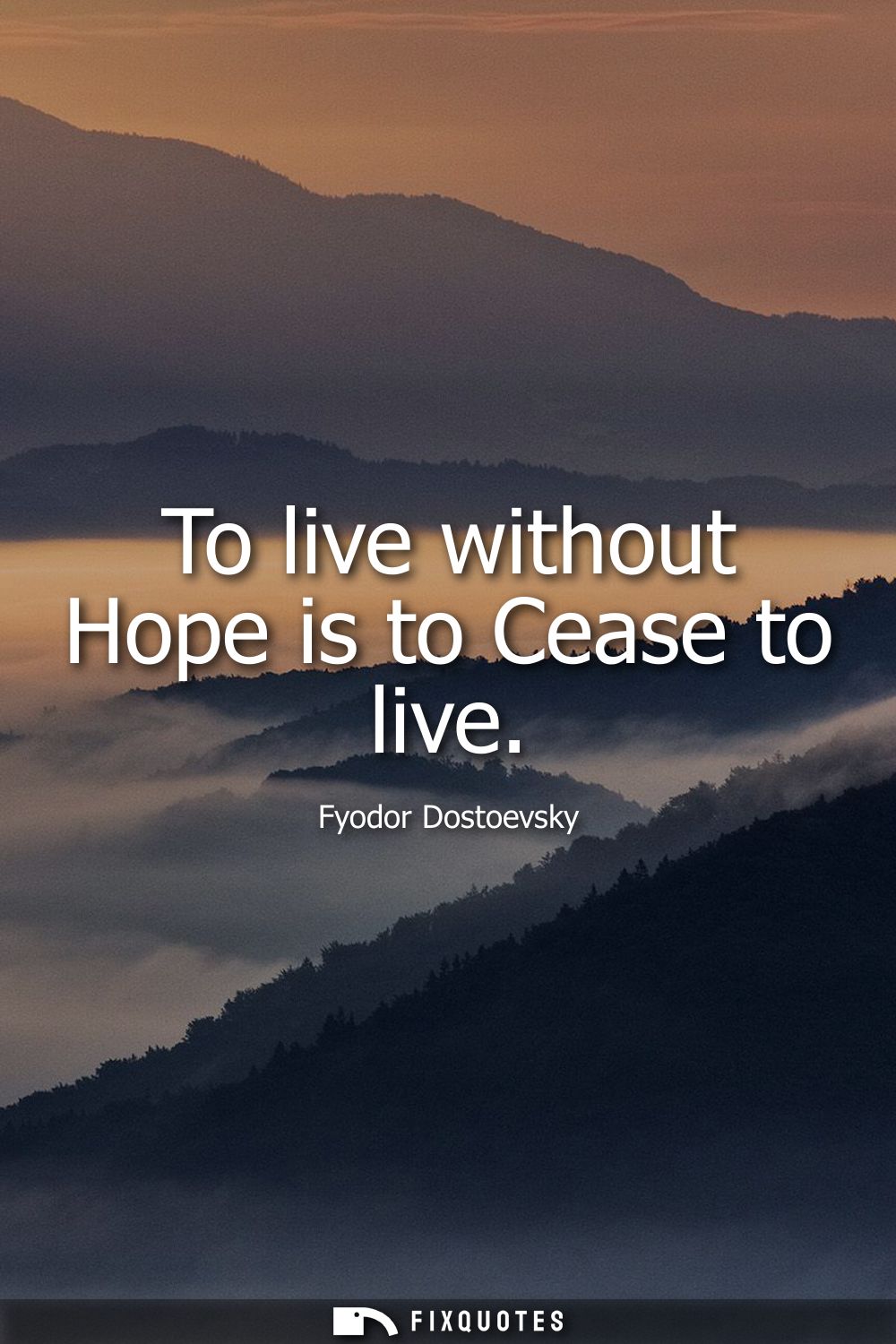
"To live without hope is to cease to live"
About this Quote
Dostoevsky doesn’t romanticize hope here; he weaponizes it. “To live without Hope is to Cease to live” turns a psychological state into an ontological verdict. The line’s force comes from its refusal to treat despair as merely a mood. Hope isn’t a decorative virtue in Dostoevsky’s world; it’s the thin, stubborn membrane separating a person from spiritual and social collapse. Strip it away and you may still breathe, work, even speak, but you’ve entered a condition he recognizes as living death.
The phrasing is bluntly binary, almost mathematical: hope equals life; its absence equals nonlife. That severity mirrors the moral pressure cooker of his fiction, where characters are tested not by comfort but by extremity: poverty, addiction, prison, humiliation, illness, guilt. Dostoevsky knew this terrain firsthand through his mock execution, Siberian imprisonment, and lifelong encounters with suffering. In that context, “hope” isn’t optimism or good vibes; it’s the capacity to imagine redemption when evidence argues otherwise.
The subtext is also theological without being soft-focus religious. Hope functions as a bridge between the self and the possibility of grace, repair, meaning. When it collapses, isolation hardens into nihilism, and the person becomes susceptible to the cold logic of self-erasure or cruelty. Dostoevsky’s intent is less motivational poster than warning label: despair isn’t an idea you hold; it’s a solvent that dissolves your claim to being fully human.
The phrasing is bluntly binary, almost mathematical: hope equals life; its absence equals nonlife. That severity mirrors the moral pressure cooker of his fiction, where characters are tested not by comfort but by extremity: poverty, addiction, prison, humiliation, illness, guilt. Dostoevsky knew this terrain firsthand through his mock execution, Siberian imprisonment, and lifelong encounters with suffering. In that context, “hope” isn’t optimism or good vibes; it’s the capacity to imagine redemption when evidence argues otherwise.
The subtext is also theological without being soft-focus religious. Hope functions as a bridge between the self and the possibility of grace, repair, meaning. When it collapses, isolation hardens into nihilism, and the person becomes susceptible to the cold logic of self-erasure or cruelty. Dostoevsky’s intent is less motivational poster than warning label: despair isn’t an idea you hold; it’s a solvent that dissolves your claim to being fully human.
Quote Details
| Topic | Hope |
|---|---|
| Source | Help us find the source |
| Cite |
Citation Formats
APA Style (7th ed.)
Dostoevsky, Fyodor. (2026, February 16). To live without hope is to cease to live. FixQuotes. https://fixquotes.com/quotes/to-live-without-hope-is-to-cease-to-live-7151/
Chicago Style
Dostoevsky, Fyodor. "To live without hope is to cease to live." FixQuotes. February 16, 2026. https://fixquotes.com/quotes/to-live-without-hope-is-to-cease-to-live-7151/.
MLA Style (9th ed.)
"To live without hope is to cease to live." FixQuotes, 16 Feb. 2026, https://fixquotes.com/quotes/to-live-without-hope-is-to-cease-to-live-7151/. Accessed 11 Mar. 2026.
More Quotes by Fyodor
Add to List