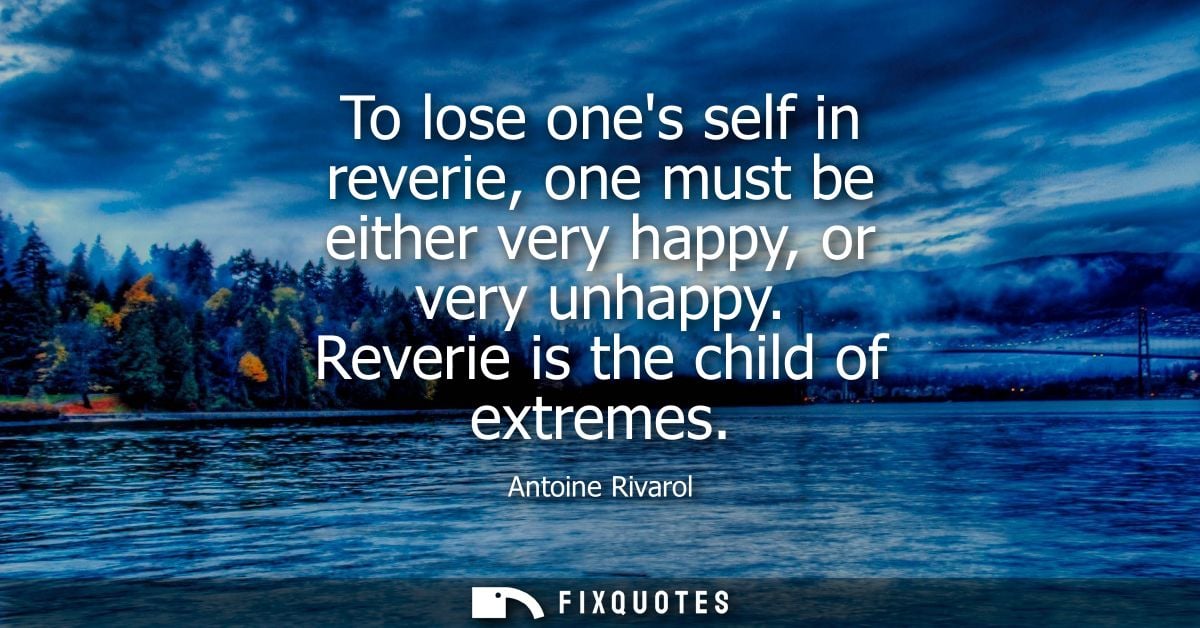
"To lose one's self in reverie, one must be either very happy, or very unhappy. Reverie is the child of extremes"
About this Quote
The craftsmanship is in the binary. “Very” does the heavy lifting, denying the middle range its romantic credentials. Mild contentment doesn’t produce reverie; neither does mild dissatisfaction. Only extremes unmoor you from the present. That’s the subtextual sting: reverie isn’t leisure, it’s displacement. It’s what you do when reality is either too radiant to hold directly or too painful to inhabit without mediation.
Calling it “the child of extremes” adds a sly moral edge. Children are not chosen; they arrive. Reverie becomes less a cultivated artistic habit than the unintended offspring of emotional excess. For an 18th-century journalist and salon-era observer like Rivarol, that’s pointed: he’s writing in a culture that prized composure, wit, and measured judgment, even as it edged toward revolutionary volatility. The aphorism flatters no one. It suggests that when society polarizes - in private feeling or public life - the mind retreats into narrative, fantasy, memory. Reverie becomes both refuge and tell: a beautiful withdrawal that reveals just how far from equilibrium you’ve drifted.
Quote Details
| Topic | Deep |
|---|---|
| Source | Help us find the source |
| Cite |
Citation Formats
APA Style (7th ed.)
Rivarol, Antoine. (2026, January 17). To lose one's self in reverie, one must be either very happy, or very unhappy. Reverie is the child of extremes. FixQuotes. https://fixquotes.com/quotes/to-lose-ones-self-in-reverie-one-must-be-either-43485/
Chicago Style
Rivarol, Antoine. "To lose one's self in reverie, one must be either very happy, or very unhappy. Reverie is the child of extremes." FixQuotes. January 17, 2026. https://fixquotes.com/quotes/to-lose-ones-self-in-reverie-one-must-be-either-43485/.
MLA Style (9th ed.)
"To lose one's self in reverie, one must be either very happy, or very unhappy. Reverie is the child of extremes." FixQuotes, 17 Jan. 2026, https://fixquotes.com/quotes/to-lose-ones-self-in-reverie-one-must-be-either-43485/. Accessed 23 Mar. 2026.