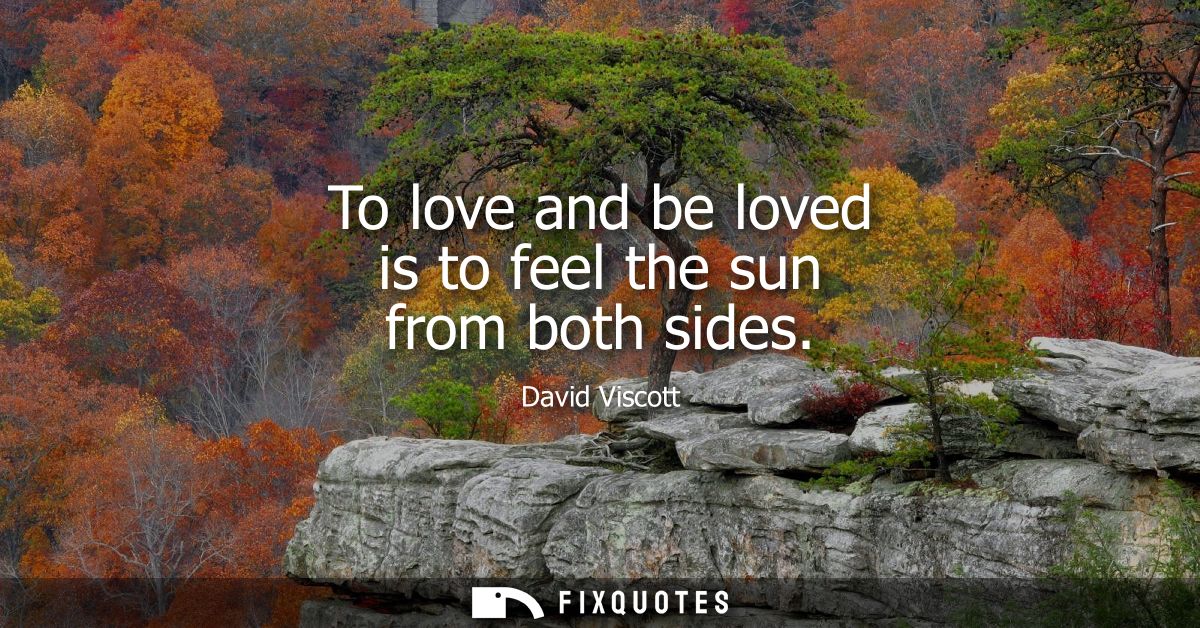
"To love and be loved is to feel the sun from both sides"
About this Quote
Viscott’s line flatters love by borrowing the oldest piece of evidence we have: the body’s certainty that warmth means life. “To feel the sun from both sides” is a physiological fantasy - impossible in the literal world, instantly legible in the emotional one. That’s why it works. It doesn’t argue for love as virtue; it sells love as an environment, a climate you inhabit. Being loved becomes not a compliment but a condition: steady heat, full coverage, no cold corner left for self-doubt to colonize.
As a psychologist writing in an era obsessed with self-esteem and “healthy relationships,” Viscott is also sneaking in a therapeutic corrective. Many people can love outwardly (caregiving, pleasing, rescuing) while refusing to receive, as if acceptance carries debt or danger. The quote implies that one-sided warmth is survivable but incomplete: you can stand in the sun, but you’re still casting a shadow. Reciprocity isn’t romantic fussiness here; it’s the difference between exposure and saturation.
The subtext is gently prescriptive. It reframes being loved as something you’re allowed to feel, not merely something you’ve earned. And by choosing the sun - not fire, not lightning - Viscott privileges constancy over drama. This is love as reliable daylight, not a blaze that proves intensity by burning you. It’s a tidy, optimistic image with a clinical edge: the goal isn’t to chase heat, but to stop flinching from it.
As a psychologist writing in an era obsessed with self-esteem and “healthy relationships,” Viscott is also sneaking in a therapeutic corrective. Many people can love outwardly (caregiving, pleasing, rescuing) while refusing to receive, as if acceptance carries debt or danger. The quote implies that one-sided warmth is survivable but incomplete: you can stand in the sun, but you’re still casting a shadow. Reciprocity isn’t romantic fussiness here; it’s the difference between exposure and saturation.
The subtext is gently prescriptive. It reframes being loved as something you’re allowed to feel, not merely something you’ve earned. And by choosing the sun - not fire, not lightning - Viscott privileges constancy over drama. This is love as reliable daylight, not a blaze that proves intensity by burning you. It’s a tidy, optimistic image with a clinical edge: the goal isn’t to chase heat, but to stop flinching from it.
Quote Details
| Topic | Love |
|---|---|
| Source | Later attribution: Letters to My Lord (Gwen Hamill Yoos, 2020) modern compilationISBN: 9781098015503 · ID: maAuEAAAQBAJ
Evidence:
... To love and be loved is to feel the sun from both sides . -David Viscott Dear God : We need to love , and we also need to be loved ... be able to receive love that is shared with us . Some of us find it easy to love others , to share ... |
| Cite |
Citation Formats
APA Style (7th ed.)
Viscott, David. (2026, February 14). To love and be loved is to feel the sun from both sides. FixQuotes. https://fixquotes.com/quotes/to-love-and-be-loved-is-to-feel-the-sun-from-both-114393/
Chicago Style
Viscott, David. "To love and be loved is to feel the sun from both sides." FixQuotes. February 14, 2026. https://fixquotes.com/quotes/to-love-and-be-loved-is-to-feel-the-sun-from-both-114393/.
MLA Style (9th ed.)
"To love and be loved is to feel the sun from both sides." FixQuotes, 14 Feb. 2026, https://fixquotes.com/quotes/to-love-and-be-loved-is-to-feel-the-sun-from-both-114393/. Accessed 21 Mar. 2026.
More Quotes by David
Add to List