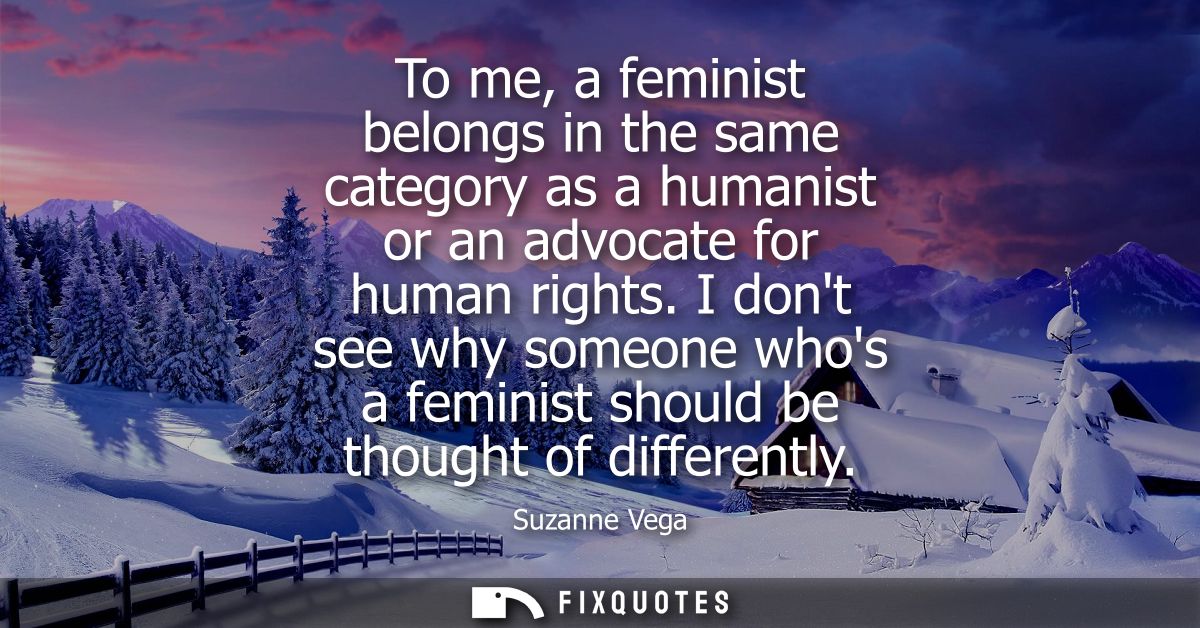
"To me, a feminist belongs in the same category as a humanist or an advocate for human rights. I don't see why someone who's a feminist should be thought of differently"
About this Quote
The subtext is a rebuttal to the long-running stigma that frames feminism as combative, humorless, or exclusionary. Vega refuses the trap of arguing policy point by policy point. Instead she targets the social vibe: why is this label “thought of differently” at all? It’s a quiet indictment of the way language gets weaponized - how one word can be made to sound like a personality defect while its adjacent values (“human rights”) remain safely applauded.
Context matters: Vega comes out of late-20th-century pop culture, where female artists were routinely asked to justify ambition, anger, or autonomy as if those traits required a political permit. Her phrasing has the clean, lyrical economy of a songwriter: first-person, plainspoken, almost conversational, yet calibrated to expose a cultural double standard. It’s persuasive because it doesn’t ask permission. It assumes the reasonable baseline, then forces the listener to explain why they ever treated equality like an exception.
Quote Details
| Topic | Human Rights |
|---|---|
| Source | Help us find the source |
| Cite |
Citation Formats
APA Style (7th ed.)
Vega, Suzanne. (2026, January 15). To me, a feminist belongs in the same category as a humanist or an advocate for human rights. I don't see why someone who's a feminist should be thought of differently. FixQuotes. https://fixquotes.com/quotes/to-me-a-feminist-belongs-in-the-same-category-as-159747/
Chicago Style
Vega, Suzanne. "To me, a feminist belongs in the same category as a humanist or an advocate for human rights. I don't see why someone who's a feminist should be thought of differently." FixQuotes. January 15, 2026. https://fixquotes.com/quotes/to-me-a-feminist-belongs-in-the-same-category-as-159747/.
MLA Style (9th ed.)
"To me, a feminist belongs in the same category as a humanist or an advocate for human rights. I don't see why someone who's a feminist should be thought of differently." FixQuotes, 15 Jan. 2026, https://fixquotes.com/quotes/to-me-a-feminist-belongs-in-the-same-category-as-159747/. Accessed 12 Feb. 2026.