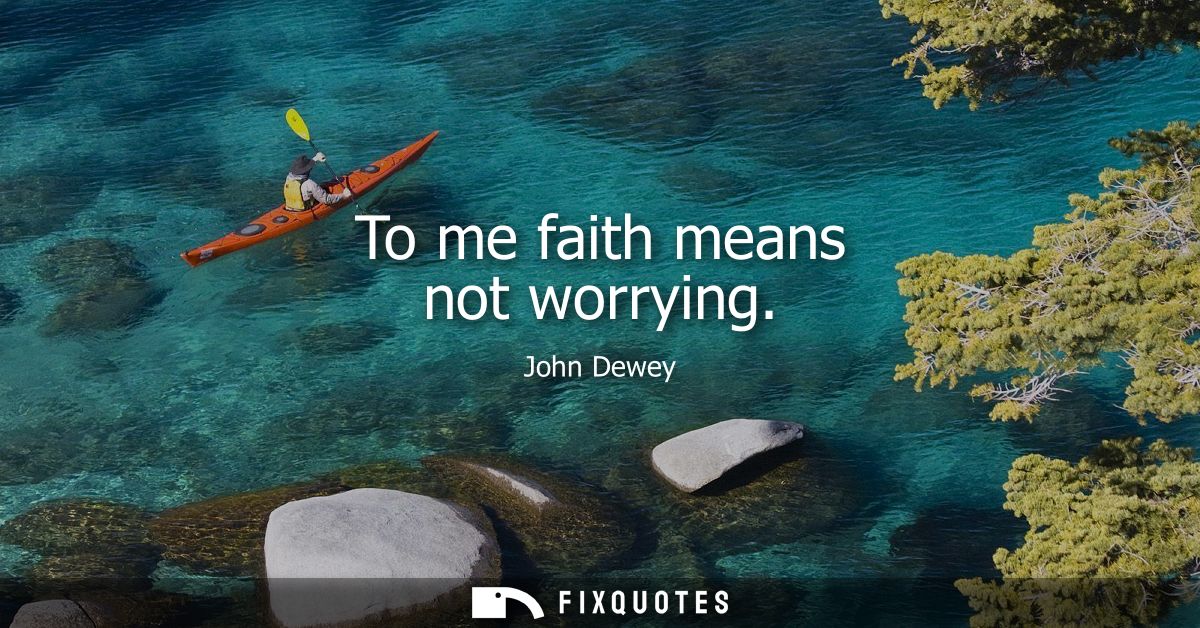
"To me, faith means not worrying"
About this Quote
Faith, in Dewey's hands, gets stripped of incense and placed under fluorescent light. "To me faith means not worrying" is a quiet provocation from a philosopher who spent his career arguing that ideas earn their keep in lived experience. Dewey wasn’t interested in belief as a badge or a metaphysical wager; he cared about belief as a tool for navigating uncertainty. So he defines faith by its psychological output: a reduction in anxious rumination. If your "faith" doesn’t change how you move through risk, it’s just decoration.
The subtext is almost clinical. Worry is wasted energy - a loop that feels like control but produces paralysis. Dewey’s pragmatism treats that loop as an obstacle to action. Faith, then, isn’t the conviction that things will magically work out; it’s the decision to stop paying a tax to hypothetical futures and to reallocate attention to what can be tested, built, repaired. That’s why the line reads less like theology than like mental discipline: an ethic of steadiness.
Context matters: Dewey lived through industrial upheaval, world war, and the Great Depression, while also pushing a democratic, experimental approach to education and public life. In that environment, "not worrying" isn’t complacency; it’s a civic posture. The goal is durable confidence in inquiry, community, and problem-solving - a faith in process, not prophecy. The sentence works because it’s disarmingly personal ("to me") while smuggling in a larger claim: faith is justified not by certainty, but by the kind of person it makes you under pressure.
The subtext is almost clinical. Worry is wasted energy - a loop that feels like control but produces paralysis. Dewey’s pragmatism treats that loop as an obstacle to action. Faith, then, isn’t the conviction that things will magically work out; it’s the decision to stop paying a tax to hypothetical futures and to reallocate attention to what can be tested, built, repaired. That’s why the line reads less like theology than like mental discipline: an ethic of steadiness.
Context matters: Dewey lived through industrial upheaval, world war, and the Great Depression, while also pushing a democratic, experimental approach to education and public life. In that environment, "not worrying" isn’t complacency; it’s a civic posture. The goal is durable confidence in inquiry, community, and problem-solving - a faith in process, not prophecy. The sentence works because it’s disarmingly personal ("to me") while smuggling in a larger claim: faith is justified not by certainty, but by the kind of person it makes you under pressure.
Quote Details
| Topic | Faith |
|---|---|
| Source | Help us find the source |
| Cite |
Citation Formats
APA Style (7th ed.)
Dewey, John. (2026, February 20). To me, faith means not worrying. FixQuotes. https://fixquotes.com/quotes/to-me-faith-means-not-worrying-17706/
Chicago Style
Dewey, John. "To me, faith means not worrying." FixQuotes. February 20, 2026. https://fixquotes.com/quotes/to-me-faith-means-not-worrying-17706/.
MLA Style (9th ed.)
"To me, faith means not worrying." FixQuotes, 20 Feb. 2026, https://fixquotes.com/quotes/to-me-faith-means-not-worrying-17706/. Accessed 11 Mar. 2026.
More Quotes by John
Add to List