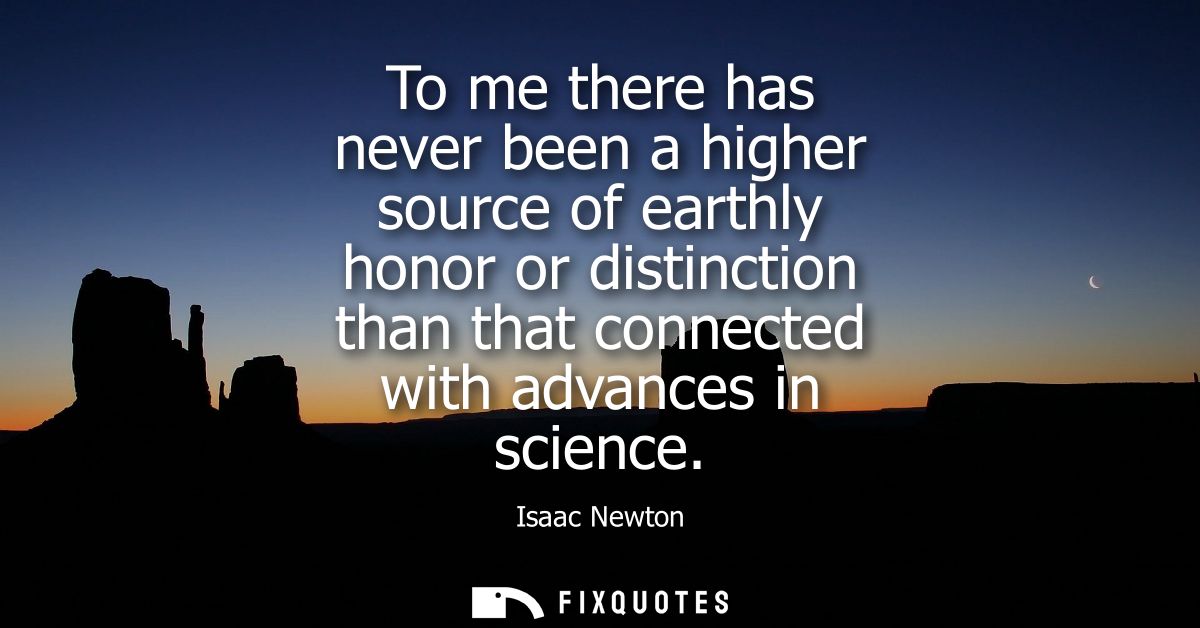
"To me, there has never been a higher source of earthly honor or distinction than that connected with advances in science"
About this Quote
The intent is partly personal creed, partly cultural lobbying. Newton lived at the hinge of the Scientific Revolution, when “natural philosophy” was hardening into what we now call science. He’s staking a claim that intellectual discovery should outrank aristocratic pedigree and political theater. That’s subtext with consequences: if advances in science are the highest earthly distinction, then institutions should fund them, protect them, and defer to them. A society that buys that premise starts to reorganize its idea of merit.
There’s also strategic humility embedded in the phrasing. Newton isn’t saying scientists are morally superior; he’s praising the kind of honor “connected with” scientific advance, as if the glory attaches to the work, not the ego. That matters for a figure whose career was entangled with rivalry and institutional power. The quote offers an idealized self-portrait: the scientist as servant of truth, accidentally famous, dignified by discovery rather than by applause.
Quote Details
| Topic | Science |
|---|---|
| Source | Help us find the source |
| Cite |
Citation Formats
APA Style (7th ed.)
Newton, Isaac. (2026, February 19). To me, there has never been a higher source of earthly honor or distinction than that connected with advances in science. FixQuotes. https://fixquotes.com/quotes/to-me-there-has-never-been-a-higher-source-of-31633/
Chicago Style
Newton, Isaac. "To me, there has never been a higher source of earthly honor or distinction than that connected with advances in science." FixQuotes. February 19, 2026. https://fixquotes.com/quotes/to-me-there-has-never-been-a-higher-source-of-31633/.
MLA Style (9th ed.)
"To me, there has never been a higher source of earthly honor or distinction than that connected with advances in science." FixQuotes, 19 Feb. 2026, https://fixquotes.com/quotes/to-me-there-has-never-been-a-higher-source-of-31633/. Accessed 31 Mar. 2026.