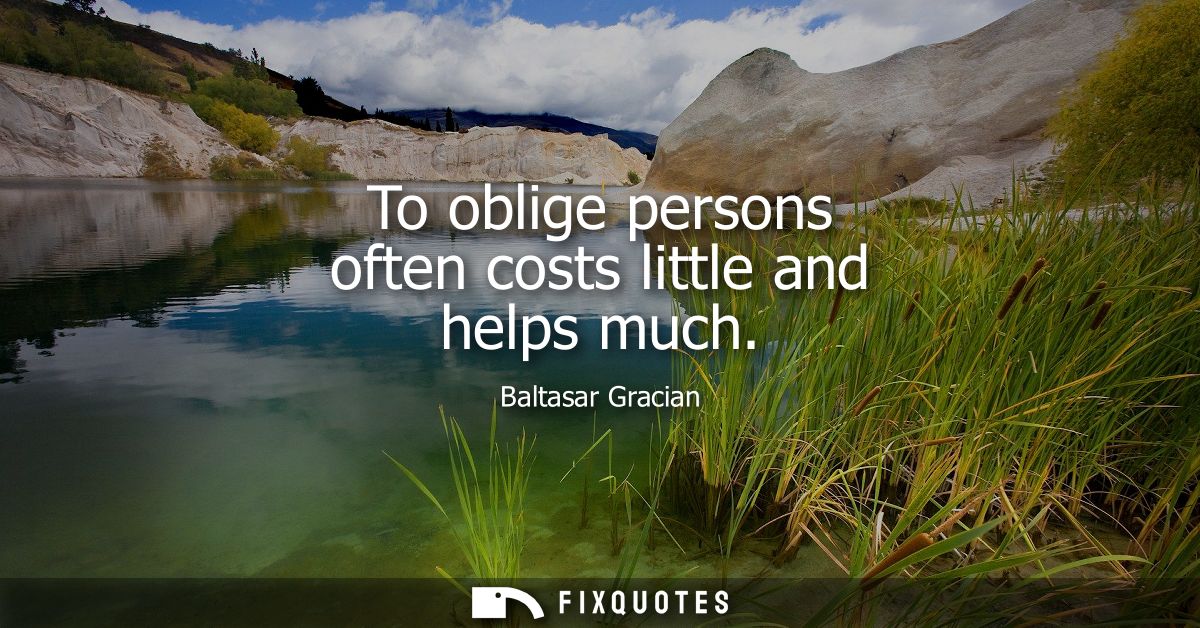
"To oblige persons often costs little and helps much"
About this Quote
A good deed, Gracian implies, is less a halo than a lever. "To oblige persons often costs little and helps much" reads like a piece of moral advice, but it’s also a miniature strategy manual: small, well-timed favors generate outsized returns in goodwill, alliances, and reputation. The line works because it treats generosity as a social technology, not a sentimental outburst.
Gracian, a 17th-century Spanish Jesuit steeped in court politics and ecclesiastical hierarchy, wrote for people navigating brittle systems where status is fragile and enemies are plentiful. In that world, the cheapest insurance policy is often the easiest kindness: an introduction, a word in someone’s favor, a minor accommodation. The subtext is almost clinical: most people don’t need grand sacrifices from you; they need to feel seen, assisted, remembered. That costs little. The payoff can be immense because gratitude, unlike money, compounds through networks.
There’s also a warning embedded in the apparent benevolence. "Oblige" isn’t just "be nice"; it carries the idea of placing someone under obligation. Gracian is alert to the economy of favors: who owes whom, who can be counted on, who can be nudged. He’s not preaching purity; he’s training attention. Notice what helps others disproportionately. Do it when it’s cheap. Bank the relationship.
What makes the aphorism durable is its cold clarity about human motivation: our lives are shaped less by heroic acts than by tiny interventions that change how doors open, how people speak of you, and what help arrives when you finally need it.
Gracian, a 17th-century Spanish Jesuit steeped in court politics and ecclesiastical hierarchy, wrote for people navigating brittle systems where status is fragile and enemies are plentiful. In that world, the cheapest insurance policy is often the easiest kindness: an introduction, a word in someone’s favor, a minor accommodation. The subtext is almost clinical: most people don’t need grand sacrifices from you; they need to feel seen, assisted, remembered. That costs little. The payoff can be immense because gratitude, unlike money, compounds through networks.
There’s also a warning embedded in the apparent benevolence. "Oblige" isn’t just "be nice"; it carries the idea of placing someone under obligation. Gracian is alert to the economy of favors: who owes whom, who can be counted on, who can be nudged. He’s not preaching purity; he’s training attention. Notice what helps others disproportionately. Do it when it’s cheap. Bank the relationship.
What makes the aphorism durable is its cold clarity about human motivation: our lives are shaped less by heroic acts than by tiny interventions that change how doors open, how people speak of you, and what help arrives when you finally need it.
Quote Details
| Topic | Kindness |
|---|---|
| Source | Help us find the source |
| Cite |
Citation Formats
APA Style (7th ed.)
Gracian, Baltasar. (2026, January 17). To oblige persons often costs little and helps much. FixQuotes. https://fixquotes.com/quotes/to-oblige-persons-often-costs-little-and-helps-37565/
Chicago Style
Gracian, Baltasar. "To oblige persons often costs little and helps much." FixQuotes. January 17, 2026. https://fixquotes.com/quotes/to-oblige-persons-often-costs-little-and-helps-37565/.
MLA Style (9th ed.)
"To oblige persons often costs little and helps much." FixQuotes, 17 Jan. 2026, https://fixquotes.com/quotes/to-oblige-persons-often-costs-little-and-helps-37565/. Accessed 28 Mar. 2026.
More Quotes by Baltasar
Add to List